



 Chat with AI
Exam 3: The Chemistry of Life Organic Compounds

Exam 1: A View of Life66 Questions
Exam 2: Atoms and Molecules the Chemical Basis of Life69 Questions
Exam 3: The Chemistry of Life Organic Compounds68 Questions
Exam 4: Organization of the Cell71 Questions
Exam 5: Biological Membranes69 Questions
Exam 6: Cell Communication69 Questions
Exam 7: Energy and Metabolism73 Questions
Exam 8: How Cells Make Atp Energy-Releasing Pathways66 Questions
Exam 9: Photosynthesis Capturing Light Energy72 Questions
Exam 10: Chromosomes, Mitosis, and Meiosis66 Questions
Exam 11: The Basic Principles of Heredity78 Questions
Exam 12: Dna the Carrier of Genetic Information68 Questions
Exam 13: Gene Expression82 Questions
Exam 14: Gene Regulation77 Questions
Exam 15: Dna Technology and Genomics81 Questions
Exam 16: Human Genetics and the Human Genome75 Questions
Exam 17: Developmental Genetics83 Questions
Exam 18: Introduction to Darwinian Evolution66 Questions
Exam 19: Evolutionary Change in Populations72 Questions
Exam 20: Speciation and Macroevolution139 Questions
Exam 21: The Origin and Evolutionary History of Life67 Questions
Exam 22: The Evolution of Primates70 Questions
Exam 23: Understanding Diversity Systematics66 Questions
Exam 24: Viruses and Subviral Agents51 Questions
Exam 25: Bacteria and Archaea59 Questions
Exam 26: Protists69 Questions
Exam 27: Seedless Plants70 Questions
Exam 28: Seed Plants69 Questions
Exam 29: The Fungi69 Questions
Exam 30: An Introduction to Animal Diversity66 Questions
Exam 31: Sponges, Cnidarians, Ctenophores, and Protostomes99 Questions
Exam 32: The Deuterostomes75 Questions
Exam 33: Plant Structure Growth and Development73 Questions
Exam 34: Leaf Structure and Function76 Questions
Exam 35: Stem Structure and Transport75 Questions
Exam 36: Roots and Mineral Nutrition84 Questions
Exam 37: Reproduction in Flowering Plants81 Questions
Exam 38: Plant Developmental Responses to External and Internal Signals84 Questions
Exam 39: Animal Structure and Function an Introduction84 Questions
Exam 40: Protection Support and Movement68 Questions
Exam 41: Neural Signaling66 Questions
Exam 42: Neural Regulation67 Questions
Exam 43: Sensory Systems78 Questions
Exam 44: Internal Transport90 Questions
Exam 45: The Immune System Internal Defense79 Questions
Exam 46: Gas Exchange93 Questions
Exam 47: Processing Food and Nutrition90 Questions
Exam 48: Osmoregulation and Disposal of Metabolic Wastes111 Questions
Exam 49: Endocrine Regulation69 Questions
Exam 50: Reproduction95 Questions
Exam 51: Animal Development88 Questions
Exam 52: Animal Behavior83 Questions
Exam 53: Introduction to Ecology Population Ecology90 Questions
Exam 54: Community Ecology73 Questions
Exam 55: Ecosystems and the Biosphere91 Questions
Exam 56: Ecology and the Geography of Life81 Questions
Exam 57: Biological Diversity and Conservation Biology68 Questions
Select questions type


Figure 3-3 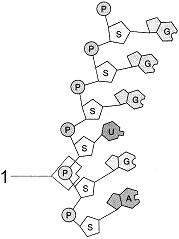 The molecular fragment (the G, U and A's) represented in the accompanying figure is:
 (Multiple Choice)
5.0/5  (71)
(71) Molecular chaperones mediate the folding of other protein molecules.
__________________
(True/False)
4.9/5 (82)
(82) If tyrosine and isoleucine undergo condensation, where does the new bond form?
(Multiple Choice)
4.9/5 (68)
(68) Unlike lipids, hydrophilic functional groups typically contain ____ atoms, which make them more soluble in water.
(Multiple Choice)
4.8/5 (90)
(90) A disaccharide is composed of two monosaccharides joined by a(n) glycosidic linkage .
__________________
(True/False)
4.9/5 (72)
(72) Match the molecule with the appropriate word or phrase.
Correct Answer: Verified
Premises:
Responses:
(Matching)
4.9/5 (73)
(73) The primary difference between the amino acids commonly found in proteins is in their:
(Multiple Choice)
4.9/5 (86)
(86) Sickle cell anemia is a genetic disease caused by the replacement of one amino acid in the hemoglobin molecule. This replacement changes the shape and function of the hemoglobin protein in dramatic ways, which can sometimes be lethal. How can the substitution of one amino acid lead to such drastic results?
(Essay)
4.8/5 (72)
(72) Since a carbon atom has 4 valence electrons, it can complete its valence shell by forming a total of 4 hydrogen bonds.
__________________
(True/False)
4.8/5 (82)
(82) What does the term "functional group" mean in reference to the structure of organic molecules? Identify two types of functional groups and describe their chemical properties.
(Essay)
4.8/5 (80)
(80) Why is carbon ideally suited to be the "backbone" in molecules produced by living organisms?
(Essay)
4.8/5 (76)
(76) What organic molecules is the primary structural component of cell membranes?
(Multiple Choice)
4.8/5 (86)
(86) Identify the levels of organization for protein molecules, and list the type(s) of bond(s) involved in establishing each structural level.
(Essay)
4.9/5 (86)
(86) 
Filters
- Essay(0)
- Multiple Choice(0)
- Short Answer(0)
- True False(0)
- Matching(0)