



 Chat with AI
Exam 38: Plant Developmental Responses to External and Internal Signals

Exam 1: A View of Life66 Questions
Exam 2: Atoms and Molecules the Chemical Basis of Life69 Questions
Exam 3: The Chemistry of Life Organic Compounds68 Questions
Exam 4: Organization of the Cell71 Questions
Exam 5: Biological Membranes69 Questions
Exam 6: Cell Communication69 Questions
Exam 7: Energy and Metabolism73 Questions
Exam 8: How Cells Make Atp Energy-Releasing Pathways66 Questions
Exam 9: Photosynthesis Capturing Light Energy72 Questions
Exam 10: Chromosomes, Mitosis, and Meiosis66 Questions
Exam 11: The Basic Principles of Heredity78 Questions
Exam 12: Dna the Carrier of Genetic Information68 Questions
Exam 13: Gene Expression82 Questions
Exam 14: Gene Regulation77 Questions
Exam 15: Dna Technology and Genomics81 Questions
Exam 16: Human Genetics and the Human Genome75 Questions
Exam 17: Developmental Genetics83 Questions
Exam 18: Introduction to Darwinian Evolution66 Questions
Exam 19: Evolutionary Change in Populations72 Questions
Exam 20: Speciation and Macroevolution139 Questions
Exam 21: The Origin and Evolutionary History of Life67 Questions
Exam 22: The Evolution of Primates70 Questions
Exam 23: Understanding Diversity Systematics66 Questions
Exam 24: Viruses and Subviral Agents51 Questions
Exam 25: Bacteria and Archaea59 Questions
Exam 26: Protists69 Questions
Exam 27: Seedless Plants70 Questions
Exam 28: Seed Plants69 Questions
Exam 29: The Fungi69 Questions
Exam 30: An Introduction to Animal Diversity66 Questions
Exam 31: Sponges, Cnidarians, Ctenophores, and Protostomes99 Questions
Exam 32: The Deuterostomes75 Questions
Exam 33: Plant Structure Growth and Development73 Questions
Exam 34: Leaf Structure and Function76 Questions
Exam 35: Stem Structure and Transport75 Questions
Exam 36: Roots and Mineral Nutrition84 Questions
Exam 37: Reproduction in Flowering Plants81 Questions
Exam 38: Plant Developmental Responses to External and Internal Signals84 Questions
Exam 39: Animal Structure and Function an Introduction84 Questions
Exam 40: Protection Support and Movement68 Questions
Exam 41: Neural Signaling66 Questions
Exam 42: Neural Regulation67 Questions
Exam 43: Sensory Systems78 Questions
Exam 44: Internal Transport90 Questions
Exam 45: The Immune System Internal Defense79 Questions
Exam 46: Gas Exchange93 Questions
Exam 47: Processing Food and Nutrition90 Questions
Exam 48: Osmoregulation and Disposal of Metabolic Wastes111 Questions
Exam 49: Endocrine Regulation69 Questions
Exam 50: Reproduction95 Questions
Exam 51: Animal Development88 Questions
Exam 52: Animal Behavior83 Questions
Exam 53: Introduction to Ecology Population Ecology90 Questions
Exam 54: Community Ecology73 Questions
Exam 55: Ecosystems and the Biosphere91 Questions
Exam 56: Ecology and the Geography of Life81 Questions
Exam 57: Biological Diversity and Conservation Biology68 Questions
Select questions type


Unripe green fruits ripen quickly in supermarkets or commercial storage facilities after exposure to:
(Multiple Choice)
4.8/5  (96)
(96) Any response of a plant to the relative lengths of light and darkness is referred to as:
(Multiple Choice)
4.9/5 (73)
(73) You want to obtain the strongest phototropic response from a shoot. Which wavelength of light should you use?
(Multiple Choice)
4.9/5 (83)
(83) Plants compete for light, a response known as ____, in which plants tend to grow taller when closely surrounded by other plants.
(Multiple Choice)
4.8/5 (78)
(78) Auxin produced by the apical meristem inhibits the germination of lateral buds.
(True/False)
4.7/5 (78)
(78) ____ stimulates rapid elongation of a floral stalk in many plant species.
(Multiple Choice)
4.8/5 (74)
(74) Figure 38-1 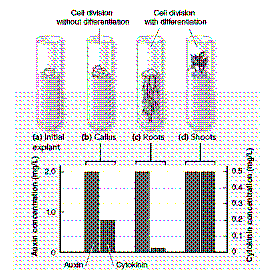 Based on the data in the accompanying figure, the condition that results in root development is:
 (Multiple Choice)
4.8/5 (76)
(76) Which hormone stimulates both leaf abscission and fruit ripening?
(Multiple Choice)
4.9/5 (101)
(101) Which of the following would be the most likely consequence of removing the apical meristem from a plant?
(Multiple Choice)
4.9/5 (68)
(68) You plant two gardens, one in the sun and one in the shade. The plants grown in the shade will most likely be ____ because neighboring leaves absorb more ____.
(Multiple Choice)
4.9/5 (80)
(80) Which statement about the internal biological clock is false ?
(Multiple Choice)
4.8/5 (84)
(84) Figure 38-2 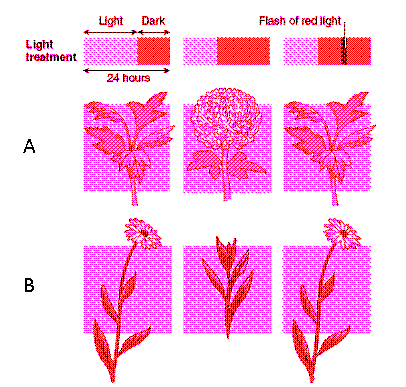 Refer to the accompanying figure. What does the photoperiodic response of the plant in Row A suggest?
 (Multiple Choice)
4.8/5 (72)
(72) In the mechanism of action for auxin, after auxin binds with its receptor, which of the following happens next?
(Multiple Choice)
4.9/5 (68)
(68) ____ used tiny blocks of agar to show that auxin is made in the tip of coleoptiles and still capable of influencing bending of the coleoptile.
(Multiple Choice)
4.9/5 (83)
(83) 
Filters
- Essay(0)
- Multiple Choice(0)
- Short Answer(0)
- True False(0)
- Matching(0)