



 Chat with AI
Exam 37: Reproduction in Flowering Plants

Exam 1: A View of Life66 Questions
Exam 2: Atoms and Molecules the Chemical Basis of Life69 Questions
Exam 3: The Chemistry of Life Organic Compounds68 Questions
Exam 4: Organization of the Cell71 Questions
Exam 5: Biological Membranes69 Questions
Exam 6: Cell Communication69 Questions
Exam 7: Energy and Metabolism73 Questions
Exam 8: How Cells Make Atp Energy-Releasing Pathways66 Questions
Exam 9: Photosynthesis Capturing Light Energy72 Questions
Exam 10: Chromosomes, Mitosis, and Meiosis66 Questions
Exam 11: The Basic Principles of Heredity78 Questions
Exam 12: Dna the Carrier of Genetic Information68 Questions
Exam 13: Gene Expression82 Questions
Exam 14: Gene Regulation77 Questions
Exam 15: Dna Technology and Genomics81 Questions
Exam 16: Human Genetics and the Human Genome75 Questions
Exam 17: Developmental Genetics83 Questions
Exam 18: Introduction to Darwinian Evolution66 Questions
Exam 19: Evolutionary Change in Populations72 Questions
Exam 20: Speciation and Macroevolution139 Questions
Exam 21: The Origin and Evolutionary History of Life67 Questions
Exam 22: The Evolution of Primates70 Questions
Exam 23: Understanding Diversity Systematics66 Questions
Exam 24: Viruses and Subviral Agents51 Questions
Exam 25: Bacteria and Archaea59 Questions
Exam 26: Protists69 Questions
Exam 27: Seedless Plants70 Questions
Exam 28: Seed Plants69 Questions
Exam 29: The Fungi69 Questions
Exam 30: An Introduction to Animal Diversity66 Questions
Exam 31: Sponges, Cnidarians, Ctenophores, and Protostomes99 Questions
Exam 32: The Deuterostomes75 Questions
Exam 33: Plant Structure Growth and Development73 Questions
Exam 34: Leaf Structure and Function76 Questions
Exam 35: Stem Structure and Transport75 Questions
Exam 36: Roots and Mineral Nutrition84 Questions
Exam 37: Reproduction in Flowering Plants81 Questions
Exam 38: Plant Developmental Responses to External and Internal Signals84 Questions
Exam 39: Animal Structure and Function an Introduction84 Questions
Exam 40: Protection Support and Movement68 Questions
Exam 41: Neural Signaling66 Questions
Exam 42: Neural Regulation67 Questions
Exam 43: Sensory Systems78 Questions
Exam 44: Internal Transport90 Questions
Exam 45: The Immune System Internal Defense79 Questions
Exam 46: Gas Exchange93 Questions
Exam 47: Processing Food and Nutrition90 Questions
Exam 48: Osmoregulation and Disposal of Metabolic Wastes111 Questions
Exam 49: Endocrine Regulation69 Questions
Exam 50: Reproduction95 Questions
Exam 51: Animal Development88 Questions
Exam 52: Animal Behavior83 Questions
Exam 53: Introduction to Ecology Population Ecology90 Questions
Exam 54: Community Ecology73 Questions
Exam 55: Ecosystems and the Biosphere91 Questions
Exam 56: Ecology and the Geography of Life81 Questions
Exam 57: Biological Diversity and Conservation Biology68 Questions
Select questions type


Aboveground shoots that develop from adventitious buds on roots are called:
(Multiple Choice)
4.9/5  (83)
(83) During embryonic development, the proembryo develops from the basal cell.
(True/False)
4.8/5 (74)
(74) Figure 37-4 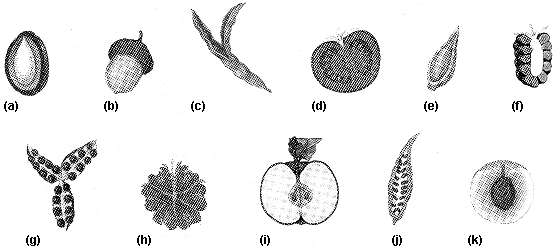 Refer to the accompanying figure. Which of the fruits listed would be classified as an accessory fruit?
 (Multiple Choice)
4.9/5 (79)
(79) Plants that are wind-pollinated characteristically have conspicuous flowers.
(True/False)
4.9/5 (71)
(71) Imbibition is the process by which a seed takes in oxygen from the environment.
(True/False)
4.8/5 (74)
(74) Fruits that develop from a flower with many separate ovaries are referred to as:
(Multiple Choice)
4.7/5 (84)
(84) Following double fertilization, the ovule develops into a(n) ____, and the ovary develops into a(n) ____.
(Multiple Choice)
4.9/5 (77)
(77) Certain orchids produce flowers and secrete scents that resemble female bees so that male bees will mount these flowers and attempt to copulate with them. This bizarre occurrence is an example of:
(Multiple Choice)
4.8/5 (77)
(77) Apomixis is often found in ____ plants with different degrees of sterility.
(Multiple Choice)
4.8/5 (85)
(85) Which is the correct sequence of embryonic development in eudicots?
(Multiple Choice)
4.7/5 (70)
(70) Special structures found in seeds that are dispersed by ants are called:
(Multiple Choice)
4.8/5 (79)
(79) Asexual reproduction in flowering plants does not usually involve the formation of:
(Multiple Choice)
4.9/5 (85)
(85) Sometimes plants produce embryos in seeds without meiosis and fusion of gametes. This process is known as:
(Multiple Choice)
4.9/5 (91)
(91) Each pollen grain produces two cells, one of which may develop into a(n):
(Multiple Choice)
4.9/5 (78)
(78) Diagram a flower, labeling the parts and identify the function of each labeled part from the following list: a) reproduction male, b) reproduction female, c) attracting a pollinator, d) point of attachment of flower parts, and e) protection for a bud.
(Essay)
4.9/5 (76)
(76) The female plant structure on which a pollen grain must land for sexual reproduction to occur is the:
(Multiple Choice)
4.9/5 (82)
(82) Match the flower part with its description.
Correct Answer: Verified
Premises:
Responses:
(Matching)
4.8/5 (94)
(94) 
Filters
- Essay(0)
- Multiple Choice(0)
- Short Answer(0)
- True False(0)
- Matching(0)