



 Chat with AI
Exam 29: The Fungi

Exam 1: A View of Life66 Questions
Exam 2: Atoms and Molecules the Chemical Basis of Life69 Questions
Exam 3: The Chemistry of Life Organic Compounds68 Questions
Exam 4: Organization of the Cell71 Questions
Exam 5: Biological Membranes69 Questions
Exam 6: Cell Communication69 Questions
Exam 7: Energy and Metabolism73 Questions
Exam 8: How Cells Make Atp Energy-Releasing Pathways66 Questions
Exam 9: Photosynthesis Capturing Light Energy72 Questions
Exam 10: Chromosomes, Mitosis, and Meiosis66 Questions
Exam 11: The Basic Principles of Heredity78 Questions
Exam 12: Dna the Carrier of Genetic Information68 Questions
Exam 13: Gene Expression82 Questions
Exam 14: Gene Regulation77 Questions
Exam 15: Dna Technology and Genomics81 Questions
Exam 16: Human Genetics and the Human Genome75 Questions
Exam 17: Developmental Genetics83 Questions
Exam 18: Introduction to Darwinian Evolution66 Questions
Exam 19: Evolutionary Change in Populations72 Questions
Exam 20: Speciation and Macroevolution139 Questions
Exam 21: The Origin and Evolutionary History of Life67 Questions
Exam 22: The Evolution of Primates70 Questions
Exam 23: Understanding Diversity Systematics66 Questions
Exam 24: Viruses and Subviral Agents51 Questions
Exam 25: Bacteria and Archaea59 Questions
Exam 26: Protists69 Questions
Exam 27: Seedless Plants70 Questions
Exam 28: Seed Plants69 Questions
Exam 29: The Fungi69 Questions
Exam 30: An Introduction to Animal Diversity66 Questions
Exam 31: Sponges, Cnidarians, Ctenophores, and Protostomes99 Questions
Exam 32: The Deuterostomes75 Questions
Exam 33: Plant Structure Growth and Development73 Questions
Exam 34: Leaf Structure and Function76 Questions
Exam 35: Stem Structure and Transport75 Questions
Exam 36: Roots and Mineral Nutrition84 Questions
Exam 37: Reproduction in Flowering Plants81 Questions
Exam 38: Plant Developmental Responses to External and Internal Signals84 Questions
Exam 39: Animal Structure and Function an Introduction84 Questions
Exam 40: Protection Support and Movement68 Questions
Exam 41: Neural Signaling66 Questions
Exam 42: Neural Regulation67 Questions
Exam 43: Sensory Systems78 Questions
Exam 44: Internal Transport90 Questions
Exam 45: The Immune System Internal Defense79 Questions
Exam 46: Gas Exchange93 Questions
Exam 47: Processing Food and Nutrition90 Questions
Exam 48: Osmoregulation and Disposal of Metabolic Wastes111 Questions
Exam 49: Endocrine Regulation69 Questions
Exam 50: Reproduction95 Questions
Exam 51: Animal Development88 Questions
Exam 52: Animal Behavior83 Questions
Exam 53: Introduction to Ecology Population Ecology90 Questions
Exam 54: Community Ecology73 Questions
Exam 55: Ecosystems and the Biosphere91 Questions
Exam 56: Ecology and the Geography of Life81 Questions
Exam 57: Biological Diversity and Conservation Biology68 Questions
Select questions type


Thrush, a painful yeast infection of the mouth, throat and vagina, is caused by a member of the genus:
(Multiple Choice)
4.7/5  (77)
(77) Production of ____ is a means of rapidly propagating new mycelia when environmental conditions are favorable for ascomycetes.
(Multiple Choice)
4.9/5 (99)
(99) Identify the parts of a typical fungal body plan and briefly explain the function of each of the structures you identified.
(Essay)
4.8/5 (85)
(85) Which process marks the start of the dikaryotic stage ( n + n ) in the fungal reproductive cycle?
(Multiple Choice)
4.9/5 (70)
(70) What is a fungal chemical that shows promise as an anticancer agent because of its ability to inhibit the formation of new blood vessels?
(Multiple Choice)
5.0/5 (77)
(77) Lichens are most typically formed by the symbiotic association of an alga or cyanobacterium and a(n):
(Multiple Choice)
4.7/5 (82)
(82) Black bread mold is ____, which means that it is self-sterile.
(Multiple Choice)
4.7/5 (76)
(76) A ____ is a filament that makes up the vegetative body of most fungi.
(Multiple Choice)
4.8/5 (71)
(71) Of the following, which would be predicted to grow at the slowest rate?
(Multiple Choice)
4.9/5 (75)
(75) Phyla Ascomycota and Basidiomycota are considered ____ because they share a more recent common ancestor with each other than either does with any other group.
(Multiple Choice)
4.9/5 (85)
(85) The primary mycelium of basidiomycetes is dikaryotic.
____________________
(True/False)
4.9/5 (76)
(76) Figure 29-1 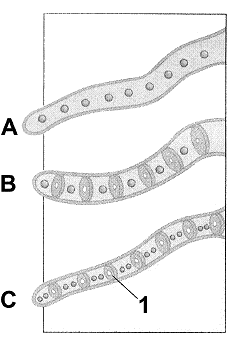 Refer to the accompanying figure. What is missing in the filament labeled as A?
 (Multiple Choice)
4.7/5 (90)
(90) Which process takes place within the young basidia on the gills of the mushroom?
(Multiple Choice)
4.7/5 (90)
(90) Reduction in ____ growth is used as a sensitive indicator of air pollution.
(Multiple Choice)
4.8/5 (79)
(79) One ancestral characteristic remaining in representatives of the Chytridiomycota is:
(Multiple Choice)
4.8/5 (72)
(72) 
Filters
- Essay(0)
- Multiple Choice(0)
- Short Answer(0)
- True False(0)
- Matching(0)