



 Chat with AI
Exam 28: Seed Plants

Exam 1: A View of Life66 Questions
Exam 2: Atoms and Molecules the Chemical Basis of Life69 Questions
Exam 3: The Chemistry of Life Organic Compounds68 Questions
Exam 4: Organization of the Cell71 Questions
Exam 5: Biological Membranes69 Questions
Exam 6: Cell Communication69 Questions
Exam 7: Energy and Metabolism73 Questions
Exam 8: How Cells Make Atp Energy-Releasing Pathways66 Questions
Exam 9: Photosynthesis Capturing Light Energy72 Questions
Exam 10: Chromosomes, Mitosis, and Meiosis66 Questions
Exam 11: The Basic Principles of Heredity78 Questions
Exam 12: Dna the Carrier of Genetic Information68 Questions
Exam 13: Gene Expression82 Questions
Exam 14: Gene Regulation77 Questions
Exam 15: Dna Technology and Genomics81 Questions
Exam 16: Human Genetics and the Human Genome75 Questions
Exam 17: Developmental Genetics83 Questions
Exam 18: Introduction to Darwinian Evolution66 Questions
Exam 19: Evolutionary Change in Populations72 Questions
Exam 20: Speciation and Macroevolution139 Questions
Exam 21: The Origin and Evolutionary History of Life67 Questions
Exam 22: The Evolution of Primates70 Questions
Exam 23: Understanding Diversity Systematics66 Questions
Exam 24: Viruses and Subviral Agents51 Questions
Exam 25: Bacteria and Archaea59 Questions
Exam 26: Protists69 Questions
Exam 27: Seedless Plants70 Questions
Exam 28: Seed Plants69 Questions
Exam 29: The Fungi69 Questions
Exam 30: An Introduction to Animal Diversity66 Questions
Exam 31: Sponges, Cnidarians, Ctenophores, and Protostomes99 Questions
Exam 32: The Deuterostomes75 Questions
Exam 33: Plant Structure Growth and Development73 Questions
Exam 34: Leaf Structure and Function76 Questions
Exam 35: Stem Structure and Transport75 Questions
Exam 36: Roots and Mineral Nutrition84 Questions
Exam 37: Reproduction in Flowering Plants81 Questions
Exam 38: Plant Developmental Responses to External and Internal Signals84 Questions
Exam 39: Animal Structure and Function an Introduction84 Questions
Exam 40: Protection Support and Movement68 Questions
Exam 41: Neural Signaling66 Questions
Exam 42: Neural Regulation67 Questions
Exam 43: Sensory Systems78 Questions
Exam 44: Internal Transport90 Questions
Exam 45: The Immune System Internal Defense79 Questions
Exam 46: Gas Exchange93 Questions
Exam 47: Processing Food and Nutrition90 Questions
Exam 48: Osmoregulation and Disposal of Metabolic Wastes111 Questions
Exam 49: Endocrine Regulation69 Questions
Exam 50: Reproduction95 Questions
Exam 51: Animal Development88 Questions
Exam 52: Animal Behavior83 Questions
Exam 53: Introduction to Ecology Population Ecology90 Questions
Exam 54: Community Ecology73 Questions
Exam 55: Ecosystems and the Biosphere91 Questions
Exam 56: Ecology and the Geography of Life81 Questions
Exam 57: Biological Diversity and Conservation Biology68 Questions
Select questions type


The accompanying figures are representative of which of the following? 
(Multiple Choice)
4.8/5  (88)
(88) Leaf ____ in autumn is an adaptation for flowering plants to survive harsh winters in temperate climates.
(Multiple Choice)
4.9/5 (78)
(78) Figure 28-1 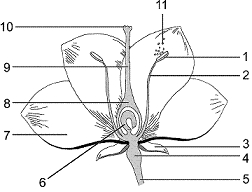 What is the structure labeled as 9 in the accompanying figure?
 (Multiple Choice)
4.8/5 (85)
(85) The wood of conifers consists mostly of tracheids .
____________________
(True/False)
4.9/5 (82)
(82) Most conifers have separate male and female reproductive parts on the same tree. This condition is referred to as:
(Multiple Choice)
4.9/5 (83)
(83) Coniferous forests are important ecosystems, particularly in higher latitudes and altitudes. How are conifers of direct economic importance to humans?
(Essay)
4.9/5 (84)
(84) Which of the following is an economically important basal angiosperm?
(Multiple Choice)
5.0/5 (69)
(69) If you identify a plant as Magnolia grandiflora , you therefore conclude that this plant is:
(Multiple Choice)
4.7/5 (76)
(76) Which statement about gymnosperms and angiosperms is FALSE?
(Multiple Choice)
4.9/5 (72)
(72) Seeds are superior reproductive structures, compared to spores. Describe the advantages of seeds. Briefly describe the connection between human civilization and seeds.
(Essay)
4.8/5 (87)
(87) Recent studies of gene function as it relates to reproductive development suggest that angiosperms evolved most directly from:
(Multiple Choice)
4.9/5 (82)
(82) Identify and briefly explain three adaptations of flowering plants that contributed to their evolutionary expansion and success.
(Essay)
4.9/5 (85)
(85) The fertilization process of flowering plants involves ____ nuclear fusion(s).
(Multiple Choice)
4.8/5 (72)
(72) Give examples of plants in each of the gymnosperm phyla. Differentiate among them with respect to morphology and reproductive characteristics. Which is the most diverse? Least diverse?
(Essay)
4.9/5 (80)
(80) 
Filters
- Essay(0)
- Multiple Choice(0)
- Short Answer(0)
- True False(0)
- Matching(0)