



 Chat with AI
Exam 15: Dna Technology and Genomics

Exam 1: A View of Life88 Questions
Exam 2: Atoms and Molecules: the Chemical Basis of Life85 Questions
Exam 3: The Chemistry of Life: Organic Compounds95 Questions
Exam 4: Organization of the Cell68 Questions
Exam 5: Biological Membranes77 Questions
Exam 6: Cell Communication73 Questions
Exam 7: Energy and Metabolism76 Questions
Exam 8: How Cells Make Atp: Energy-Releasing Pathways90 Questions
Exam 9: Photosynthesis: Capturing Light Energy80 Questions
Exam 10: Chromosomes, Mitosis, and Meiosis91 Questions
Exam 11: The Basic Principles of Heredity75 Questions
Exam 12: Dna: the Carrier of Genetic Information80 Questions
Exam 13: Gene Expression76 Questions
Exam 14: Gene Regulation77 Questions
Exam 15: Dna Technology and Genomics79 Questions
Exam 16: Human Genetics and the Human Genome78 Questions
Exam 17: Developmental Genetics79 Questions
Exam 18: Introduction to Darwinian Evolution70 Questions
Exam 19: Evolutionary Change in Populations79 Questions
Exam 20: Speciation and Macroevolution91 Questions
Exam 21: The Origin and Evolutionary History of Life89 Questions
Exam 22: The Evolution of Primates87 Questions
Exam 23: Understanding Diversity: Systematics79 Questions
Exam 24: Viruses and Subviral Agents41 Questions
Exam 25: Bacteria and Archaea55 Questions
Exam 26: Protists92 Questions
Exam 27: Seedless Plants80 Questions
Exam 28: Seed Plants78 Questions
Exam 29: The Fungi87 Questions
Exam 30: An Introduction to Animal Diversity79 Questions
Exam 31: Sponges, Cnidarians, Ctenophores, and Protostomes146 Questions
Exam 32: The Deuterostomes90 Questions
Exam 33: Plant Structure, Growth, and Development86 Questions
Exam 34: Leaf Structure and Function76 Questions
Exam 35: Stem Structure and Transport74 Questions
Exam 36: Roots and Mineral Nutrition84 Questions
Exam 37: Reproduction in Flowering Plants89 Questions
Exam 38: Plant Developmental Responses to External and Internal Signals95 Questions
Exam 39: Animal Structure and Function: an Introduction96 Questions
Exam 40: Protection, Support, and Movement101 Questions
Exam 41: Neural Signaling87 Questions
Exam 42: Neural Regulation88 Questions
Exam 43: Sensory Systems111 Questions
Exam 44: Internal Transport104 Questions
Exam 45: The Immune System: Internal Defense85 Questions
Exam 46: Gas Exchange109 Questions
Exam 47: Processing Food and Nutrition119 Questions
Exam 48: Osmoregulation and Disposal of Metabolic Wastes94 Questions
Exam 49: Endocrine Regulation82 Questions
Exam 50: Reproduction104 Questions
Exam 51: Animal Development98 Questions
Exam 52: Animal Behavior77 Questions
Exam 53: Introduction to Ecology: Population Ecology97 Questions
Exam 54: Community Ecology74 Questions
Exam 55: Ecosystems and the Biosphere88 Questions
Exam 56: Ecology and the Geography of Life105 Questions
Exam 57: Biological Diversity and Conservation Biology66 Questions
Select questions type


__________ is a technique that can be used to separate DNA molecules on the basis of their size.
(Multiple Choice)
4.9/5  (94)
(94) Figure 15-1
Use the figure to answer the corresponding question(s). 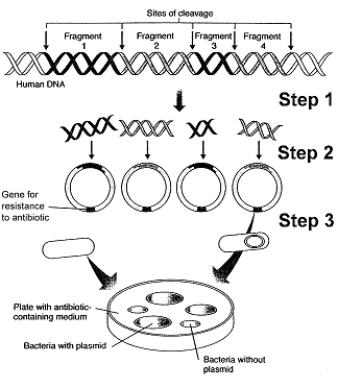 -To avoid the introduction of introns into the vector, a __________ copy of mature mRNA is made, using the enzyme __________.
 (Multiple Choice)
4.9/5 (75)
(75) When DNA ligase is used to combine a human fragment with a plasmid, the result is a redundant plasmid.
__________________
(True/False)
4.7/5 (77)
(77) Figure 15-1
Use the figure to answer the corresponding question(s).
-What process or enzyme was used for Step 1 in Figure 15-1?
-What process or enzyme was used for Step 1 in Figure 15-1? (Multiple Choice)
4.8/5 (92)
(92) DNA ligase links two __________ DNA fragments by __________ bonds.
(Multiple Choice)
4.9/5 (68)
(68) Figure 15-3
Use the figure to answer the corresponding question(s). 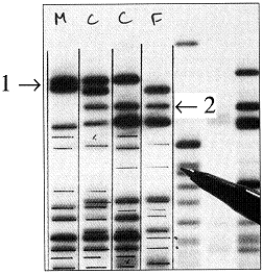 -Retroviruses make __________ by the process of __________.
 (Multiple Choice)
4.7/5 (74)
(74) Explain how DNA sequencing can be accomplished using dideoxynucleotides.
(Essay)
4.9/5 (89)
(89) Southern blotting is a process where __________ is transferred from a gel to a __________ where a probe can be applied.
(Multiple Choice)
4.9/5 (62)
(62) Figure 15-1
Use the figure to answer the corresponding question(s).
-Refer to Figure 15-1.The use of antibiotic medium at the end of this process:
-Refer to Figure 15-1.The use of antibiotic medium at the end of this process: (Multiple Choice)
4.8/5 (72)
(72) If a(n) intron containing a human gene sequence is inserted into a prokaryote cell, that molecule will produce a functional protein product.
__________________
(True/False)
4.9/5 (68)
(68) MATCHING
Match the sequence of the steps for the Southern Blot assay.
a.visualize DNA fragments using UV light
d.place filter and radioactively labeled probe together in sealed bag
b.resulting radiograph shows hybridized DNA fragments
e.load DNA fragments on gel and separate by electrophoresis
c.blotting buffer transfers DNA fragments toDNA binding filter
-How does a cDNA library differ from a genomic library? How are cDNA libraries significant to the production of eukaryotic gene products?
(Essay)
4.9/5 (78)
(78) MATCHING
Match the sequence of the steps for the Southern Blot assay.
a.visualize DNA fragments using UV light
d.place filter and radioactively labeled probe together in sealed bag
b.resulting radiograph shows hybridized DNA fragments
e.load DNA fragments on gel and separate by electrophoresis
c.blotting buffer transfers DNA fragments toDNA binding filter
-step 3
(Essay)
4.8/5 (77)
(77) What are transgenic organisms? Explain the rationale behind using these organisms to produce some of the proteins needed for human use, instead of relying solely on proteins produced by genetically engineered E.coli.
(Essay)
4.9/5 (83)
(83) Introducing a gene for a surface protein produced by a disease-causing agent into a nonpathogenic vector is a method to:
(Multiple Choice)
4.8/5 (83)
(83) In the process by which cDNA is formed, reverse transcriptase is used to produce _____ from _______.
(Multiple Choice)
4.8/5 (75)
(75) 
Filters
- Essay(0)
- Multiple Choice(0)
- Short Answer(0)
- True False(0)
- Matching(0)