



 Chat with AI
Exam 13: Gene Expression

Exam 1: A View of Life88 Questions
Exam 2: Atoms and Molecules: the Chemical Basis of Life85 Questions
Exam 3: The Chemistry of Life: Organic Compounds95 Questions
Exam 4: Organization of the Cell68 Questions
Exam 5: Biological Membranes77 Questions
Exam 6: Cell Communication73 Questions
Exam 7: Energy and Metabolism76 Questions
Exam 8: How Cells Make Atp: Energy-Releasing Pathways90 Questions
Exam 9: Photosynthesis: Capturing Light Energy80 Questions
Exam 10: Chromosomes, Mitosis, and Meiosis91 Questions
Exam 11: The Basic Principles of Heredity75 Questions
Exam 12: Dna: the Carrier of Genetic Information80 Questions
Exam 13: Gene Expression76 Questions
Exam 14: Gene Regulation77 Questions
Exam 15: Dna Technology and Genomics79 Questions
Exam 16: Human Genetics and the Human Genome78 Questions
Exam 17: Developmental Genetics79 Questions
Exam 18: Introduction to Darwinian Evolution70 Questions
Exam 19: Evolutionary Change in Populations79 Questions
Exam 20: Speciation and Macroevolution91 Questions
Exam 21: The Origin and Evolutionary History of Life89 Questions
Exam 22: The Evolution of Primates87 Questions
Exam 23: Understanding Diversity: Systematics79 Questions
Exam 24: Viruses and Subviral Agents41 Questions
Exam 25: Bacteria and Archaea55 Questions
Exam 26: Protists92 Questions
Exam 27: Seedless Plants80 Questions
Exam 28: Seed Plants78 Questions
Exam 29: The Fungi87 Questions
Exam 30: An Introduction to Animal Diversity79 Questions
Exam 31: Sponges, Cnidarians, Ctenophores, and Protostomes146 Questions
Exam 32: The Deuterostomes90 Questions
Exam 33: Plant Structure, Growth, and Development86 Questions
Exam 34: Leaf Structure and Function76 Questions
Exam 35: Stem Structure and Transport74 Questions
Exam 36: Roots and Mineral Nutrition84 Questions
Exam 37: Reproduction in Flowering Plants89 Questions
Exam 38: Plant Developmental Responses to External and Internal Signals95 Questions
Exam 39: Animal Structure and Function: an Introduction96 Questions
Exam 40: Protection, Support, and Movement101 Questions
Exam 41: Neural Signaling87 Questions
Exam 42: Neural Regulation88 Questions
Exam 43: Sensory Systems111 Questions
Exam 44: Internal Transport104 Questions
Exam 45: The Immune System: Internal Defense85 Questions
Exam 46: Gas Exchange109 Questions
Exam 47: Processing Food and Nutrition119 Questions
Exam 48: Osmoregulation and Disposal of Metabolic Wastes94 Questions
Exam 49: Endocrine Regulation82 Questions
Exam 50: Reproduction104 Questions
Exam 51: Animal Development98 Questions
Exam 52: Animal Behavior77 Questions
Exam 53: Introduction to Ecology: Population Ecology97 Questions
Exam 54: Community Ecology74 Questions
Exam 55: Ecosystems and the Biosphere88 Questions
Exam 56: Ecology and the Geography of Life105 Questions
Exam 57: Biological Diversity and Conservation Biology66 Questions
Select questions type


Eukaryotic mRNA has a significantly longer half life than its prokaryotic counterpart.How is this accomplished in eukaryotes? What processes tend to degrade mRNA molecules in both eukaryotes and prokaryotes, and why are these processes needed?

Free
(Essay)
4.9/5  (83)
(83) Correct Answer: Verified
Concepts to Consider: Eukaryotic mRNA is protected after it is made by the addition of a poly-A tail and a cap.These additions protect the mRNA from degradation by nucleases that target RNA.These nucleases are needed to degrade foreign RNA and DNA that enter the cell.
Where is the amino-acid binding site located on the tRNA molecule?
Free
(Multiple Choice)
4.9/5 (71)
(71) Correct Answer:Verified
VerifiedB
The template DNA strand is described as being parallel to the complementary RNA strand.
__________________
Free
(True/False)
4.9/5 (77)
(77) Correct Answer:Verified
VerifiedFalse
Figure 13-1
Use the figure to answer the corresponding question(s). 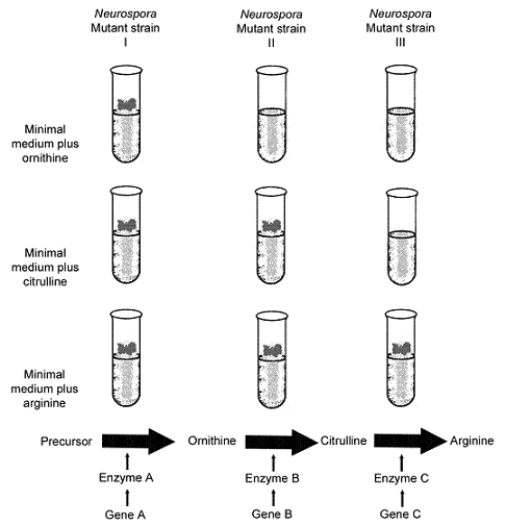 -The conclusion associated with mutant strain III in Figure 13-1 was that it:
 (Multiple Choice)
5.0/5 (75)
(75) Figure 13-3
Use the figure to answer the corresponding question(s). 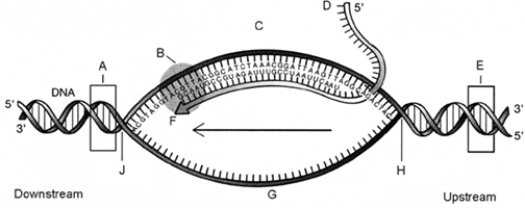 -Which of the following numbered terms represents the correct order of sequences in a prokaryotic mRNA molecule as it was synthesized? 1)
3' trailing sequences
2)
Coding sequences
3)
Leader sequences
4)
Termination signals
-Which of the following numbered terms represents the correct order of sequences in a prokaryotic mRNA molecule as it was synthesized? 1)
3' trailing sequences
2)
Coding sequences
3)
Leader sequences
4)
Termination signals (Multiple Choice)
4.9/5 (75)
(75) Uracil forms a complementary pair with __________ in RNA and __________ in DNA.
(Multiple Choice)
4.8/5 (91)
(91) All of the following characteristics of tRNA molecules are true except::
(Multiple Choice)
4.8/5 (78)
(78) Substitution of one base pair for another can result in a __________ mutation that results in the conversion of an amino acid specifying codon to a termination codon.
(Multiple Choice)
4.8/5 (66)
(66) Reverse transcriptase catalyzes the synthesis of DNA from an RNA template.
__________________
(True/False)
4.9/5 (74)
(74) Which of the following numbered events represents the correct sequence of events of prokaryotic translation initiation? 1)
Large ribosomal subunit binds to initiation complex
2)
Initiation tRNA binds small ribosomal subunit
3)
Initiation complex binds to ribosome recognition sequence on mRNA
(Multiple Choice)
4.9/5 (76)
(76) Beadle and Tatum began their studies with wild-type Neurospora, which is:
(Multiple Choice)
4.9/5 (81)
(81) Aminoacyl-tRNA synthetases __________ link __________ to their respective tRNA molecules.
(Multiple Choice)
4.9/5 (72)
(72) Which of the following is not a reason why Neurospora is an ideal organism to study the effects of genetic mutations?
(Multiple Choice)
4.9/5 (101)
(101) Explain the process of translation of the genetic code.Include the relevant chemical and cellular structures in your explanation.
(Essay)
5.0/5 (75)
(75) One function of sno-RNAs is processing pre-rRNA molecules in the mitochondrion.
__________________
(True/False)
4.8/5 (77)
(77) What conclusions did Beadle and Tatum reach with their studies of Neurospora?
(Multiple Choice)
4.8/5 (83)
(83) 
Filters
- Essay(0)
- Multiple Choice(0)
- Short Answer(0)
- True False(0)
- Matching(0)