



 Chat with AI
Exam 38: Plant Developmental Responses to External and Internal Signals

Exam 1: A View of Life88 Questions
Exam 2: Atoms and Molecules: the Chemical Basis of Life85 Questions
Exam 3: The Chemistry of Life: Organic Compounds95 Questions
Exam 4: Organization of the Cell68 Questions
Exam 5: Biological Membranes77 Questions
Exam 6: Cell Communication73 Questions
Exam 7: Energy and Metabolism76 Questions
Exam 8: How Cells Make Atp: Energy-Releasing Pathways90 Questions
Exam 9: Photosynthesis: Capturing Light Energy80 Questions
Exam 10: Chromosomes, Mitosis, and Meiosis91 Questions
Exam 11: The Basic Principles of Heredity75 Questions
Exam 12: Dna: the Carrier of Genetic Information80 Questions
Exam 13: Gene Expression76 Questions
Exam 14: Gene Regulation77 Questions
Exam 15: Dna Technology and Genomics79 Questions
Exam 16: Human Genetics and the Human Genome78 Questions
Exam 17: Developmental Genetics79 Questions
Exam 18: Introduction to Darwinian Evolution70 Questions
Exam 19: Evolutionary Change in Populations79 Questions
Exam 20: Speciation and Macroevolution91 Questions
Exam 21: The Origin and Evolutionary History of Life89 Questions
Exam 22: The Evolution of Primates87 Questions
Exam 23: Understanding Diversity: Systematics79 Questions
Exam 24: Viruses and Subviral Agents41 Questions
Exam 25: Bacteria and Archaea55 Questions
Exam 26: Protists92 Questions
Exam 27: Seedless Plants80 Questions
Exam 28: Seed Plants78 Questions
Exam 29: The Fungi87 Questions
Exam 30: An Introduction to Animal Diversity79 Questions
Exam 31: Sponges, Cnidarians, Ctenophores, and Protostomes146 Questions
Exam 32: The Deuterostomes90 Questions
Exam 33: Plant Structure, Growth, and Development86 Questions
Exam 34: Leaf Structure and Function76 Questions
Exam 35: Stem Structure and Transport74 Questions
Exam 36: Roots and Mineral Nutrition84 Questions
Exam 37: Reproduction in Flowering Plants89 Questions
Exam 38: Plant Developmental Responses to External and Internal Signals95 Questions
Exam 39: Animal Structure and Function: an Introduction96 Questions
Exam 40: Protection, Support, and Movement101 Questions
Exam 41: Neural Signaling87 Questions
Exam 42: Neural Regulation88 Questions
Exam 43: Sensory Systems111 Questions
Exam 44: Internal Transport104 Questions
Exam 45: The Immune System: Internal Defense85 Questions
Exam 46: Gas Exchange109 Questions
Exam 47: Processing Food and Nutrition119 Questions
Exam 48: Osmoregulation and Disposal of Metabolic Wastes94 Questions
Exam 49: Endocrine Regulation82 Questions
Exam 50: Reproduction104 Questions
Exam 51: Animal Development98 Questions
Exam 52: Animal Behavior77 Questions
Exam 53: Introduction to Ecology: Population Ecology97 Questions
Exam 54: Community Ecology74 Questions
Exam 55: Ecosystems and the Biosphere88 Questions
Exam 56: Ecology and the Geography of Life105 Questions
Exam 57: Biological Diversity and Conservation Biology66 Questions
Select questions type


Ethylene stimulates the ripening of fruits.
____________________

Free
(True/False)
4.8/5  (66)
(66) Correct Answer: Verified
True
MATCHING
Match the plant hormone with its description.
a.abscisic acid
d.cytokinin
b.auxin
e.ethylene
c.brassinosteroid
f.gibberellin
-closes stomata of plants suffering from water stress
Free
(Essay)
4.8/5 (73)
(73) Correct Answer:Verified
VerifiedB
What am I? I am structurally related to aspirin, and I help defend plants against insect attack.
Free
(Multiple Choice)
4.9/5 (81)
(81) Correct Answer:Verified
VerifiedD
Figure 38-1
Use the figure to answer the corresponding question(s). 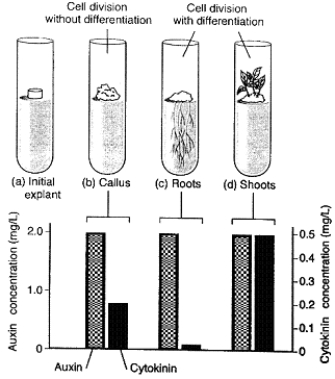 -One conclusion that can be drawn from Figure 38-1 is that:
 (Multiple Choice)
4.9/5 (70)
(70) Figure 38-2
Use the figure to answer the corresponding question(s). 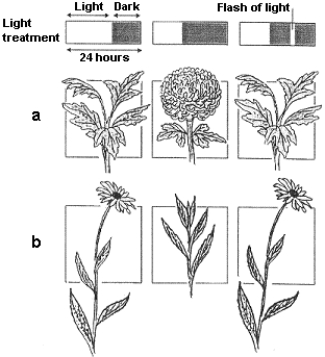 -Refer to Figure 38-2.The photoperiodic response of the plant in row a suggests:
 (Multiple Choice)
4.8/5 (69)
(69) Which of the following sequences correctly represents the phytochrome signal transduction pathway?
(Multiple Choice)
4.9/5 (80)
(80) Grand Rapids variety of lettuce produces seeds that will not germinate unless they are exposed to light.Phytochrome is also involved in that exposure to red light stimulates germination and far-red light inhibits germination.However, the effect of red light can be reversed by an immediate exposure to far-red light--and vice versa.You design an experiment in which you expose seeds of Grand Rapids lettuce first to red light, then immediately to far-red light, and then immediately to red light again.Would these seeds germinate? Use your knowledge of the phytochrome molecule to explain your reasoning.What if the seeds were exposed first to red light, then immediately to far-red light, then immediately to red light again, and then immediately to far-red light again?
(Essay)
4.7/5 (67)
(67) Figure 38-2
Use the figure to answer the corresponding question(s).
-The plant in row b of Figure 38-2 demonstrates a photoperiodic response characteristic of:
-The plant in row b of Figure 38-2 demonstrates a photoperiodic response characteristic of: (Multiple Choice)
4.8/5 (77)
(77) Figure 38-2
Use the figure to answer the corresponding question(s).
-Phy B may inhibit flowering in:
-Phy B may inhibit flowering in: (Multiple Choice)
4.7/5 (77)
(77) __________ is growth in response to a mechanical stimulus, such as contact with a solid object.
(Multiple Choice)
4.8/5 (70)
(70) When you shine light having a wavelength of 660 nm on a plant, which of the following will most likely happen next?
(Multiple Choice)
4.9/5 (89)
(89) MATCHING
Match the plant hormone with its description.
a.abscisic acid
d.cytokinin
b.auxin
e.ethylene
c.brassinosteroid
f.gibberellin
-inhibits the growth of axillary buds
(Essay)
4.8/5 (94)
(94) If you planted two gardens, one in the sun and one in the shade, the plants grown in the shade would most likely be __________ because chlorophyll absorbs more __________.
(Multiple Choice)
5.0/5 (79)
(79) If you wished to obtain the strongest phototropic response from a shoot, which wavelength of light would you use?
(Multiple Choice)
5.0/5 (75)
(75) Figure 38-2
Use the figure to answer the corresponding question(s).
-The photoreceptor for photoperiodism and some other light-initiated plant responses is a group of blue-green pigments named:
-The photoreceptor for photoperiodism and some other light-initiated plant responses is a group of blue-green pigments named: (Multiple Choice)
4.8/5 (79)
(79) Figure 38-1
Use the figure to answer the corresponding question(s).
-Unripe green fruits ripen quickly in supermarkets or commercial storage facilities after exposure to:
-Unripe green fruits ripen quickly in supermarkets or commercial storage facilities after exposure to: (Multiple Choice)
4.8/5 (95)
(95) Figure 38-1
Use the figure to answer the corresponding question(s).
-Which hormone stimulates both leaf abscission and fruit ripening?
-Which hormone stimulates both leaf abscission and fruit ripening? (Multiple Choice)
4.9/5 (82)
(82) 
Filters
- Essay(0)
- Multiple Choice(0)
- Short Answer(0)
- True False(0)
- Matching(0)