



 Chat with AI
Exam 5: Biological Membranes

Exam 1: A View of Life88 Questions
Exam 2: Atoms and Molecules: the Chemical Basis of Life85 Questions
Exam 3: The Chemistry of Life: Organic Compounds95 Questions
Exam 4: Organization of the Cell68 Questions
Exam 5: Biological Membranes77 Questions
Exam 6: Cell Communication73 Questions
Exam 7: Energy and Metabolism76 Questions
Exam 8: How Cells Make Atp: Energy-Releasing Pathways90 Questions
Exam 9: Photosynthesis: Capturing Light Energy80 Questions
Exam 10: Chromosomes, Mitosis, and Meiosis91 Questions
Exam 11: The Basic Principles of Heredity75 Questions
Exam 12: Dna: the Carrier of Genetic Information80 Questions
Exam 13: Gene Expression76 Questions
Exam 14: Gene Regulation77 Questions
Exam 15: Dna Technology and Genomics79 Questions
Exam 16: Human Genetics and the Human Genome78 Questions
Exam 17: Developmental Genetics79 Questions
Exam 18: Introduction to Darwinian Evolution70 Questions
Exam 19: Evolutionary Change in Populations79 Questions
Exam 20: Speciation and Macroevolution91 Questions
Exam 21: The Origin and Evolutionary History of Life89 Questions
Exam 22: The Evolution of Primates87 Questions
Exam 23: Understanding Diversity: Systematics79 Questions
Exam 24: Viruses and Subviral Agents41 Questions
Exam 25: Bacteria and Archaea55 Questions
Exam 26: Protists92 Questions
Exam 27: Seedless Plants80 Questions
Exam 28: Seed Plants78 Questions
Exam 29: The Fungi87 Questions
Exam 30: An Introduction to Animal Diversity79 Questions
Exam 31: Sponges, Cnidarians, Ctenophores, and Protostomes146 Questions
Exam 32: The Deuterostomes90 Questions
Exam 33: Plant Structure, Growth, and Development86 Questions
Exam 34: Leaf Structure and Function76 Questions
Exam 35: Stem Structure and Transport74 Questions
Exam 36: Roots and Mineral Nutrition84 Questions
Exam 37: Reproduction in Flowering Plants89 Questions
Exam 38: Plant Developmental Responses to External and Internal Signals95 Questions
Exam 39: Animal Structure and Function: an Introduction96 Questions
Exam 40: Protection, Support, and Movement101 Questions
Exam 41: Neural Signaling87 Questions
Exam 42: Neural Regulation88 Questions
Exam 43: Sensory Systems111 Questions
Exam 44: Internal Transport104 Questions
Exam 45: The Immune System: Internal Defense85 Questions
Exam 46: Gas Exchange109 Questions
Exam 47: Processing Food and Nutrition119 Questions
Exam 48: Osmoregulation and Disposal of Metabolic Wastes94 Questions
Exam 49: Endocrine Regulation82 Questions
Exam 50: Reproduction104 Questions
Exam 51: Animal Development98 Questions
Exam 52: Animal Behavior77 Questions
Exam 53: Introduction to Ecology: Population Ecology97 Questions
Exam 54: Community Ecology74 Questions
Exam 55: Ecosystems and the Biosphere88 Questions
Exam 56: Ecology and the Geography of Life105 Questions
Exam 57: Biological Diversity and Conservation Biology66 Questions
Select questions type


MATCHING
a.Transmit information into cell
d.Use ATP to transport solutes
b.Catalyze reactions which take place within or along membrane surface
e.Anchor cell to extracellular matrix
c.Allow selective transport of ions or molecules
-signal transuction receptors

Free
(Essay)
4.8/5  (83)
(83) Correct Answer: Verified
A
All of the following are functions of the cell membrane EXCEPT:
Free
(Multiple Choice)
4.8/5 (89)
(89) Correct Answer:Verified
VerifiedC
A bacterium containing sodium ions at a concentration of 0.1 mM lives in a pond that contains sodium ions at 0.005 mM.Evidently, sodium ions are entering the cell by:
Free
(Multiple Choice)
4.7/5 (81)
(81) Correct Answer:Verified
VerifiedA
Peripheral proteins are linked to either surface of the plasma membrane by:
(Multiple Choice)
4.8/5 (81)
(81) Mutations to ABC transporter genes contribute to cystic fibrosis.
__________________
(True/False)
4.9/5 (78)
(78) Catalysts are reusable.Enzymes are protein catalysts, and are reusable.Select the protein(s) below that is(are) not used up by the process carried out:
(Multiple Choice)
4.8/5 (77)
(77) Consider a U-tube that initially contains pure water on one side of a selectively permeable membrane and water plus solute on the other side.Which of the following best describes what will happen next?
(Multiple Choice)
4.7/5 (88)
(88) MATCHING
a.Transmit information into cell
d.Use ATP to transport solutes
b.Catalyze reactions which take place within or along membrane surface
e.Anchor cell to extracellular matrix
c.Allow selective transport of ions or molecules
-integrins
(Essay)
4.7/5 (78)
(78) A bottle of perfume is opened on the opposite side of the room and within minutes you begin to smell the perfume.This phenomenon is a classic example of:
(Multiple Choice)
4.9/5 (73)
(73) Simple diffusion may involve the movement of __________ through the plasma membrane down a concentration gradient.
(Multiple Choice)
4.8/5 (74)
(74) In a lipid bilayer, __________ fatty acid tails face each other within the bilayer and form a region that excludes water.
(Multiple Choice)
4.8/5 (83)
(83) LDL cholesterol is taken into the cell by receptor-mediated endocytosis.
__________________
(True/False)
4.8/5 (70)
(70) A transmembrane protein differs from other membrane proteins because it:
(Multiple Choice)
4.8/5 (77)
(77) MATCHING
a.Transmit information into cell
d.Use ATP to transport solutes
b.Catalyze reactions which take place within or along membrane surface
e.Anchor cell to extracellular matrix
c.Allow selective transport of ions or molecules
-protein pumps
(Essay)
4.9/5 (97)
(97) Figure 5-1
Use the figure to answer the corresponding question(s). 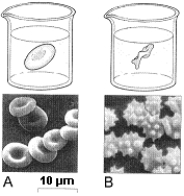 -Refer to Figure 5-1.Which of the following statements about the red blood cells in Figure A is true?
 (Multiple Choice)
4.9/5 (88)
(88) Although glucose molecules constantly diffuse into a cell along their concentration gradient, equilibrium is never reached and glucose continues to enter the cell.This is a direct result of:
(Multiple Choice)
4.8/5 (75)
(75) Compare and contrast the processes of facilitated diffusion and active transport.
(Essay)
4.9/5 (67)
(67) Which of the following membrane activities does NOT require the expenditure of energy by the cell?
(Multiple Choice)
4.8/5 (71)
(71) 
Filters
- Essay(0)
- Multiple Choice(0)
- Short Answer(0)
- True False(0)
- Matching(0)