



 Chat with AI
Exam 43: Sensory Systems

Exam 1: A View of Life88 Questions
Exam 2: Atoms and Molecules: the Chemical Basis of Life85 Questions
Exam 3: The Chemistry of Life: Organic Compounds95 Questions
Exam 4: Organization of the Cell68 Questions
Exam 5: Biological Membranes77 Questions
Exam 6: Cell Communication73 Questions
Exam 7: Energy and Metabolism76 Questions
Exam 8: How Cells Make Atp: Energy-Releasing Pathways90 Questions
Exam 9: Photosynthesis: Capturing Light Energy80 Questions
Exam 10: Chromosomes, Mitosis, and Meiosis91 Questions
Exam 11: The Basic Principles of Heredity75 Questions
Exam 12: Dna: the Carrier of Genetic Information80 Questions
Exam 13: Gene Expression76 Questions
Exam 14: Gene Regulation77 Questions
Exam 15: Dna Technology and Genomics79 Questions
Exam 16: Human Genetics and the Human Genome78 Questions
Exam 17: Developmental Genetics79 Questions
Exam 18: Introduction to Darwinian Evolution70 Questions
Exam 19: Evolutionary Change in Populations79 Questions
Exam 20: Speciation and Macroevolution91 Questions
Exam 21: The Origin and Evolutionary History of Life89 Questions
Exam 22: The Evolution of Primates87 Questions
Exam 23: Understanding Diversity: Systematics79 Questions
Exam 24: Viruses and Subviral Agents41 Questions
Exam 25: Bacteria and Archaea55 Questions
Exam 26: Protists92 Questions
Exam 27: Seedless Plants80 Questions
Exam 28: Seed Plants78 Questions
Exam 29: The Fungi87 Questions
Exam 30: An Introduction to Animal Diversity79 Questions
Exam 31: Sponges, Cnidarians, Ctenophores, and Protostomes146 Questions
Exam 32: The Deuterostomes90 Questions
Exam 33: Plant Structure, Growth, and Development86 Questions
Exam 34: Leaf Structure and Function76 Questions
Exam 35: Stem Structure and Transport74 Questions
Exam 36: Roots and Mineral Nutrition84 Questions
Exam 37: Reproduction in Flowering Plants89 Questions
Exam 38: Plant Developmental Responses to External and Internal Signals95 Questions
Exam 39: Animal Structure and Function: an Introduction96 Questions
Exam 40: Protection, Support, and Movement101 Questions
Exam 41: Neural Signaling87 Questions
Exam 42: Neural Regulation88 Questions
Exam 43: Sensory Systems111 Questions
Exam 44: Internal Transport104 Questions
Exam 45: The Immune System: Internal Defense85 Questions
Exam 46: Gas Exchange109 Questions
Exam 47: Processing Food and Nutrition119 Questions
Exam 48: Osmoregulation and Disposal of Metabolic Wastes94 Questions
Exam 49: Endocrine Regulation82 Questions
Exam 50: Reproduction104 Questions
Exam 51: Animal Development98 Questions
Exam 52: Animal Behavior77 Questions
Exam 53: Introduction to Ecology: Population Ecology97 Questions
Exam 54: Community Ecology74 Questions
Exam 55: Ecosystems and the Biosphere88 Questions
Exam 56: Ecology and the Geography of Life105 Questions
Exam 57: Biological Diversity and Conservation Biology66 Questions
Select questions type


MATCHING
Match the sense organ with its description.
a.ear
f.proprioreceptor
b.eye
g.semicircular canal
c.lateral line organ
h.tongue
d.nocioreceptor
i.utricle/saccule
e.nose
-the choroid layer is found here

Free
(Essay)
4.7/5  (79)
(79) Correct Answer: Verified
B
If the __________ of the stomach were damaged, one would be incapable of detecting the presence of food inside.
Free
(Multiple Choice)
4.9/5 (77)
(77) Correct Answer:Verified
VerifiedA
After working several hours in a flower shop, you do not detect the smell of the roses.Why?
Free
(Multiple Choice)
4.8/5 (88)
(88) Correct Answer:Verified
VerifiedA
Figure 43-4
Use the figure to answer the corresponding question(s). 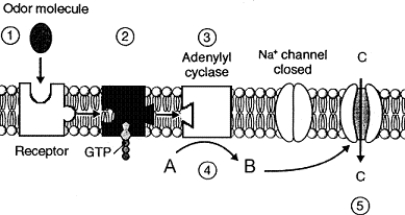 -Referring to Figure 43-4, which of the following would not be involved in producing a receptor potential?
 (Multiple Choice)
4.9/5 (89)
(89) Bats, by emitting high-pitched sounds, can detect distant objects via:
(Multiple Choice)
4.8/5 (78)
(78) Mechanoreceptors include receptors that allow us to detect all of the following except:
(Multiple Choice)
4.9/5 (82)
(82) Explain energy transduction and receptor potential as they relate to the function of a sensory receptor.
(Essay)
4.9/5 (71)
(71) The semicircular canals are not part of the vestibular apparatus.
____________________
(True/False)
4.9/5 (74)
(74) Figure 43-2
Use the figure to answer the corresponding question(s). 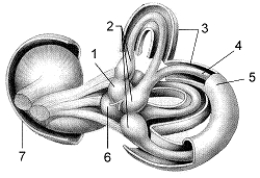 -The structures responsible for detecting linear movement relative to the pull of gravity are labeled __________ in Figure 43-2.
 (Multiple Choice)
4.8/5 (80)
(80) Figure 43-1
Use the figure to answer the corresponding question(s). 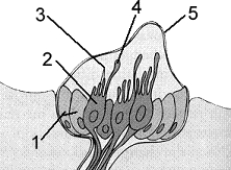 -The sense organ in Figure 43-1 includes receptor cells referred to as:
 (Multiple Choice)
4.9/5 (88)
(88) Figure 43-1
Use the figure to answer the corresponding question(s).
-The sensory structure in Figure 43-1 is capable of:
-The sensory structure in Figure 43-1 is capable of: (Multiple Choice)
4.7/5 (90)
(90) Figure 43-3
Use the figure to answer the corresponding question(s). 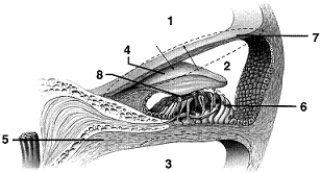 -In Figure 43-3 the structure labeled 4 is:
 (Multiple Choice)
4.8/5 (76)
(76) MATCHING
Match the sense organ with its description.
a.ear
f.proprioreceptor
b.eye
g.semicircular canal
c.lateral line organ
h.tongue
d.nocioreceptor
i.utricle/saccule
e.nose
-Trace the path of a sound wave beginning from its entry into the ear to its transmission to the brain.
(Essay)
4.8/5 (86)
(86) Some species of sharks, rays, and bony fish sense the movement of prey through the use of:
(Multiple Choice)
4.8/5 (79)
(79) The ciliary muscle changes the shape of the lens.
____________________
(True/False)
4.8/5 (78)
(78) High frequencies are detected by hair cells near the base of the cochlea.
____________________
(True/False)
4.9/5 (92)
(92) Figure 43-3
Use the figure to answer the corresponding question(s).
-Which portion of Figure 43-3 would be connected to the oval window?
-Which portion of Figure 43-3 would be connected to the oval window? (Multiple Choice)
4.8/5 (68)
(68) Some sensory receptors decrease their frequency of action potentials when exposed to a continued, constant stimulus in a process known as:
(Multiple Choice)
4.9/5 (84)
(84) 
Filters
- Essay(0)
- Multiple Choice(0)
- Short Answer(0)
- True False(0)
- Matching(0)