



 Chat with AI
Exam 54: Community Ecology

Exam 1: A View of Life88 Questions
Exam 2: Atoms and Molecules: the Chemical Basis of Life85 Questions
Exam 3: The Chemistry of Life: Organic Compounds95 Questions
Exam 4: Organization of the Cell68 Questions
Exam 5: Biological Membranes77 Questions
Exam 6: Cell Communication73 Questions
Exam 7: Energy and Metabolism76 Questions
Exam 8: How Cells Make Atp: Energy-Releasing Pathways90 Questions
Exam 9: Photosynthesis: Capturing Light Energy80 Questions
Exam 10: Chromosomes, Mitosis, and Meiosis91 Questions
Exam 11: The Basic Principles of Heredity75 Questions
Exam 12: Dna: the Carrier of Genetic Information80 Questions
Exam 13: Gene Expression76 Questions
Exam 14: Gene Regulation77 Questions
Exam 15: Dna Technology and Genomics79 Questions
Exam 16: Human Genetics and the Human Genome78 Questions
Exam 17: Developmental Genetics79 Questions
Exam 18: Introduction to Darwinian Evolution70 Questions
Exam 19: Evolutionary Change in Populations79 Questions
Exam 20: Speciation and Macroevolution91 Questions
Exam 21: The Origin and Evolutionary History of Life89 Questions
Exam 22: The Evolution of Primates87 Questions
Exam 23: Understanding Diversity: Systematics79 Questions
Exam 24: Viruses and Subviral Agents41 Questions
Exam 25: Bacteria and Archaea55 Questions
Exam 26: Protists92 Questions
Exam 27: Seedless Plants80 Questions
Exam 28: Seed Plants78 Questions
Exam 29: The Fungi87 Questions
Exam 30: An Introduction to Animal Diversity79 Questions
Exam 31: Sponges, Cnidarians, Ctenophores, and Protostomes146 Questions
Exam 32: The Deuterostomes90 Questions
Exam 33: Plant Structure, Growth, and Development86 Questions
Exam 34: Leaf Structure and Function76 Questions
Exam 35: Stem Structure and Transport74 Questions
Exam 36: Roots and Mineral Nutrition84 Questions
Exam 37: Reproduction in Flowering Plants89 Questions
Exam 38: Plant Developmental Responses to External and Internal Signals95 Questions
Exam 39: Animal Structure and Function: an Introduction96 Questions
Exam 40: Protection, Support, and Movement101 Questions
Exam 41: Neural Signaling87 Questions
Exam 42: Neural Regulation88 Questions
Exam 43: Sensory Systems111 Questions
Exam 44: Internal Transport104 Questions
Exam 45: The Immune System: Internal Defense85 Questions
Exam 46: Gas Exchange109 Questions
Exam 47: Processing Food and Nutrition119 Questions
Exam 48: Osmoregulation and Disposal of Metabolic Wastes94 Questions
Exam 49: Endocrine Regulation82 Questions
Exam 50: Reproduction104 Questions
Exam 51: Animal Development98 Questions
Exam 52: Animal Behavior77 Questions
Exam 53: Introduction to Ecology: Population Ecology97 Questions
Exam 54: Community Ecology74 Questions
Exam 55: Ecosystems and the Biosphere88 Questions
Exam 56: Ecology and the Geography of Life105 Questions
Exam 57: Biological Diversity and Conservation Biology66 Questions
Select questions type


Which of the following is not one of the main types of interactions that occur among species in a community?
(Multiple Choice)
4.9/5  (87)
(87) In Mullerian mimicry a defenseless species is protected by its resemblance to a dangerous species.
____________________
(True/False)
4.7/5 (81)
(81) Figure 54-1
Use the figure to answer the corresponding question(s). 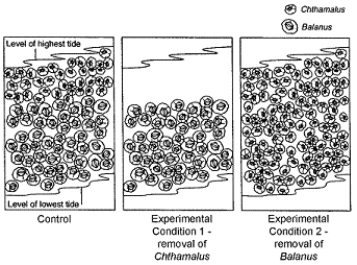 -In Experimental Condition 2 of Figure 54-1, the distribution of Chthamalus suggests:
 (Multiple Choice)
4.9/5 (86)
(86) An example of both chemical protection and coevolution is seen in:
(Multiple Choice)
4.9/5 (83)
(83) Which of the following organisms is a keystone species in a tropical rain forest?
(Multiple Choice)
4.8/5 (97)
(97) The __________ niche is the broadest role that an organism can potentially have in a community.
(Multiple Choice)
4.9/5 (75)
(75) If you were to study all of the insect-eating birds in a forest, you would see that many birds eat insects, yet you may not see any evidence of competition.What is the most probable explanation?
(Multiple Choice)
4.9/5 (87)
(87) MATCHING
a.restricts ecological niche species
d.finding common patterns and processes within the community
b.local environment in which a species lives
e.biological community and its abiotic environment
c.species' ecological role within the structure and function of a community
-habitat
(Essay)
4.7/5 (75)
(75) In a lake, a certain native species of zooplankton is found evenly distributed in the water column.After introduction of a different species of zooplankton, the native species is only found in the shallow water zone.This is most likely an illustration of:
(Multiple Choice)
4.7/5 (81)
(81) Cryptic coloration advertises a species unpalatability to potential predators.
____________________
(True/False)
4.8/5 (80)
(80) The potential ecological niche of a species is its realized niche.
____________________
(True/False)
5.0/5 (89)
(89) Describe the factors that affect species richness.Describe the parameters that would probably result in an environment with the greatest possible species richness.Knowing what you do about the tropical rain forests, do they meet these expected parameters?
(Essay)
4.8/5 (85)
(85) A frog that lacks chemical defenses, yet resembles a poison arrow frog, would exhibit:
(Multiple Choice)
4.9/5 (91)
(91) 
Filters
- Essay(0)
- Multiple Choice(0)
- Short Answer(0)
- True False(0)
- Matching(0)