



 Chat with AI
Exam 54: Community Ecology

Exam 1: A View of Life88 Questions
Exam 2: Atoms and Molecules: the Chemical Basis of Life85 Questions
Exam 3: The Chemistry of Life: Organic Compounds95 Questions
Exam 4: Organization of the Cell68 Questions
Exam 5: Biological Membranes77 Questions
Exam 6: Cell Communication73 Questions
Exam 7: Energy and Metabolism76 Questions
Exam 8: How Cells Make Atp: Energy-Releasing Pathways90 Questions
Exam 9: Photosynthesis: Capturing Light Energy80 Questions
Exam 10: Chromosomes, Mitosis, and Meiosis91 Questions
Exam 11: The Basic Principles of Heredity75 Questions
Exam 12: Dna: the Carrier of Genetic Information80 Questions
Exam 13: Gene Expression76 Questions
Exam 14: Gene Regulation77 Questions
Exam 15: Dna Technology and Genomics79 Questions
Exam 16: Human Genetics and the Human Genome78 Questions
Exam 17: Developmental Genetics79 Questions
Exam 18: Introduction to Darwinian Evolution70 Questions
Exam 19: Evolutionary Change in Populations79 Questions
Exam 20: Speciation and Macroevolution91 Questions
Exam 21: The Origin and Evolutionary History of Life89 Questions
Exam 22: The Evolution of Primates87 Questions
Exam 23: Understanding Diversity: Systematics79 Questions
Exam 24: Viruses and Subviral Agents41 Questions
Exam 25: Bacteria and Archaea55 Questions
Exam 26: Protists92 Questions
Exam 27: Seedless Plants80 Questions
Exam 28: Seed Plants78 Questions
Exam 29: The Fungi87 Questions
Exam 30: An Introduction to Animal Diversity79 Questions
Exam 31: Sponges, Cnidarians, Ctenophores, and Protostomes146 Questions
Exam 32: The Deuterostomes90 Questions
Exam 33: Plant Structure, Growth, and Development86 Questions
Exam 34: Leaf Structure and Function76 Questions
Exam 35: Stem Structure and Transport74 Questions
Exam 36: Roots and Mineral Nutrition84 Questions
Exam 37: Reproduction in Flowering Plants89 Questions
Exam 38: Plant Developmental Responses to External and Internal Signals95 Questions
Exam 39: Animal Structure and Function: an Introduction96 Questions
Exam 40: Protection, Support, and Movement101 Questions
Exam 41: Neural Signaling87 Questions
Exam 42: Neural Regulation88 Questions
Exam 43: Sensory Systems111 Questions
Exam 44: Internal Transport104 Questions
Exam 45: The Immune System: Internal Defense85 Questions
Exam 46: Gas Exchange109 Questions
Exam 47: Processing Food and Nutrition119 Questions
Exam 48: Osmoregulation and Disposal of Metabolic Wastes94 Questions
Exam 49: Endocrine Regulation82 Questions
Exam 50: Reproduction104 Questions
Exam 51: Animal Development98 Questions
Exam 52: Animal Behavior77 Questions
Exam 53: Introduction to Ecology: Population Ecology97 Questions
Exam 54: Community Ecology74 Questions
Exam 55: Ecosystems and the Biosphere88 Questions
Exam 56: Ecology and the Geography of Life105 Questions
Exam 57: Biological Diversity and Conservation Biology66 Questions
Select questions type


The associated figure provides support for which of the following processes? 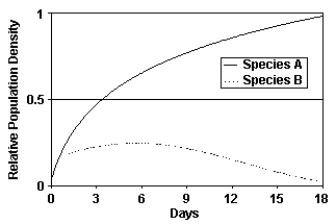
(Multiple Choice)
4.8/5  (73)
(73) Explain Gleason's individualistic model describing community structure.
(Essay)
4.7/5 (78)
(78) Which is not a property that is characteristic of a community?
(Multiple Choice)
4.9/5 (73)
(73) An organism's ecological role within the structure and function of a particular community is its:
(Multiple Choice)
4.8/5 (71)
(71) Explain the ecological significance of limiting resources, using three specific examples in your discussion.
(Essay)
4.8/5 (80)
(80) In a parasitic relationship where the host contracts a disease and sometimes dies, the parasite is called:
(Multiple Choice)
4.8/5 (88)
(88) Since the realized niche and the fundamental niche are not typically the same, this illustrates that:
(Multiple Choice)
4.8/5 (79)
(79) During __________ between predator and prey species, the predatory species becomes more efficient at catching prey, while the prey species becomes better at escaping predators.
(Multiple Choice)
5.0/5 (76)
(76) The association of nitrogen fixing bacteria of the genus Rhizobium with legumes such as peas is an example of mutualism.
____________________
(True/False)
4.9/5 (82)
(82) MATCHING
a.restricts ecological niche species
d.finding common patterns and processes within the community
b.local environment in which a species lives
e.biological community and its abiotic environment
c.species' ecological role within the structure and function of a community
-community ecology
(Essay)
4.8/5 (85)
(85) Nicotine synthesis is an adaptation of plant chemical defense against insects.
____________________
(True/False)
4.8/5 (79)
(79) Most likely, which of the following would not be an example of a limiting resource?
(Multiple Choice)
4.9/5 (80)
(80) A community consists of __________ species in a given area.
(Multiple Choice)
4.7/5 (81)
(81) The species richness of high-latitude communities is __________ compared with that of low-latitude communities.
(Multiple Choice)
4.8/5 (85)
(85) Destructive outbreaks of pests are __________ in cultivated fields, which are low-diversity communities, than in natural communities with greater species richness.
(Multiple Choice)
4.8/5 (71)
(71) Humans have small mites that live in hair follicles and oil glands around the nose and eyelashes.What would you need to know to classify them as exhibiting mutualism, commensalisms, or parasitism?
(Essay)
4.8/5 (79)
(79) 
Filters
- Essay(0)
- Multiple Choice(0)
- Short Answer(0)
- True False(0)
- Matching(0)