



 Chat with AI
Exam 54: Community Ecology

Exam 1: A View of Life88 Questions
Exam 2: Atoms and Molecules: the Chemical Basis of Life85 Questions
Exam 3: The Chemistry of Life: Organic Compounds95 Questions
Exam 4: Organization of the Cell68 Questions
Exam 5: Biological Membranes77 Questions
Exam 6: Cell Communication73 Questions
Exam 7: Energy and Metabolism76 Questions
Exam 8: How Cells Make Atp: Energy-Releasing Pathways90 Questions
Exam 9: Photosynthesis: Capturing Light Energy80 Questions
Exam 10: Chromosomes, Mitosis, and Meiosis91 Questions
Exam 11: The Basic Principles of Heredity75 Questions
Exam 12: Dna: the Carrier of Genetic Information80 Questions
Exam 13: Gene Expression76 Questions
Exam 14: Gene Regulation77 Questions
Exam 15: Dna Technology and Genomics79 Questions
Exam 16: Human Genetics and the Human Genome78 Questions
Exam 17: Developmental Genetics79 Questions
Exam 18: Introduction to Darwinian Evolution70 Questions
Exam 19: Evolutionary Change in Populations79 Questions
Exam 20: Speciation and Macroevolution91 Questions
Exam 21: The Origin and Evolutionary History of Life89 Questions
Exam 22: The Evolution of Primates87 Questions
Exam 23: Understanding Diversity: Systematics79 Questions
Exam 24: Viruses and Subviral Agents41 Questions
Exam 25: Bacteria and Archaea55 Questions
Exam 26: Protists92 Questions
Exam 27: Seedless Plants80 Questions
Exam 28: Seed Plants78 Questions
Exam 29: The Fungi87 Questions
Exam 30: An Introduction to Animal Diversity79 Questions
Exam 31: Sponges, Cnidarians, Ctenophores, and Protostomes146 Questions
Exam 32: The Deuterostomes90 Questions
Exam 33: Plant Structure, Growth, and Development86 Questions
Exam 34: Leaf Structure and Function76 Questions
Exam 35: Stem Structure and Transport74 Questions
Exam 36: Roots and Mineral Nutrition84 Questions
Exam 37: Reproduction in Flowering Plants89 Questions
Exam 38: Plant Developmental Responses to External and Internal Signals95 Questions
Exam 39: Animal Structure and Function: an Introduction96 Questions
Exam 40: Protection, Support, and Movement101 Questions
Exam 41: Neural Signaling87 Questions
Exam 42: Neural Regulation88 Questions
Exam 43: Sensory Systems111 Questions
Exam 44: Internal Transport104 Questions
Exam 45: The Immune System: Internal Defense85 Questions
Exam 46: Gas Exchange109 Questions
Exam 47: Processing Food and Nutrition119 Questions
Exam 48: Osmoregulation and Disposal of Metabolic Wastes94 Questions
Exam 49: Endocrine Regulation82 Questions
Exam 50: Reproduction104 Questions
Exam 51: Animal Development98 Questions
Exam 52: Animal Behavior77 Questions
Exam 53: Introduction to Ecology: Population Ecology97 Questions
Exam 54: Community Ecology74 Questions
Exam 55: Ecosystems and the Biosphere88 Questions
Exam 56: Ecology and the Geography of Life105 Questions
Exam 57: Biological Diversity and Conservation Biology66 Questions
Select questions type


Discuss coevolution as it relates to predator-prey interactions.Include a brief discussion of two specific examples.
(Essay)
4.7/5  (73)
(73) Many poisonous snakes share warning colors of red, yellow, and black.This is an example of:
(Multiple Choice)
5.0/5 (80)
(80) Which habitat would be expected to have the greatest species richness?
(Multiple Choice)
4.8/5 (78)
(78) Large-scale experiments conducted in oak forests of the northeastern United States linked bumper acorn crops to booming mouse populations.The conclusion from these experiments is that:
(Multiple Choice)
4.8/5 (76)
(76) Species richness is __________ when any one species enjoys a position of dominance.
(Multiple Choice)
4.8/5 (81)
(81) Competition between species 1 and species 2 is beneficial for species 1 and harmful for species 2.
____________________
(True/False)
5.0/5 (72)
(72) Adaptations that exert a strong competitive force on a predator are the result of coevolution.
____________________
(True/False)
4.9/5 (66)
(66) Traditionally, most ecologists have assumed that community stability is a consequence of:
(Multiple Choice)
4.9/5 (73)
(73) Ecologist James H.Brown of the University of New Mexico has addressed species composition and richness in experiments conducted since 1977 in the Chihuahuan desert of southeastern Arizona.In one experiment, the removal of three dominant species, all kangaroo rats, from several plots resulted in an increased diversity of other rodent species.This increase was ascribed both to lowered competition for food and also to an altered habitat, because the abundance of grass species __________ after the removal of the kangaroo rats.
(Multiple Choice)
4.9/5 (76)
(76) Resource partitioning may include all of the following except:
(Multiple Choice)
4.9/5 (67)
(67) The almost complete loss of the American chestnut tree to the chestnut blight fungus had __________ ecological impact on the moderately diverse Appalachian woodlands of which it was formerly a part.
(Multiple Choice)
5.0/5 (81)
(81) In ecosystems bottom up processes, predators affect the abundances of other populations in the ecological community.
____________________
(True/False)
4.8/5 (79)
(79) In which of the following habitat types would species diversity be expected to be relatively low?
(Multiple Choice)
4.8/5 (76)
(76) Figure 54-1
Use the figure to answer the corresponding question(s). 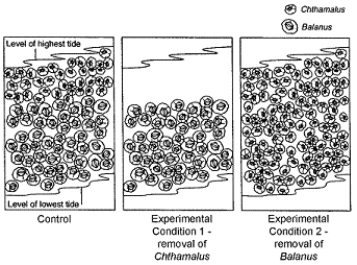 -In Experimental Condition 1 of Figure 54-1, the distribution of Balanus suggests:
 (Multiple Choice)
5.0/5 (88)
(88) MATCHING
a.restricts ecological niche species
d.finding common patterns and processes within the community
b.local environment in which a species lives
e.biological community and its abiotic environment
c.species' ecological role within the structure and function of a community
-ecological niche
(Essay)
4.9/5 (69)
(69) 
Filters
- Essay(0)
- Multiple Choice(0)
- Short Answer(0)
- True False(0)
- Matching(0)