



 Chat with AI
Exam 13: Structure Determination: Nuclear Magnetic Resonance Spectroscopy

Exam 1: Structure and Bonding29 Questions
Exam 2: Polar Covalent Bonds;acids and Bases50 Questions
Exam 3: Organic Compounds: Alkanes and Their Stereochemistry37 Questions
Exam 4: Organic Compounds: Cycloalkanes and Their Stereochemistry37 Questions
Exam 5: Stereochemistry at Tetrahedral Centers43 Questions
Exam 6: An Overview of Organic Reactions42 Questions
Exam 6: Par 12 Questions
Exam 7: Alkenes: Structure and Reactivity37 Questions
Exam 8: Alkenes: Reactions and Synthesis42 Questions
Exam 9: Alkynes: an Introduction to Organic Synthesis31 Questions
Exam 10: Organohalides31 Questions
Exam 11: Reactions of Alkyl Halides: Nucleophilic Substitutions and Eliminations34 Questions
Exam 11: Par 22 Questions
Exam 12: Structure Determination: Mass Spectrometry and Infrared Spectroscopy42 Questions
Exam 13: Structure Determination: Nuclear Magnetic Resonance Spectroscopy46 Questions
Exam 14: Conjugated Compounds and Ultraviolet Spectroscopy40 Questions
Exam 14: Par 32 Questions
Exam 15: Benzene and Aromaticity47 Questions
Exam 16: Chemistry of Benzene: Electrophilic Aromatic Substitution30 Questions
Exam 17: Alcohols and Phenols44 Questions
Exam 18: Ethers and Epoxides;thiols and Sulfides33 Questions
Exam 19: Aldehydes and Ketones: Nucleophilic Addition Reactions48 Questions
Exam 19: Par 42 Questions
Exam 20: Carboxylic Acids and Nitriles32 Questions
Exam 21: Carboxylic Acid Derivatives: Nucleophilic Acyl Substitution Reactions44 Questions
Exam 22: Carbonyl Alpha-Substitution Reactions33 Questions
Exam 23: Carbonyl Condensation Reactions36 Questions
Exam 23: Par 52 Questions
Exam 24: Amines and Heterocycles41 Questions
Exam 25: Biomolecules: Carbohydrates63 Questions
Exam 26: Biomolecules: Amino Acids,peptides,and Proteins45 Questions
Exam 27: Par 72 Questions
Exam 27: Biomolecules: Lipids54 Questions
Exam 28: Biomolecules: Nucleic Acids44 Questions
Exam 29: The Organic Chemistry of Metabolic Pathways48 Questions
Exam 30: Orbitals and Organic Chemistry: Pericyclic Reactions44 Questions
Exam 31: Synthetic Polymers33 Questions
Exam 30: Par 12 Questions
Select questions type


Exhibit 13-1
The following question(s) pertain to the charting of NMR spectra.MATCH a term to each description below.
-_____ The NMR charts are calibrated using an arbitrary scale that is divided into _____ units.
(Multiple Choice)
4.7/5  (69)
(69) Explain why all protons in a molecule do not absorb rf energy at the same frequency.
(Essay)
5.0/5 (88)
(88) Exhibit 13-11
Answer the question(s) for the compound whose 1H NMR spectra is shown below.
C5H12O  Spectrum obtained from: SDBSWeb: http://www.aist.go.jp/RIODB/SDBS/
-Refer to Exhibit 13-11.Propose a structure for this compound.
Spectrum obtained from: SDBSWeb: http://www.aist.go.jp/RIODB/SDBS/
-Refer to Exhibit 13-11.Propose a structure for this compound. (Essay)
4.9/5 (78)
(78) Exhibit 13-11
Answer the question(s) for the compound whose 1H NMR spectra is shown below.
C5H12O Spectrum obtained from: SDBSWeb: http://www.aist.go.jp/RIODB/SDBS/
-Refer to Exhibit 13-11.Describe each signal in the 1H NMR in terms of its integration,splitting and chemical shift.
Spectrum obtained from: SDBSWeb: http://www.aist.go.jp/RIODB/SDBS/
-Refer to Exhibit 13-11.Describe each signal in the 1H NMR in terms of its integration,splitting and chemical shift. (Essay)
4.9/5 (85)
(85) For a nucleus to exhibit the nuclear magnetic resonance phenomenon,it must be magnetic.Magnetic nuclei include:
(Multiple Choice)
4.8/5 (79)
(79) Propose a structure for an alkyl halide,C4H9Br,that has the following 13C NMR data:
Broadband decoupled 13C NMR: 18.3,38.6,60.2 δ
DEPT-90: 38.6 δ
DEPT-135: positive peak at 18.3,60.2 δ;negative peak at 38.6 δ
(Essay)
4.8/5 (83)
(83) Exhibit 13-12
Answer the question(s) for the compound whose 1H NMR spectra is shown below.
C8H7ClO  Spectrum obtained from: SDBSWeb: http://www.aist.go.jp/RIODB/SDBS/
-Refer to Exhibit 13-12.Describe the signal at 2.6 δ in terms of integration,splitting and chemical shift.
Spectrum obtained from: SDBSWeb: http://www.aist.go.jp/RIODB/SDBS/
-Refer to Exhibit 13-12.Describe the signal at 2.6 δ in terms of integration,splitting and chemical shift. (Essay)
5.0/5 (71)
(71) How would you use 1H and 13C NMR to help you distinguish between these two isomeric structures? 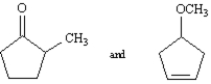
(Essay)
4.8/5 (66)
(66) 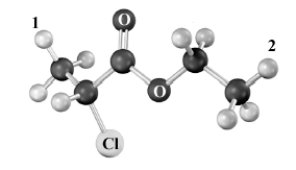
Exhibit 13-9
To answer the following question(s),consider the data and 1H NMR spectrum below:
The mass spectrum of this compound shows a molecular ion at m/z = 113,the IR spectrum has characteristic absorptions at 2270 and 1735 cm−1,and the 13C NMR spectrum has five signals.  Spectrum obtained from: SDBSWeb: http://www.aist.go.jp/RIODB/SDBS/
-Refer to Exhibit 13-9.Describe the signals at 4.35 δ and 1.3 δ in terms of their integration,splitting and chemical shift.
Spectrum obtained from: SDBSWeb: http://www.aist.go.jp/RIODB/SDBS/
-Refer to Exhibit 13-9.Describe the signals at 4.35 δ and 1.3 δ in terms of their integration,splitting and chemical shift. (Essay)
4.8/5 (80)
(80) Which structure of molecular formula C4H8Cl2 fits both the 1H NMR and 13C NMR spectra shown below?
(Multiple Choice)
4.7/5 (75)
(75) What would be the approximate positions at which you would expect 2-chloro-3-butyne to show 13C NMR absorptions? 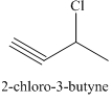
(Essay)
4.8/5 (74)
(74) The molecular formula of a certain compound is C4H9OBr.It has the following 1H NMR data: 1.30 δ (6H,singlet),3.94 δ (2H,doublet),and 2.51 δ (1H,triplet).Propose a structure for the compound using the information given.
(Essay)
4.7/5 (68)
(68) Exhibit 13-9
To answer the following question(s),consider the data and 1H NMR spectrum below:
The mass spectrum of this compound shows a molecular ion at m/z = 113,the IR spectrum has characteristic absorptions at 2270 and 1735 cm−1,and the 13C NMR spectrum has five signals. Spectrum obtained from: SDBSWeb: http://www.aist.go.jp/RIODB/SDBS/
-Refer to Exhibit 13-9.Based on the mass spectral data and the IR data,what functional groups are present in this compound?
Spectrum obtained from: SDBSWeb: http://www.aist.go.jp/RIODB/SDBS/
-Refer to Exhibit 13-9.Based on the mass spectral data and the IR data,what functional groups are present in this compound? (Essay)
4.8/5 (89)
(89) Describe how you could differentiate the following compounds using a DEPT NMR experiment. 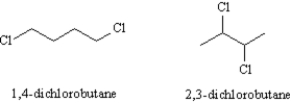
(Essay)
4.9/5 (83)
(83) Exhibit 13-9
To answer the following question(s),consider the data and 1H NMR spectrum below:
The mass spectrum of this compound shows a molecular ion at m/z = 113,the IR spectrum has characteristic absorptions at 2270 and 1735 cm−1,and the 13C NMR spectrum has five signals. Spectrum obtained from: SDBSWeb: http://www.aist.go.jp/RIODB/SDBS/
-Refer to Exhibit 13-9.Describe the signal at 3.5 δ in terms of its integration,splitting pattern and chemical shift.
Spectrum obtained from: SDBSWeb: http://www.aist.go.jp/RIODB/SDBS/
-Refer to Exhibit 13-9.Describe the signal at 3.5 δ in terms of its integration,splitting pattern and chemical shift. (Essay)
4.9/5 (83)
(83) How many signals would appear in the proton NMR for the following substance? Atoms other than carbon and hydrogen are labeled. 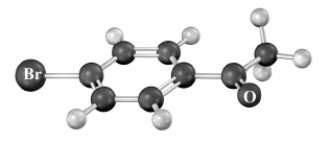
(Multiple Choice)
5.0/5 (93)
(93) Propose a structure for a compound,C6H14O,with the following 13C NMR spectral data:
Broadband decoupled 13C NMR:
23.0,68.4 δ
DEPT-90:
68.4 δ
DEPT-135:
positive peaks at 23.0,68.4 δ;no negative peaks
(Essay)
4.7/5 (87)
(87) Consider the following structure.Atoms other than carbon and hydrogen are labeled.The carbon atoms are designated by numbers. 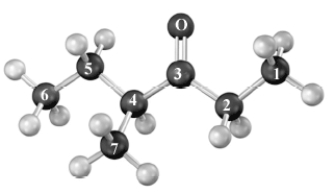 Which carbon atom(s) will produce a signal in a DEPT-90 spectrum?
 (Multiple Choice)
4.9/5 (73)
(73) Exhibit 13-1
The following question(s) pertain to the charting of NMR spectra.MATCH a term to each description below.
-_____ When looking at an NMR chart the right-hand part of the chart is the _____.
(Multiple Choice)
4.9/5 (81)
(81) 
Filters
- Essay(0)
- Multiple Choice(0)
- Short Answer(0)
- True False(0)
- Matching(0)