



 Chat with AI
Exam 15: Monopoly

Exam 1: Ten Principles of Economics439 Questions
Exam 2: Thinking Like an Economist617 Questions
Exam 3: Interdependence and the Gains From Trade527 Questions
Exam 4: The Market Forces of Supply and Demand698 Questions
Exam 5: Elasticity and Its Application595 Questions
Exam 6: Supply, Demand, and Government Policies644 Questions
Exam 7: Consumers, Producers, and the Efficiency of Markets549 Questions
Exam 8: Application: The Costs of Taxation511 Questions
Exam 9: Application: International Trade493 Questions
Exam 10: Externalities524 Questions
Exam 11: Public Goods and Common Resources433 Questions
Exam 12: The Design of the Tax System551 Questions
Exam 13: The Costs of Production420 Questions
Exam 14: Firms in Competitive Markets543 Questions
Exam 15: Monopoly637 Questions
Exam 16: Monopolistic Competition587 Questions
Exam 17: Oligopoly496 Questions
Exam 18: The Markets for the Factors of Production564 Questions
Exam 19: Earnings and Discrimination490 Questions
Exam 20: Income Inequality and Poverty457 Questions
Exam 21: The Theory of Consumer Choice440 Questions
Exam 22: Frontiers of Microeconomics441 Questions
Select questions type


If the distribution of water is a natural monopoly, then (i) imultiple firms would likely each have to pay large fixed costs to develop their own network of pipes.
(ii) allowing for competition among different firms in the water-distribution industry is efficient.
(iii) a single firm can serve the market at the lowest possible average total cost.
(Multiple Choice)
4.8/5  (85)
(85) Bob's Butcher Shop is the only place within 100 miles that sells bison burgers. Assuming that Bob is maximizing his profit, which of the following statements is true?
(Multiple Choice)
4.9/5 (83)
(83) Figure 15-3  -Refer to Figure 15-3. Which of the following statements is correct?
 (Multiple Choice)
4.8/5 (82)
(82) Figure 15-8  -Refer to Figure 15-8. What area represents the total surplus lost due to monopoly pricing?
 (Multiple Choice)
4.8/5 (80)
(80) Scenario 15-6
The concert promoters of a heavy-metal band, WeR2Loud, know that there are two types of concert-goers: die- hard fans and casual fans. For a particular WeR2Loud concert, there are 1,000 die-hard fans who will pay $150 for a ticket and 500 casual fans who will pay $50 for a ticket. There are 1,500 seats available at the concert venue. Suppose the cost of putting on the concert is $50,000, which includes the cost of the band, lighting, security, etc.
-Refer to Scenario 15-6. How much additional profit can the concert promoters earn by charging each customer their willingness to pay relative to charging a flat price of $50 per ticket?
(Multiple Choice)
4.9/5 (82)
(82) Consumers' willingness to pay for a good minus the amount they actually pay for it equals
(Multiple Choice)
4.9/5 (93)
(93) Table 15-19
A monopolist faces the following demand curve:
 -Refer to Table 15-19. If a monopolist faces a constant marginal cost of $9, how much output should the firm produce?
 (Multiple Choice)
4.8/5 (77)
(77) Which of the following would be most likely to have monopoly power?
(Multiple Choice)
4.8/5 (82)
(82) Figure 15-16 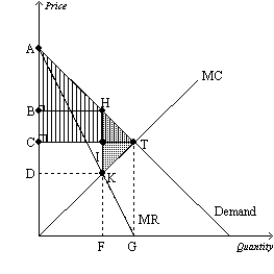 -Refer to Figure 15-16. Which triangle represents the monopoly deadweight loss?
 (Multiple Choice)
4.8/5 (78)
(78) Scenario 15-11
Vincent operates a scenic tour business in Boston. He has one bus which can fit 50 people per tour and each tour lasts 2 hours. His total cost of operating one tour is fixed at $450. Vincent's cost is not reduced if he runs a tour with a partially full bus. While his cost is the same for all tours, Vincent charges each passenger his/her willingness to pay: adults $18 per trip, children $10 per trip, and senior citizens $12 per trip. At those rates, on a typical day Vincent's demand is:
 Assume that Vincent's customers are always available for the tour; therefore, he can fill his bus for each tour as long as there is sufficient total demand for the day.
-Refer to Scenario 15-11. One of Vincent's friends tells him he would be more profitable if he charged a single price of $12. Assuming no changes in consumer demand, what would Vincent's profit be if he charged every customer $12?
Assume that Vincent's customers are always available for the tour; therefore, he can fill his bus for each tour as long as there is sufficient total demand for the day.
-Refer to Scenario 15-11. One of Vincent's friends tells him he would be more profitable if he charged a single price of $12. Assuming no changes in consumer demand, what would Vincent's profit be if he charged every customer $12? (Short Answer)
4.9/5 (77)
(77) What are the four ways that government policymakers can respond to the problem of monopoly?
(Essay)
4.8/5 (76)
(76) Scenario 15-11
Vincent operates a scenic tour business in Boston. He has one bus which can fit 50 people per tour and each tour lasts 2 hours. His total cost of operating one tour is fixed at $450. Vincent's cost is not reduced if he runs a tour with a partially full bus. While his cost is the same for all tours, Vincent charges each passenger his/her willingness to pay: adults $18 per trip, children $10 per trip, and senior citizens $12 per trip. At those rates, on a typical day Vincent's demand is:
Assume that Vincent's customers are always available for the tour; therefore, he can fill his bus for each tour as long as there is sufficient total demand for the day.
-Refer to Scenario 15-11. Vincent uses a pricing practice called
Assume that Vincent's customers are always available for the tour; therefore, he can fill his bus for each tour as long as there is sufficient total demand for the day.
-Refer to Scenario 15-11. Vincent uses a pricing practice called (Short Answer)
4.8/5 (70)
(70) Table 15-20
A monopolist faces the following demand curve:
 -Refer to Table 15-20. If a monopolist faces a constant marginal cost of $2, how much output should the firm produce in order to maximize profit?
 (Multiple Choice)
4.8/5 (84)
(84) Figure 15-6  -Refer to Figure 15-6. How much output will the monopolist produce?
 (Multiple Choice)
4.9/5 (74)
(74) The proper level of government intervention is unclear when dealing with a monopoly.
(True/False)
4.9/5 (85)
(85) Comparing firms in perfectly competitive markets to monopoly firms, which produces more output?
(Short Answer)
4.8/5 (78)
(78) If the monopolist's linear demand curve intersects the quantity axis at Q = 30, then the monopolist's marginal revenue will be equal to zero at
(Multiple Choice)
4.7/5 (90)
(90) 
Filters
- Essay(0)
- Multiple Choice(0)
- Short Answer(0)
- True False(0)
- Matching(0)