



 Chat with AI
Exam 15: Monopoly

Exam 1: Ten Principles of Economics439 Questions
Exam 2: Thinking Like an Economist617 Questions
Exam 3: Interdependence and the Gains From Trade527 Questions
Exam 4: The Market Forces of Supply and Demand698 Questions
Exam 5: Elasticity and Its Application595 Questions
Exam 6: Supply, Demand, and Government Policies644 Questions
Exam 7: Consumers, Producers, and the Efficiency of Markets549 Questions
Exam 8: Application: The Costs of Taxation511 Questions
Exam 9: Application: International Trade493 Questions
Exam 10: Externalities524 Questions
Exam 11: Public Goods and Common Resources433 Questions
Exam 12: The Design of the Tax System551 Questions
Exam 13: The Costs of Production420 Questions
Exam 14: Firms in Competitive Markets543 Questions
Exam 15: Monopoly637 Questions
Exam 16: Monopolistic Competition587 Questions
Exam 17: Oligopoly496 Questions
Exam 18: The Markets for the Factors of Production564 Questions
Exam 19: Earnings and Discrimination490 Questions
Exam 20: Income Inequality and Poverty457 Questions
Exam 21: The Theory of Consumer Choice440 Questions
Exam 22: Frontiers of Microeconomics441 Questions
Select questions type


Figure 15-18  -Refer to Figure 15-18. If the monopoly firm perfectly price discriminates, then the deadweight loss amounts to
 (Multiple Choice)
4.8/5  (77)
(77) Table 15-14
The following table gives information on the price, quantity, and total cost of production for a monopolist.
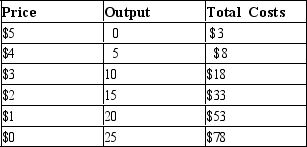 -Refer to Table 15-14. At what price does marginal revenue equal marginal cost?
 (Multiple Choice)
4.7/5 (74)
(74) The three main sources of barriers to entry are monopoly resources, government regulation, and the firm's production process.
(True/False)
4.8/5 (78)
(78) Competitive firms differ from monopolies in which of the following ways? (i) Competitive firms do not have to worry about the price effect lowering their total revenue.
(ii) Marginal revenue for a competitive firm equals price, while marginal revenue for a monopoly is less than the price it is able to charge.
(iii) Monopolies must lower their price in order to sell more of their product, while competitive firms do not.
(Multiple Choice)
4.9/5 (73)
(73) Table 15-1
 -Refer to Table 15-1. If the monopolist sells 8 units of its product, how much total revenue will it receive from the sale?
 (Multiple Choice)
4.9/5 (82)
(82) When a firm experiences continually declining average total costs, the firm is a
(Multiple Choice)
5.0/5 (85)
(85) Scenario 15-11
Vincent operates a scenic tour business in Boston. He has one bus which can fit 50 people per tour and each tour lasts 2 hours. His total cost of operating one tour is fixed at $450. Vincent's cost is not reduced if he runs a tour with a partially full bus. While his cost is the same for all tours, Vincent charges each passenger his/her willingness to pay: adults $18 per trip, children $10 per trip, and senior citizens $12 per trip. At those rates, on a typical day Vincent's demand is:
 Assume that Vincent's customers are always available for the tour; therefore, he can fill his bus for each tour as long as there is sufficient total demand for the day.
-Refer to Scenario 15-11. What is Vincent's profit on a typical day?
Assume that Vincent's customers are always available for the tour; therefore, he can fill his bus for each tour as long as there is sufficient total demand for the day.
-Refer to Scenario 15-11. What is Vincent's profit on a typical day? (Short Answer)
4.7/5 (75)
(75) Which of the following statements comparing monopoly with competition is correct?
(Multiple Choice)
4.9/5 (74)
(74) The profit-maximization problem for a monopolist differs from that of a competitive firm in which of the following ways?
(Multiple Choice)
4.9/5 (86)
(86) Monopolists can achieve any level of profit they desire because they have unlimited market power.
(True/False)
4.9/5 (92)
(92) Why might economists prefer private ownership of monopolies over public ownership of monopolies?
(Essay)
4.8/5 (73)
(73) For a monopolist, when does marginal revenue exceed average revenue?
(Multiple Choice)
4.7/5 (84)
(84) Which of the following would be most likely to have monopoly power?
(Multiple Choice)
4.8/5 (90)
(90) Suppose when a monopolist produces 75 units its average revenue is $10 per unit, its marginal revenue is $5 per unit, its marginal cost is $6 per unit, and its average total cost is $5 per unit. What can we conclude about this monopolist?
(Multiple Choice)
4.9/5 (88)
(88) The George Stigler quote, "...the degree of 'market failure' for the American economy is much smaller than the 'political failure' arising from the imperfections of economic policies ..." illustrates the advantage of which type of public policy toward monopolies?
(Multiple Choice)
4.9/5 (87)
(87) Suppose most people regard emeralds, rubies, and sapphires as close substitutes for diamonds. Then DeBeers, a large diamond company, has
(Multiple Choice)
4.8/5 (88)
(88) Table 15-12
The following table provides information on the price, quantity, and average total cost for a monopoly.
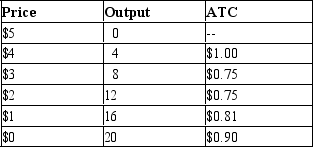 -Refer to Table 15-12. In order to maximize profits, the firm should produce
 (Multiple Choice)
4.8/5 (83)
(83) 
Filters
- Essay(0)
- Multiple Choice(0)
- Short Answer(0)
- True False(0)
- Matching(0)