



 Chat with AI
Exam 15: Monopoly

Exam 1: Ten Principles of Economics439 Questions
Exam 2: Thinking Like an Economist617 Questions
Exam 3: Interdependence and the Gains From Trade527 Questions
Exam 4: The Market Forces of Supply and Demand698 Questions
Exam 5: Elasticity and Its Application595 Questions
Exam 6: Supply, Demand, and Government Policies644 Questions
Exam 7: Consumers, Producers, and the Efficiency of Markets549 Questions
Exam 8: Application: The Costs of Taxation511 Questions
Exam 9: Application: International Trade493 Questions
Exam 10: Externalities524 Questions
Exam 11: Public Goods and Common Resources433 Questions
Exam 12: The Design of the Tax System551 Questions
Exam 13: The Costs of Production420 Questions
Exam 14: Firms in Competitive Markets543 Questions
Exam 15: Monopoly637 Questions
Exam 16: Monopolistic Competition587 Questions
Exam 17: Oligopoly496 Questions
Exam 18: The Markets for the Factors of Production564 Questions
Exam 19: Earnings and Discrimination490 Questions
Exam 20: Income Inequality and Poverty457 Questions
Exam 21: The Theory of Consumer Choice440 Questions
Exam 22: Frontiers of Microeconomics441 Questions
Select questions type


Figure 15-18  -Refer to Figure 15-18. If there are no fixed costs of production, monopoly profit without price discrimination equals
 (Multiple Choice)
4.8/5  (84)
(84) When deciding what price to charge consumers, the monopolist may choose to charge them different prices based on the customers'
(Multiple Choice)
4.9/5 (91)
(91) Allowing an inventor to have the exclusive rights to market her new invention will lead to (i) a product that is priced higher than it would be without the exclusive rights.
(ii) desirable behavior in the sense that inventors are encouraged to invent.
(iii) higher profits for the inventor.
(Multiple Choice)
4.8/5 (79)
(79) For a monopoly, the level of output at which marginal revenue equals zero is also the level of output at which
(Multiple Choice)
4.9/5 (84)
(84) A profit-maximizing monopolist charges a price of $14. The intersection of the marginal revenue curve and the marginal cost curve occurs where output is 15 units and marginal cost is $7. What is the monopolist's profit?
(Multiple Choice)
4.9/5 (69)
(69) Table 15-3
Consider the following demand and cost information for a monopoly.
 -Refer to Table 15-3. The marginal cost of the 4th unit is
 (Multiple Choice)
4.9/5 (82)
(82) What are the three main sources of barriers to entry for monopolies?
(Essay)
4.8/5 (66)
(66) Which of the following can eliminate the inefficiency inherent in monopoly pricing?
(Multiple Choice)
4.8/5 (81)
(81) Scenario 15-10
Vincent operates a scenic tour business in Boston. He has one bus which can fit 50 people per tour and each tour lasts 2 hours. His total cost of operating one tour is fixed at $450. Vincent's cost is not reduced if he runs a tour with a partially full bus. While his cost is the same for all tours, Vincent charges each passenger his/her willingness to pay: adults $18 per trip, children $10 per trip, and senior citizens $12 per trip. At those rates, on a typical day Vincent's demand is:
 Assume that Vincent's customers are always available for the tour; therefore, he can fill his bus for each tour as long as there is sufficient total demand for the day.
-Refer to Scenario 15-10. Vincent is considering changing his pricing strategy. Which of the following options results in the highest profit per day?
Assume that Vincent's customers are always available for the tour; therefore, he can fill his bus for each tour as long as there is sufficient total demand for the day.
-Refer to Scenario 15-10. Vincent is considering changing his pricing strategy. Which of the following options results in the highest profit per day? (Multiple Choice)
4.9/5 (80)
(80) One example of price discrimination occurs in the publishing industry when a publisher initially releases an expensive hardcover edition of a popular novel and later releases a cheaper paperback edition. Use this example to demonstrate the benefits and potential pitfalls of a price discrimination pricing strategy.
(Essay)
4.8/5 (88)
(88) Figure 15-18
-Refer to Figure 15-18. If the monopoly firm perfectly price discriminates, then consumer surplus amounts to
-Refer to Figure 15-18. If the monopoly firm perfectly price discriminates, then consumer surplus amounts to (Multiple Choice)
4.8/5 (81)
(81) Table 15-13
The following table gives information on the price, quantity, and total cost of production for a monopolist.
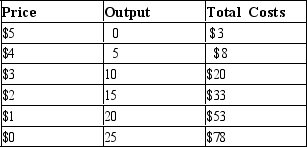 -Refer to Table 15-13. If the monopolist maximizes profits, he will charge a price of
 (Multiple Choice)
5.0/5 (76)
(76) Price discrimination explains why Ivy League universities often base tuition costs on students'
(Multiple Choice)
4.8/5 (94)
(94) Table 15-1
 -Refer to Table 15-1. Assume this monopolist's marginal cost is constant at $12. What quantity of output (Q) will it produce and what price (P) will it charge?
 (Multiple Choice)
4.7/5 (74)
(74) Figure 15-19  -Refer to Figure 15-19. If the monopoly firm is not allowed to price discriminate, then the deadweight loss amounts to
 (Multiple Choice)
4.8/5 (74)
(74) Price discrimination is a rational strategy for a profit-maximizing monopolist when
(Multiple Choice)
4.8/5 (69)
(69) Table 15-7
Sally owns the only shoe store in town. She has the following cost and revenue information.
 -Refer to Table 15-7. What is the total revenue from selling 6 pairs of shoes?
 (Multiple Choice)
4.8/5 (83)
(83) Scenario 15-5
An airline knows that there are two types of travelers: business travelers and vacationers. For a particular flight, there are 100 business travelers who will pay $600 for a ticket while there are 50 vacationers who will pay $300 for a ticket. There are 150 seats available on the plane. Suppose the cost to the airline of providing the flight is $20,000, which includes the cost of the pilots, flight attendants, fuel, etc.
-Refer to Scenario 15-5. How much profit will the airline earn if it sets the price of each ticket at $600?
(Multiple Choice)
4.9/5 (86)
(86) 
Filters
- Essay(0)
- Multiple Choice(0)
- Short Answer(0)
- True False(0)
- Matching(0)