



 Chat with AI
Exam 15: Monopoly

Exam 1: Ten Principles of Economics439 Questions
Exam 2: Thinking Like an Economist617 Questions
Exam 3: Interdependence and the Gains From Trade527 Questions
Exam 4: The Market Forces of Supply and Demand698 Questions
Exam 5: Elasticity and Its Application595 Questions
Exam 6: Supply, Demand, and Government Policies644 Questions
Exam 7: Consumers, Producers, and the Efficiency of Markets549 Questions
Exam 8: Application: The Costs of Taxation511 Questions
Exam 9: Application: International Trade493 Questions
Exam 10: Externalities524 Questions
Exam 11: Public Goods and Common Resources433 Questions
Exam 12: The Design of the Tax System551 Questions
Exam 13: The Costs of Production420 Questions
Exam 14: Firms in Competitive Markets543 Questions
Exam 15: Monopoly637 Questions
Exam 16: Monopolistic Competition587 Questions
Exam 17: Oligopoly496 Questions
Exam 18: The Markets for the Factors of Production564 Questions
Exam 19: Earnings and Discrimination490 Questions
Exam 20: Income Inequality and Poverty457 Questions
Exam 21: The Theory of Consumer Choice440 Questions
Exam 22: Frontiers of Microeconomics441 Questions
Select questions type


Suppose a monopolist charges a price of $27 for its product and sells 10 units at that price. At 10 units of production the firm has average fixed cost equal to $10 and average variable cost equal to $12. How much total profit is the firm earning at this price?
(Multiple Choice)
5.0/5  (81)
(81) A movie theater can increase its profits through price discrimination by charging a higher price to adults and a lower price to children if
(Multiple Choice)
4.9/5 (70)
(70) Figure 15-5  -Refer to Figure 15-5. At the profit-maximizing level of output,
 (Multiple Choice)
5.0/5 (72)
(72) Table 15-4
A monopolist faces the following demand curve:
 -Refer to Table 15-4. If the monopolist produces 10 units, what is its average revenue?
 (Multiple Choice)
4.8/5 (74)
(74) Table 15-21
Tommy's Tie Company, a monopolist, has the following cost and revenue information. Assume that Tommy's is
able to engage in perfect price discrimination.
 -Refer to Table 15-21. If the monopolist can engage in perfect price discrimination, what is the marginal revenue from selling the 5th tie?
 (Multiple Choice)
4.7/5 (87)
(87) Figure 15-22  -Refer to Figure 15-22. If the monopolist uses perfect price discrimination, how much profit does the firm earn?
 (Short Answer)
4.8/5 (99)
(99) Scenario 15-9
Suppose executives at an art museum know that 100 adults are willing to pay $12 for admission to the museum on a weekday. Suppose the executives also know that 200 students are willing to pay $8 for admission on a weekday. The cost of operating the museum on a weekday is $2,000.
-Refer to Scenario 15-9. How much additional profit will the museum earn if it engages in price discrimination compared to charging each customer $8 for admission?
(Multiple Choice)
4.9/5 (75)
(75) Because a monopolist does not face competition from other firms, the outcome in a market with a monopoly
(Multiple Choice)
4.9/5 (85)
(85) Which of the following is not an example of a barrier to entry?
(Multiple Choice)
4.8/5 (61)
(61) For a monopoly, marginal revenue is often greater than the price it charges for its good.
(True/False)
4.9/5 (74)
(74) Figure 15-3 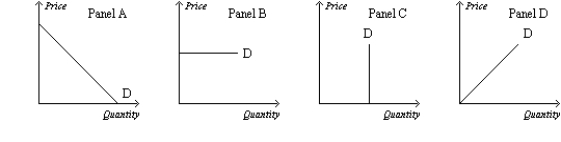 -Refer to Figure 15-3. Which panel could represent the demand curve facing the soybean industry?
 (Multiple Choice)
4.9/5 (84)
(84) Assume that a monopolist decides to maximize revenue rather than profit. How does this operating objective change the size of the deadweight loss? If you are a "benevolent" manager of a monopoly firm and are interested in reducing the deadweight loss of monopoly, should you maximize profits or maximize revenue? Explain your answer.
(Essay)
4.9/5 (69)
(69) Movie theatres charge different prices to different groups of people based on the differing marginal costs that exist from group to group.
(True/False)
4.9/5 (71)
(71) Because a monopolist must lower its price in order to sell another unit of output,
(Multiple Choice)
4.8/5 (94)
(94) If a monopolist's marginal costs increase by $1 for all levels of output, then the monopoly price will
(Multiple Choice)
4.9/5 (73)
(73) Figure 15-1 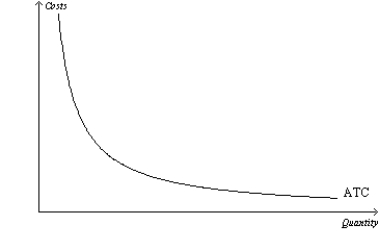 -Refer to Figure 15-1. The shape of the average total cost curve in the figure suggests an opportunity for a profit- maximizing monopolist to take advantage of
 (Multiple Choice)
4.8/5 (87)
(87) Figure 15-21  -Refer to Figure 15-21. Which of the following areas describes the profit of this natural monopolist under socially optimal pricing?
 (Multiple Choice)
4.9/5 (65)
(65) 
Filters
- Essay(0)
- Multiple Choice(0)
- Short Answer(0)
- True False(0)
- Matching(0)