



 Chat with AI
Exam 15: Monopoly

Exam 1: Ten Principles of Economics439 Questions
Exam 2: Thinking Like an Economist617 Questions
Exam 3: Interdependence and the Gains From Trade527 Questions
Exam 4: The Market Forces of Supply and Demand698 Questions
Exam 5: Elasticity and Its Application595 Questions
Exam 6: Supply, Demand, and Government Policies644 Questions
Exam 7: Consumers, Producers, and the Efficiency of Markets549 Questions
Exam 8: Application: The Costs of Taxation511 Questions
Exam 9: Application: International Trade493 Questions
Exam 10: Externalities524 Questions
Exam 11: Public Goods and Common Resources433 Questions
Exam 12: The Design of the Tax System551 Questions
Exam 13: The Costs of Production420 Questions
Exam 14: Firms in Competitive Markets543 Questions
Exam 15: Monopoly637 Questions
Exam 16: Monopolistic Competition587 Questions
Exam 17: Oligopoly496 Questions
Exam 18: The Markets for the Factors of Production564 Questions
Exam 19: Earnings and Discrimination490 Questions
Exam 20: Income Inequality and Poverty457 Questions
Exam 21: The Theory of Consumer Choice440 Questions
Exam 22: Frontiers of Microeconomics441 Questions
Select questions type


Table 15-1
 -Refer to Table 15-1. If the monopolist wants to maximize its revenue, how many units of its product should it sell?
 (Multiple Choice)
4.8/5  (73)
(73) Scenario 15-7
Black Box Cable TV is able to purchase an exclusive right to sell a premium movie channel (PMC) in its market area. Let's assume that Black Box Cable pays $150,000 a year for the exclusive marketing rights to PMC. Since Black Box has already installed cable to all of the homes in its market area, the marginal cost of delivering PMC to subscribers is zero. The manager of Black Box needs to know what price to charge for the PMC service to maximize her profit. Before setting price, she hires an economist to estimate demand for the PMC service. The economist discovers that there are two types of subscribers who value premium movie channels. First are the 4,000 die-hard TV viewers who will pay as much as $150 a year for the new PMC premium channel. Second, the PMC channel will appeal to 20,000 occasional TV viewers who will pay as much as $20 a year for a subscription to PMC.
-Refer to Scenario 15-7. What is the deadweight loss associated with the nondiscriminating pricing policy compared to the price discriminating policy?
(Multiple Choice)
4.8/5 (67)
(67) Which of the following statements is (are) true of a monopoly? (i) A monopoly has the ability to set the price of its product at whatever level it desires.
(ii) A monopoly's total revenue will always increase when it increases the price of its product.
(iii) The more a monopoly increases output, the higher the profits.
(Multiple Choice)
4.9/5 (79)
(79) Which of the following statements is correct for both a monopolist and a perfectly competitive firm? (i) The firm maximizes profits by equating marginal revenue with marginal cost.
(ii) The firm maximizes profits by equating price with marginal cost.
(iii) Demand equals marginal revenue.
(iv) Average revenue equals price.
(Multiple Choice)
4.8/5 (75)
(75) Compared to the monopoly outcome with a single price, imperfect price discrimination (i) sometimes raises total surplus.
(ii) sometimes lowers total surplus.
(iii) always leads to a lower quantity of output.
(Multiple Choice)
4.7/5 (76)
(76) The difference in total surplus between the socially efficient level of production and the monopolist's level of production is
(Multiple Choice)
4.7/5 (86)
(86) The socially efficient level of production occurs where the marginal cost curve intersects
(Multiple Choice)
4.9/5 (87)
(87) A monopolist that can practice perfect price discrimination will not impose a deadweight loss on society.
(True/False)
4.9/5 (63)
(63) Table 15-21
Tommy's Tie Company, a monopolist, has the following cost and revenue information. Assume that Tommy's is
able to engage in perfect price discrimination.
 -Refer to Table 15-21. If the monopolist can engage in perfect price discrimination, what is the average revenue when 7 ties are sold?
 (Multiple Choice)
5.0/5 (74)
(74) If the government regulates the price that a natural monopolist can charge to be equal to the firm's average total cost, the firm will
(Multiple Choice)
4.9/5 (75)
(75) Figure 15-23  -Refer to Figure 15-23. What type of monopoly is shown in the figure?
 (Short Answer)
4.8/5 (83)
(83) The economic inefficiency of a monopolist can be measured by the
(Multiple Choice)
4.9/5 (77)
(77) Table 15-12
The following table provides information on the price, quantity, and average total cost for a monopoly.
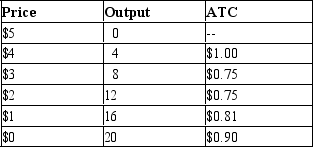 -Refer to Table 15-12. If the firm produces the profit-maximizing level of output, it will earn profits of
 (Multiple Choice)
4.8/5 (74)
(74) Scenario 15-8
Mega Media Cable TV is able to purchase an exclusive right to sell a premium sports channel in its market area. Let's assume that Mega Media pays $100,000 a year for the exclusive marketing rights to the sports channel. Since Mega Media has already installed cable to all of the homes in its market area, the marginal cost of delivering the sports channel to subscribers is zero. The manager of Mega Media needs to know what price to charge for the sports channel service to maximize her profit. Before setting price, she hires an economist to estimate demand for the sports channel. The economist discovers that there are two types of subscribers who value premium sporting channels. First are the 3,000 die-hard sports fans who will pay as much as $150 a year for the new channel. Second, the premium sports channel will appeal to 20,000 occasional sports viewers who will pay as much as $25 a year for a subscription to it.
-Refer to Scenario 15-8. If Mega Media Cable TV is unable to price discriminate, what price will it choose to maximize its profit, and what is the amount of the profit?
(Multiple Choice)
4.8/5 (100)
(100) Comparing firms in perfectly competitive markets to monopoly firms, which can earn economic profits in the long run?
(Short Answer)
4.9/5 (75)
(75) Which of the following is not a reason for the existence of a monopoly?
(Multiple Choice)
4.8/5 (80)
(80) Drug companies are allowed to be monopolists in the drugs they discover in order to
(Multiple Choice)
4.9/5 (68)
(68) Which of the following is not an example of price discrimination by a firm?
(Multiple Choice)
4.7/5 (90)
(90) 
Filters
- Essay(0)
- Multiple Choice(0)
- Short Answer(0)
- True False(0)
- Matching(0)