



 Chat with AI
Exam 15: Monopoly

Exam 1: Ten Principles of Economics439 Questions
Exam 2: Thinking Like an Economist617 Questions
Exam 3: Interdependence and the Gains From Trade527 Questions
Exam 4: The Market Forces of Supply and Demand698 Questions
Exam 5: Elasticity and Its Application595 Questions
Exam 6: Supply, Demand, and Government Policies644 Questions
Exam 7: Consumers, Producers, and the Efficiency of Markets549 Questions
Exam 8: Application: The Costs of Taxation511 Questions
Exam 9: Application: International Trade493 Questions
Exam 10: Externalities524 Questions
Exam 11: Public Goods and Common Resources433 Questions
Exam 12: The Design of the Tax System551 Questions
Exam 13: The Costs of Production420 Questions
Exam 14: Firms in Competitive Markets543 Questions
Exam 15: Monopoly637 Questions
Exam 16: Monopolistic Competition587 Questions
Exam 17: Oligopoly496 Questions
Exam 18: The Markets for the Factors of Production564 Questions
Exam 19: Earnings and Discrimination490 Questions
Exam 20: Income Inequality and Poverty457 Questions
Exam 21: The Theory of Consumer Choice440 Questions
Exam 22: Frontiers of Microeconomics441 Questions
Select questions type


One method used to control the ability of firms to capture monopoly profit in the United States is through
(Multiple Choice)
4.8/5  (87)
(87) Government intervention always reduces monopoly deadweight loss.
(True/False)
4.7/5 (72)
(72) The legislation passed by Congress in 1890 to reduce the market power of large and powerful "trusts" was the
(Multiple Choice)
4.8/5 (91)
(91) Table 15-3
Consider the following demand and cost information for a monopoly.
 -Refer to Table 15-3. To maximize profit, the monopolist sets price at
 (Multiple Choice)
4.8/5 (84)
(84) Figure 15-25  -Refer to Figure 15-25. If a regulator requires this firm to charge a socially optimal price, which letter represents the amount of output it will produce?
 (Short Answer)
4.8/5 (80)
(80) When a single firm can supply a product to an entire market at a lower cost than could two or more firms, the industry is called a
(Multiple Choice)
4.8/5 (75)
(75) A monopolist faces the following demand curve: 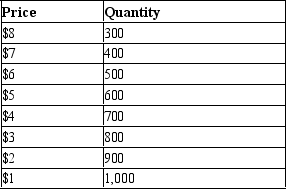 The monopolist has fixed costs of $1,000 and has a constant marginal cost of $2 per unit. If the monopolist were able to perfectly price discriminate, how many units would it sell?
 (Multiple Choice)
4.8/5 (88)
(88) Comparing firms in perfectly competitive markets to monopoly firms, which charges higher prices?
(Short Answer)
4.8/5 (93)
(93) Table 15-7
Sally owns the only shoe store in town. She has the following cost and revenue information.
 -Refer to Table 15-7. What is the marginal revenue from selling the 2nd pair of shoes?
 (Multiple Choice)
4.8/5 (62)
(62) Scenario 15-4
Suppose a monopolist has a demand curve that can be expressed as P=90-Q. The monopolist's marginal revenue curve can be expressed as MR=90-2Q. The monopolist has constant marginal costs and average total costs of $10.
-Refer to Scenario 15-4. The profit-maximizing monopolist will earn profits of
(Multiple Choice)
4.8/5 (88)
(88) Monopolies are inefficient because they (i) eliminate barriers to entry.
(ii) price their product at a level where marginal revenue exceeds marginal cost.
(iii) restrict output below the socially efficient level of production.
(Multiple Choice)
4.7/5 (80)
(80) Figure 15-18  -Refer to Figure 15-18. If there are no fixed costs of production, monopoly profit with perfect price discrimination equals
 (Multiple Choice)
4.9/5 (78)
(78) Scenario 15-5
An airline knows that there are two types of travelers: business travelers and vacationers. For a particular flight, there are 100 business travelers who will pay $600 for a ticket while there are 50 vacationers who will pay $300 for a ticket. There are 150 seats available on the plane. Suppose the cost to the airline of providing the flight is $20,000, which includes the cost of the pilots, flight attendants, fuel, etc.
-Refer to Scenario 15-5. How much profit will the airline earn if it engages in price discrimination?
(Multiple Choice)
4.9/5 (76)
(76) One problem with regulating a monopolist on the basis of cost is that
(Multiple Choice)
4.8/5 (75)
(75) Which of the following is an example of a barrier to entry? (i) A key resource is owned by a single firm.
(ii) The costs of production make a single producer more efficient than a large number of producers.
(iii) The government has given the existing monopolist the exclusive right to produce the good.
(Multiple Choice)
4.9/5 (68)
(68) For a monopolist, when the price effect is greater than the output effect, marginal revenue is
(Multiple Choice)
4.7/5 (68)
(68) 
Filters
- Essay(0)
- Multiple Choice(0)
- Short Answer(0)
- True False(0)
- Matching(0)