



 Chat with AI
Exam 15: Monopoly

Exam 1: Ten Principles of Economics439 Questions
Exam 2: Thinking Like an Economist617 Questions
Exam 3: Interdependence and the Gains From Trade527 Questions
Exam 4: The Market Forces of Supply and Demand698 Questions
Exam 5: Elasticity and Its Application595 Questions
Exam 6: Supply, Demand, and Government Policies644 Questions
Exam 7: Consumers, Producers, and the Efficiency of Markets549 Questions
Exam 8: Application: The Costs of Taxation511 Questions
Exam 9: Application: International Trade493 Questions
Exam 10: Externalities524 Questions
Exam 11: Public Goods and Common Resources433 Questions
Exam 12: The Design of the Tax System551 Questions
Exam 13: The Costs of Production420 Questions
Exam 14: Firms in Competitive Markets543 Questions
Exam 15: Monopoly637 Questions
Exam 16: Monopolistic Competition587 Questions
Exam 17: Oligopoly496 Questions
Exam 18: The Markets for the Factors of Production564 Questions
Exam 19: Earnings and Discrimination490 Questions
Exam 20: Income Inequality and Poverty457 Questions
Exam 21: The Theory of Consumer Choice440 Questions
Exam 22: Frontiers of Microeconomics441 Questions
Select questions type


When we compare economic welfare in a monopoly market to a competitive market, the profits earned by the monopolist represent
(Multiple Choice)
4.9/5  (77)
(77) A patent gives a single person or firm the exclusive right to sell some good or service forever.
(True/False)
4.8/5 (70)
(70) Figure 15-1  -Refer to Figure 15-1. Considering the relationship between average total cost and marginal cost, the marginal cost curve for this firm must
 (Multiple Choice)
4.7/5 (74)
(74) Scenario 15-11
Vincent operates a scenic tour business in Boston. He has one bus which can fit 50 people per tour and each tour lasts 2 hours. His total cost of operating one tour is fixed at $450. Vincent's cost is not reduced if he runs a tour with a partially full bus. While his cost is the same for all tours, Vincent charges each passenger his/her willingness to pay: adults $18 per trip, children $10 per trip, and senior citizens $12 per trip. At those rates, on a typical day Vincent's demand is:
 Assume that Vincent's customers are always available for the tour; therefore, he can fill his bus for each tour as long as there is sufficient total demand for the day.
-Refer to Scenario 15-11. What is Vincent's cost of serving all passengers demanding a tour on a typical day?
Assume that Vincent's customers are always available for the tour; therefore, he can fill his bus for each tour as long as there is sufficient total demand for the day.
-Refer to Scenario 15-11. What is Vincent's cost of serving all passengers demanding a tour on a typical day? (Short Answer)
4.8/5 (83)
(83) Table 15-2
Tanya has the following demand curve for selling taffy. Assume that Tanya has a marginal cost of $3 per unit.
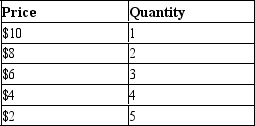 -Refer to Table 15-2. What is Tanya's profit-maximizing level of output?
 (Multiple Choice)
4.9/5 (82)
(82) The practice of selling the same goods to different customers at different prices, but with the same marginal cost, is known as
(Multiple Choice)
4.8/5 (86)
(86) Figure 15-23  -Refer to Figure 15-23. If a regulator requires the firm to charge a marginal cost price, what is the amount of profit or loss earned by the firm?
 (Short Answer)
4.8/5 (72)
(72) Scenario 15-3
A monopoly firm maximizes its profit by producing Q = 500 units of output. At that level of output, its marginal revenue is $30, its average revenue is $60, and its average total cost is $34.
-Refer to Scenario 15-3. At Q = 500, the firm's marginal cost is
(Multiple Choice)
4.9/5 (74)
(74) Which statement best describes the effect(s) that occur when a monopoly firm reduces the price of its product?
(Multiple Choice)
4.9/5 (90)
(90) Scenario 15-2
Consider a local, privately-owned electrical cooperative named Poweshiek Power Company (PPCo). PPCo has just completed a clean-coal-burning electrical power plant in Iowa. Currently, PPCo can meet the electricity needs of all residents in the county. In fact, its capacity far exceeds the needs of the county. After just a few years of operation, the shareholders of PPCo experienced incredibly high rates of return on their investment due to the profitability of the corporation.
-Refer to Scenario 15-2. PPCo will continue to be a monopolist in the electricity industry only if
(Multiple Choice)
4.7/5 (85)
(85) Scenario 15-10
Vincent operates a scenic tour business in Boston. He has one bus which can fit 50 people per tour and each tour lasts 2 hours. His total cost of operating one tour is fixed at $450. Vincent's cost is not reduced if he runs a tour with a partially full bus. While his cost is the same for all tours, Vincent charges each passenger his/her willingness to pay: adults $18 per trip, children $10 per trip, and senior citizens $12 per trip. At those rates, on a typical day Vincent's demand is:
 Assume that Vincent's customers are always available for the tour; therefore, he can fill his bus for each tour as long as there is sufficient total demand for the day.
-Refer to Scenario 15-10. What is Vincent's total revenue on a typical day?
Assume that Vincent's customers are always available for the tour; therefore, he can fill his bus for each tour as long as there is sufficient total demand for the day.
-Refer to Scenario 15-10. What is Vincent's total revenue on a typical day? (Multiple Choice)
4.9/5 (83)
(83) When a monopolist increases the amount of output that it produces and sells, average revenue
(Multiple Choice)
4.9/5 (82)
(82) Because monopoly firms do not have to compete with other firms, the outcome in a market with a monopoly
(Multiple Choice)
4.8/5 (75)
(75) Figure 15-18  -Refer to Figure 15-18. If the monopoly firm is not allowed to price discriminate, then consumer surplus amounts to
 (Multiple Choice)
4.8/5 (81)
(81) Table 15-19
A monopolist faces the following demand curve:
 -Refer to Table 15-19. If a monopolist faces a constant marginal cost of $5, how much output should the firm produce in order to equate marginal revenue with marginal cost?
 (Multiple Choice)
4.7/5 (81)
(81) What happens to the price and quantity sold of a drug when its patent runs out? (i) The price will fall.
(ii) The quantity sold will fall.
(iii) The marginal cost of producing the drug will rise.
(Multiple Choice)
4.9/5 (84)
(84) Table 15-17
A monopolist faces the following demand curve:
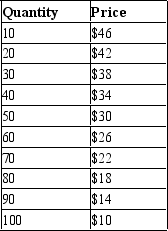 -Refer to Table 15-17. If the marginal cost of production is constant at $18 per unit, this profit-maximizing monopolist will choose to produce
 (Multiple Choice)
4.9/5 (97)
(97) Figure 15-25  -Refer to Figure 15-25. If this firm profit maximizes, which letter represents the price it will charge?
 (Multiple Choice)
4.9/5 (75)
(75) 
Filters
- Essay(0)
- Multiple Choice(0)
- Short Answer(0)
- True False(0)
- Matching(0)