



 Chat with AI
Exam 15: Monopoly

Exam 1: Ten Principles of Economics439 Questions
Exam 2: Thinking Like an Economist617 Questions
Exam 3: Interdependence and the Gains From Trade527 Questions
Exam 4: The Market Forces of Supply and Demand698 Questions
Exam 5: Elasticity and Its Application595 Questions
Exam 6: Supply, Demand, and Government Policies644 Questions
Exam 7: Consumers, Producers, and the Efficiency of Markets549 Questions
Exam 8: Application: The Costs of Taxation511 Questions
Exam 9: Application: International Trade493 Questions
Exam 10: Externalities524 Questions
Exam 11: Public Goods and Common Resources433 Questions
Exam 12: The Design of the Tax System551 Questions
Exam 13: The Costs of Production420 Questions
Exam 14: Firms in Competitive Markets543 Questions
Exam 15: Monopoly637 Questions
Exam 16: Monopolistic Competition587 Questions
Exam 17: Oligopoly496 Questions
Exam 18: The Markets for the Factors of Production564 Questions
Exam 19: Earnings and Discrimination490 Questions
Exam 20: Income Inequality and Poverty457 Questions
Exam 21: The Theory of Consumer Choice440 Questions
Exam 22: Frontiers of Microeconomics441 Questions
Select questions type


Which of the following is an example of public ownership of a monopoly?
(Multiple Choice)
4.9/5  (85)
(85) Table 15-22
 -Refer to Table 15-22. The average revenue of the 50th unit of output is
 (Short Answer)
4.7/5 (84)
(84) Figure 15-4  -Refer to Figure 15-4. The demand curve for a monopoly firm is depicted by curve
 (Multiple Choice)
4.9/5 (68)
(68) Suppose a profit-maximizing monopolist faces a constant marginal cost of $20, produces an output level of 100 units, and charges a price of $50. The socially efficient level of output is 200 units. Assume that the demand curve and marginal revenue curve are the typical downward-sloping straight lines. The monopoly deadweight loss equals $1,500.
(True/False)
4.7/5 (81)
(81) Suppose a monopolist chooses the price and production level that maximizes its profit. From that point, to increase society's economic welfare, output would need to be increased as long as
(Multiple Choice)
4.7/5 (83)
(83) Which of the following is not an example of a barrier to entry?
(Multiple Choice)
4.8/5 (72)
(72) A monopoly chooses to supply the market with a quantity of a product that is determined by the intersection of the
(Multiple Choice)
4.8/5 (93)
(93) Figure 15-5  -Refer to Figure 15-5. A profit-maximizing monopoly's profit is equal to
 (Multiple Choice)
4.8/5 (78)
(78) Scenario 15-1
Consider a transportation corporation named Reading's that has just completed the development of a new light rail system in Minneapolis. Currently, there are plenty of seats on the train, and it is never crowded. Its capacity far exceeds the needs of the city. After just a few years of operation, the shareholders of Reading's experienced incredibly high rates of return on their investment due to the profitability of the corporation.
-Refer to Scenario 15-1. Which of the following statements is most likely to be true? (i) New entrants to the market know they will have a smaller market share than Reading's
Currently has.
(ii) Reading's is most likely experiencing decreasing average total cost.
(iii) Reading's is a natural monopoly.
(Multiple Choice)
4.9/5 (73)
(73) A monopoly firm can sell 150 units of output for $10 per unit. Alternatively, it can sell 151 units of output for $9.90 per unit. The marginal revenue of the 151st unit of output is
(Multiple Choice)
4.7/5 (79)
(79) Scenario 15-4
Suppose a monopolist has a demand curve that can be expressed as P=90-Q. The monopolist's marginal revenue curve can be expressed as MR=90-2Q. The monopolist has constant marginal costs and average total costs of $10.
-Refer to Scenario 15-4. The profit-maximizing monopolist will produce an output level of
(Multiple Choice)
5.0/5 (79)
(79) A movie theater can increase its profits through price discrimination by charging a higher price to adults and a lower price to children if it
(Multiple Choice)
4.9/5 (78)
(78) Which of the following is not a difference between monopolies and perfectly competitive markets?
(Multiple Choice)
4.9/5 (80)
(80) The amount of power that a monopoly has depends on whether there are close substitutes for its product.
(True/False)
4.7/5 (80)
(80) Table 15-15
A monopolist faces the following demand curve:
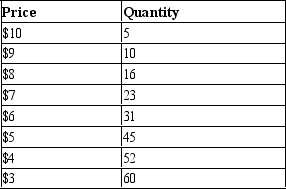 -Refer to Table 15-15. The monopolist has total fixed costs of $40 and a constant marginal cost of $5. At the profit-maximizing level of output, the monopolist's profit is
 (Multiple Choice)
4.8/5 (94)
(94) Table 15-3
Consider the following demand and cost information for a monopoly.
 -Refer to Table 15-3. The marginal revenue of the 2nd unit is
 (Multiple Choice)
4.8/5 (88)
(88) 
Filters
- Essay(0)
- Multiple Choice(0)
- Short Answer(0)
- True False(0)
- Matching(0)