



 Chat with AI
Exam 15: Monopoly

Exam 1: Ten Principles of Economics439 Questions
Exam 2: Thinking Like an Economist617 Questions
Exam 3: Interdependence and the Gains From Trade527 Questions
Exam 4: The Market Forces of Supply and Demand698 Questions
Exam 5: Elasticity and Its Application595 Questions
Exam 6: Supply, Demand, and Government Policies644 Questions
Exam 7: Consumers, Producers, and the Efficiency of Markets549 Questions
Exam 8: Application: The Costs of Taxation511 Questions
Exam 9: Application: International Trade493 Questions
Exam 10: Externalities524 Questions
Exam 11: Public Goods and Common Resources433 Questions
Exam 12: The Design of the Tax System551 Questions
Exam 13: The Costs of Production420 Questions
Exam 14: Firms in Competitive Markets543 Questions
Exam 15: Monopoly637 Questions
Exam 16: Monopolistic Competition587 Questions
Exam 17: Oligopoly496 Questions
Exam 18: The Markets for the Factors of Production564 Questions
Exam 19: Earnings and Discrimination490 Questions
Exam 20: Income Inequality and Poverty457 Questions
Exam 21: The Theory of Consumer Choice440 Questions
Exam 22: Frontiers of Microeconomics441 Questions
Select questions type


The economic inefficiency of a monopolist can be measured by the
(Multiple Choice)
4.9/5  (90)
(90) When a firm operates under conditions of monopoly, its price is
(Multiple Choice)
4.9/5 (63)
(63) Table 15-7
Sally owns the only shoe store in town. She has the following cost and revenue information.
 -Refer to Table 15-7. What is the marginal cost of the 6th pair of shoes?
 (Multiple Choice)
4.8/5 (78)
(78) A firm that is the sole seller of a product without close substitutes is
(Multiple Choice)
4.9/5 (84)
(84) Figure 15-20  -Refer to Figure 15-20. The deadweight loss caused by a profit-maximizing monopoly amounts to
 (Multiple Choice)
4.9/5 (63)
(63) Monopoly pricing prevents some mutually beneficial trades from taking place. These unrealized, mutually beneficial trades are
(Multiple Choice)
4.8/5 (77)
(77) Figure 15-5  -Refer to Figure 15-5. A profit-maximizing monopoly's total cost is equal to
 (Multiple Choice)
4.8/5 (91)
(91) Figure 15-17  -Refer to Figure 15-17. Which of the following areas represents the deadweight loss from this profit-maximizing monopolist?
 (Multiple Choice)
4.9/5 (78)
(78) Figure 15-1  -Refer to Figure 15-1. The shape of the average total cost curve reveals information about the nature of the barrier to entry that might exist in a monopoly market. Which of the following monopoly types best coincides with the figure?
 (Multiple Choice)
4.7/5 (81)
(81) The deadweight loss that arises from a monopoly is a consequence of the fact that the monopoly
(Multiple Choice)
4.9/5 (84)
(84) The marginal revenue curve for a monopoly firm starts at the same point on the vertical axis as the (i) average revenue curve.
(ii) marginal cost curve.
(iii) demand curve.
(Multiple Choice)
4.8/5 (81)
(81) Table 15-8
The following table provides information on the price, quantity, and average total cost for a monopoly.
 -Refer to Table 15-8. What is the maximum profit that the monopolist can earn?
 (Multiple Choice)
4.9/5 (79)
(79) To maximize total surplus with a monopoly firm, a benevolent social planner would choose the level of output where
(Multiple Choice)
4.9/5 (78)
(78) Figure 15-15 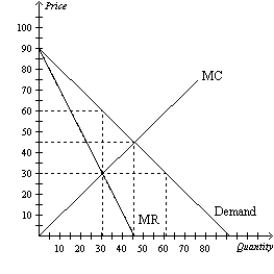 -Refer to Figure 15-15. To maximize its profit, a monopolist would choose which of the following outcomes?
 (Multiple Choice)
4.8/5 (83)
(83) Consider a profit-maximizing monopoly pricing under the following conditions. The profit-maximizing quantity is 40 units, the profit-maximizing price is $160, and the marginal cost of the 40th unit is $120. If the good were produced in a perfectly competitive market, the equilibrium quantity would be 50, and the equilibrium price would be $150. The demand curve and marginal cost curves are linear. What is the value of the deadweight loss created by the monopolist?
(Multiple Choice)
4.8/5 (80)
(80) Table 15-6
A monopolist faces the following demand curve:
 -Refer to Table 15-6. What is the marginal revenue from the sale of the 3rd unit?
 (Multiple Choice)
4.9/5 (82)
(82) Scenario 15-4
Suppose a monopolist has a demand curve that can be expressed as P=90-Q. The monopolist's marginal revenue curve can be expressed as MR=90-2Q. The monopolist has constant marginal costs and average total costs of $10.
-Refer to Scenario 15-4. The profit-maximizing monopolist will charge a price of
(Multiple Choice)
4.8/5 (88)
(88) Figure 15-7  -Refer to Figure 15-7. A profit-maximizing monopolist would earn total revenues of
 (Multiple Choice)
4.8/5 (77)
(77) 
Filters
- Essay(0)
- Multiple Choice(0)
- Short Answer(0)
- True False(0)
- Matching(0)