



 Chat with AI
Exam 15: Monopoly

Exam 1: Ten Principles of Economics439 Questions
Exam 2: Thinking Like an Economist617 Questions
Exam 3: Interdependence and the Gains From Trade527 Questions
Exam 4: The Market Forces of Supply and Demand698 Questions
Exam 5: Elasticity and Its Application595 Questions
Exam 6: Supply, Demand, and Government Policies644 Questions
Exam 7: Consumers, Producers, and the Efficiency of Markets549 Questions
Exam 8: Application: The Costs of Taxation511 Questions
Exam 9: Application: International Trade493 Questions
Exam 10: Externalities524 Questions
Exam 11: Public Goods and Common Resources433 Questions
Exam 12: The Design of the Tax System551 Questions
Exam 13: The Costs of Production420 Questions
Exam 14: Firms in Competitive Markets543 Questions
Exam 15: Monopoly637 Questions
Exam 16: Monopolistic Competition587 Questions
Exam 17: Oligopoly496 Questions
Exam 18: The Markets for the Factors of Production564 Questions
Exam 19: Earnings and Discrimination490 Questions
Exam 20: Income Inequality and Poverty457 Questions
Exam 21: The Theory of Consumer Choice440 Questions
Exam 22: Frontiers of Microeconomics441 Questions
Select questions type


Which of the following statements is true? (i) When a competitive firm sells an additional unit of output, its revenue increases by an amount less than the price.
(ii) When a monopoly firm sells an additional unit of output, its revenue increases by an amount less than the price.
(iii) Average revenue is the same as price for both competitive and monopoly firms.
(Multiple Choice)
4.8/5  (78)
(78) Figure 15-8  -Refer to Figure 15-8. What is the monopoly price and quantity?
 (Multiple Choice)
4.8/5 (68)
(68) Figure 15-12 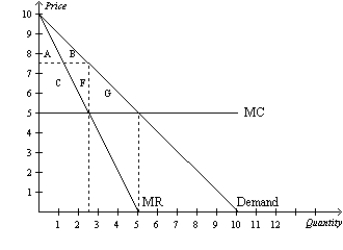 -Refer to Figure 15-12. Which area represents the deadweight loss from monopoly?
 (Multiple Choice)
4.9/5 (57)
(57) Comparing firms in perfectly competitive markets to monopoly firms, which charges a price equal to marginal cost?
(Short Answer)
4.8/5 (79)
(79) In a market characterized by monopoly, the market demand curve is
(Multiple Choice)
4.8/5 (80)
(80) When regulators use a marginal-cost pricing strategy to regulate a natural monopoly, the regulated monopoly
(Multiple Choice)
4.8/5 (85)
(85) Table 15-6
A monopolist faces the following demand curve:
 -Refer to Table 15-6. If the monopolist has a constant marginal cost for her product equal to $7, what is her profit- maximizing price?
 (Multiple Choice)
4.8/5 (75)
(75) For a monopoly firm, the shape and position of the demand curve play a role in determining the (i) profit-maximizing price.
(ii) shape and position of the marginal-cost curve.
(iii) shape and position of the marginal-revenue curve.
(Multiple Choice)
4.8/5 (70)
(70) Because a monopolist is the sole producer in its market, it can necessarily alter the price of its good (i) without affecting the quantity sold.
(ii) without affecting its average total cost.
(iii) by adjusting the quantity it supplies to the market.
(Multiple Choice)
4.8/5 (79)
(79) Government intervention is always preferable to doing nothing when reducing the social inefficiencies of monopoly.
(True/False)
4.8/5 (86)
(86) Figure 15-22  -Refer to Figure 15-22. If the monopolist uses perfect price discrimination, how much output does the firm produce?
 (Short Answer)
4.9/5 (73)
(73) Table 15-10
The monopolist faces the following demand curve:
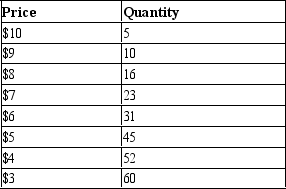 -Refer to Table 15-10. If the monopolist has total fixed costs of $40 and a constant marginal cost of $5, how much profit can the firm earn at the profit-maximizing level of output?
 (Multiple Choice)
4.8/5 (92)
(92) Price discrimination adds to social welfare in the form of (i) increased total surplus.
(ii) reduced costs of production.
(iii) increased consumer surplus.
(Multiple Choice)
4.8/5 (88)
(88) Figure 15-24  -Refer to Figure 15-24. Use the letters in the figure to identify the profit area if this firm were able to perfectly price discriminate.
 (Short Answer)
4.9/5 (89)
(89) 
Filters
- Essay(0)
- Multiple Choice(0)
- Short Answer(0)
- True False(0)
- Matching(0)