



 Chat with AI
Exam 15: Monopoly

Exam 1: Ten Principles of Economics439 Questions
Exam 2: Thinking Like an Economist617 Questions
Exam 3: Interdependence and the Gains From Trade527 Questions
Exam 4: The Market Forces of Supply and Demand698 Questions
Exam 5: Elasticity and Its Application595 Questions
Exam 6: Supply, Demand, and Government Policies644 Questions
Exam 7: Consumers, Producers, and the Efficiency of Markets549 Questions
Exam 8: Application: The Costs of Taxation511 Questions
Exam 9: Application: International Trade493 Questions
Exam 10: Externalities524 Questions
Exam 11: Public Goods and Common Resources433 Questions
Exam 12: The Design of the Tax System551 Questions
Exam 13: The Costs of Production420 Questions
Exam 14: Firms in Competitive Markets543 Questions
Exam 15: Monopoly637 Questions
Exam 16: Monopolistic Competition587 Questions
Exam 17: Oligopoly496 Questions
Exam 18: The Markets for the Factors of Production564 Questions
Exam 19: Earnings and Discrimination490 Questions
Exam 20: Income Inequality and Poverty457 Questions
Exam 21: The Theory of Consumer Choice440 Questions
Exam 22: Frontiers of Microeconomics441 Questions
Select questions type


Figure 15-6  -Refer to Figure 15-6. What area measures the monopolist's profit?
 (Multiple Choice)
4.9/5  (83)
(83) Figure 15-14 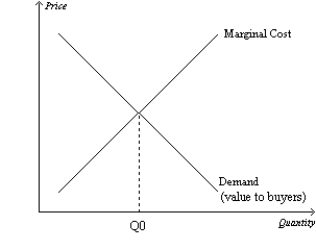 -Refer to Figure 15-14. If the monopoly operates at an output level less than Q0, then an increase in output toward (but not exceeding) Q0 would
 (Multiple Choice)
4.8/5 (80)
(80) Describe how government is involved in creating a monopoly. Why might the government create one? Give an example.
(Essay)
4.8/5 (89)
(89) In the market for "home heating" consumers typically have several options (e.g., electricity, heating fuel, natural gas, propane, etc.), yet we often think of firms in this industry as behaving like monopolists. Discuss the context in which your electricity provider is a monopolist. Is this characterization universally applicable? Explain your answer.
(Essay)
4.9/5 (76)
(76) Authors are allowed to be monopolists in the sale of their books in order to
(Multiple Choice)
4.8/5 (90)
(90) When a certain monopoly sets its price at $8 it sells 64 units. When the monopoly sets its price at $10 it sells 60 units. The marginal revenue for the firm over this range is
(Multiple Choice)
4.9/5 (95)
(95) If the government regulates the price a natural monopolist can charge to be equal to the firm's marginal cost, the government will likely need to subsidize the firm.
(True/False)
5.0/5 (91)
(91) A monopolist maximizes profit by producing an output level where marginal cost equals price.
(True/False)
4.9/5 (75)
(75) Scenario 15-9
Suppose executives at an art museum know that 100 adults are willing to pay $12 for admission to the museum on a weekday. Suppose the executives also know that 200 students are willing to pay $8 for admission on a weekday. The cost of operating the museum on a weekday is $2,000.
-Refer to Scenario 15-9. How much profit will the museum earn if it charges all customers $12 for admission?
(Multiple Choice)
4.7/5 (72)
(72) Figure 15-7  -Refer to Figure 15-7. A profit-maximizing monopolist would earn profits of
 (Multiple Choice)
5.0/5 (89)
(89) Which of the following strategies is not an effective strategy to reduce monopoly inefficiency?
(Multiple Choice)
5.0/5 (76)
(76) Figure 15-17  -Refer to Figure 15-17. Which of the following statements best describes the changes that would occur if this firm were to switch from operating as a single price profit-maximizing monopolist to perfect price discrimination?
 (Multiple Choice)
4.9/5 (88)
(88) An industry is a natural monopoly when (i) the government assists the firm in maintaining the monopoly.
(ii) a single firm owns a key resource.
(iii) a single firm can supply a good or service to an entire market at a smaller cost than could two or more firms.
(Multiple Choice)
4.8/5 (82)
(82) Figure 15-24  -Refer to Figure 15-24. Use the letters in the figure to identify the area of deadweight loss for the single price monopolist.
 (Short Answer)
4.9/5 (80)
(80) If a monopolist can sell 7 units when the price is $4 and 8 units when the price is $3, then the marginal revenue of selling the eighth unit is equal to
(Multiple Choice)
4.9/5 (79)
(79) Figure 15-4  -Refer to Figure 15-4. The marginal cost curve for a monopoly firm is depicted by curve
 (Multiple Choice)
4.9/5 (79)
(79) 
Filters
- Essay(0)
- Multiple Choice(0)
- Short Answer(0)
- True False(0)
- Matching(0)