



 Chat with AI
Exam 15: Monopoly

Exam 1: Ten Principles of Economics439 Questions
Exam 2: Thinking Like an Economist617 Questions
Exam 3: Interdependence and the Gains From Trade527 Questions
Exam 4: The Market Forces of Supply and Demand698 Questions
Exam 5: Elasticity and Its Application595 Questions
Exam 6: Supply, Demand, and Government Policies644 Questions
Exam 7: Consumers, Producers, and the Efficiency of Markets549 Questions
Exam 8: Application: The Costs of Taxation511 Questions
Exam 9: Application: International Trade493 Questions
Exam 10: Externalities524 Questions
Exam 11: Public Goods and Common Resources433 Questions
Exam 12: The Design of the Tax System551 Questions
Exam 13: The Costs of Production420 Questions
Exam 14: Firms in Competitive Markets543 Questions
Exam 15: Monopoly637 Questions
Exam 16: Monopolistic Competition587 Questions
Exam 17: Oligopoly496 Questions
Exam 18: The Markets for the Factors of Production564 Questions
Exam 19: Earnings and Discrimination490 Questions
Exam 20: Income Inequality and Poverty457 Questions
Exam 21: The Theory of Consumer Choice440 Questions
Exam 22: Frontiers of Microeconomics441 Questions
Select questions type


The collection of statutes aimed at curbing monopoly power is called
(Multiple Choice)
4.8/5  (75)
(75) The De Beers Diamond company advertises heavily to promote the sale of all diamonds, not just its own. This is evidence that it has a monopoly position to some degree.
(True/False)
4.8/5 (89)
(89) In order for antitrust laws to raise social welfare, the government must
(Multiple Choice)
4.8/5 (83)
(83) Figure 15-4 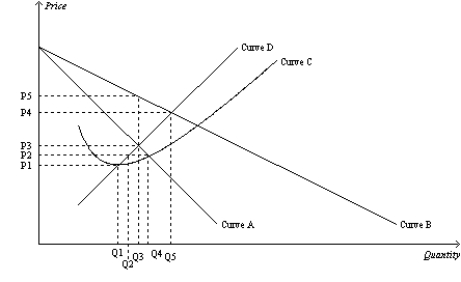 -Refer to Figure 15-4. If the monopoly firm is currently producing Q4 units of output, then a decrease in output will necessarily cause profit to
 (Multiple Choice)
4.9/5 (78)
(78) At the profit-maximizing quantity of output for a monopolist, average revenue, marginal revenue, and price are all equal.
(True/False)
4.8/5 (81)
(81) Table 15-4
A monopolist faces the following demand curve:
 -Refer to Table 15-4. If the monopolist produces 5 units, what is its marginal revenue?
 (Multiple Choice)
4.9/5 (76)
(76) If the government regulates the price a natural monopolist can charge to be equal to the firm's average total cost, the firm has no incentive to reduce costs.
(True/False)
5.0/5 (91)
(91) Figure 15-3 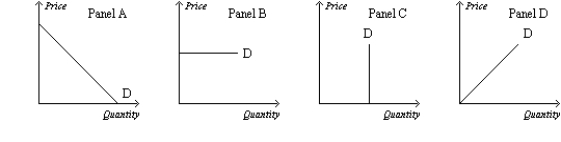 -Refer to Figure 15-3. Which panel could represent the demand curve facing a local cable television provider if that firm in a monopolist?
 (Multiple Choice)
5.0/5 (88)
(88) Suppose that a professional photographer takes a prize-winning digital photo. She can sell a 5"x7" color print of the photo for $10. She can also sell the digital file for $20. There are 500 people willing to buy the color print and 2,000 people willing to buy the digital file. Assume the costs to the photographer are zero and that the people who purchase the digital file cannot resell the file itself or any prints made from it. What should she do in order to maximize her profits?
(Multiple Choice)
4.8/5 (69)
(69) A monopoly creates a deadweight loss to society because it produces less output than the socially efficient level.
(True/False)
4.9/5 (80)
(80) The legislation passed by Congress in 1914 to strengthen the government's powers and authorize private lawsuits was the
(Multiple Choice)
4.9/5 (81)
(81) By offering lower prices to customers who buy a large quantity, a monopoly is price discriminating.
(True/False)
4.7/5 (72)
(72) When a local grocery store offers discount coupons in the Sunday paper it is most likely trying to
(Multiple Choice)
4.9/5 (75)
(75) Because natural monopolies have a declining average cost curve, regulating natural monopolies by setting price equal to marginal cost would
(Multiple Choice)
4.8/5 (89)
(89) Figure 15-5  -Refer to Figure 15-5. Profit on a typical unit sold for a profit-maximizing monopoly would equal
 (Multiple Choice)
4.9/5 (90)
(90) When a single firm can supply a good or service to an entire market at a lower cost than could two or more firms, the industry is known as a
(Short Answer)
4.9/5 (82)
(82) 
Filters
- Essay(0)
- Multiple Choice(0)
- Short Answer(0)
- True False(0)
- Matching(0)