



 Chat with AI
Exam 15: Monopoly

Exam 1: Ten Principles of Economics439 Questions
Exam 2: Thinking Like an Economist617 Questions
Exam 3: Interdependence and the Gains From Trade527 Questions
Exam 4: The Market Forces of Supply and Demand698 Questions
Exam 5: Elasticity and Its Application595 Questions
Exam 6: Supply, Demand, and Government Policies644 Questions
Exam 7: Consumers, Producers, and the Efficiency of Markets549 Questions
Exam 8: Application: The Costs of Taxation511 Questions
Exam 9: Application: International Trade493 Questions
Exam 10: Externalities524 Questions
Exam 11: Public Goods and Common Resources433 Questions
Exam 12: The Design of the Tax System551 Questions
Exam 13: The Costs of Production420 Questions
Exam 14: Firms in Competitive Markets543 Questions
Exam 15: Monopoly637 Questions
Exam 16: Monopolistic Competition587 Questions
Exam 17: Oligopoly496 Questions
Exam 18: The Markets for the Factors of Production564 Questions
Exam 19: Earnings and Discrimination490 Questions
Exam 20: Income Inequality and Poverty457 Questions
Exam 21: The Theory of Consumer Choice440 Questions
Exam 22: Frontiers of Microeconomics441 Questions
Select questions type


Like competitive firms, monopolies choose to produce a quantity in which marginal revenue equals marginal cost.
(True/False)
4.8/5  (75)
(75) Which of the following is a characteristic of a natural monopoly?
(Multiple Choice)
4.8/5 (89)
(89) The output effect describes the situation when a monopolist sells more output and, all else equal, total revenue
(Multiple Choice)
4.8/5 (80)
(80) When a monopolist reduces the quantity of output it produces and sells, the
(Multiple Choice)
4.8/5 (79)
(79) The DeBeers Company faces very little competition from other firms in the wholesale diamond market. Why isn't the price of the wholesale diamonds $10,000 per carat?
(Multiple Choice)
4.8/5 (75)
(75) The process of buying a good in one market at a low price and selling the good in another market for a higher price in order to profit from the price difference is known as
(Multiple Choice)
4.8/5 (96)
(96) Scenario 15-5
An airline knows that there are two types of travelers: business travelers and vacationers. For a particular flight, there are 100 business travelers who will pay $600 for a ticket while there are 50 vacationers who will pay $300 for a ticket. There are 150 seats available on the plane. Suppose the cost to the airline of providing the flight is $20,000, which includes the cost of the pilots, flight attendants, fuel, etc.
-Refer to Scenario 15-5. How much profit will the airline earn if it sets the price of each ticket at $300?
(Multiple Choice)
4.9/5 (86)
(86) Table 15-5
A monopolist faces the following demand curve:
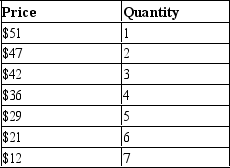 -Refer to Table 15-5. The monopolist has total fixed costs of $60 and has a constant marginal cost of $15. What is the profit-maximizing price?
 (Multiple Choice)
4.9/5 (78)
(78) Table 15-19
A monopolist faces the following demand curve:
 -Refer to Table 15-19. If a monopolist faces a constant marginal cost of $7, how much output should the firm produce?
 (Multiple Choice)
4.8/5 (73)
(73) Table 15-22
 -Refer to Table 15-22. The marginal revenue, when the quantity changes from 30 to 40 units, is
 (Short Answer)
4.7/5 (81)
(81) Scenario 15-5
An airline knows that there are two types of travelers: business travelers and vacationers. For a particular flight, there are 100 business travelers who will pay $600 for a ticket while there are 50 vacationers who will pay $300 for a ticket. There are 150 seats available on the plane. Suppose the cost to the airline of providing the flight is $20,000, which includes the cost of the pilots, flight attendants, fuel, etc.
-Refer to Scenario 15-5. How much additional profit can the airline earn by charging each customer their willingness to pay relative to charging a flat price of $300 per ticket?
(Multiple Choice)
4.8/5 (76)
(76) Antitrust laws give the Justice Department the authority to challenge potential mergers between companies in an effort to safeguard society from monopoly power.
(True/False)
4.9/5 (81)
(81) Table 15-17
A monopolist faces the following demand curve:
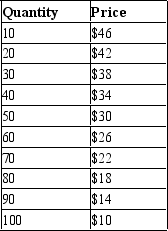 -Refer to Table 15-17. Which of the following statements best describes the relationship between the price and the marginal revenue associated with values in the table?
 (Multiple Choice)
4.9/5 (78)
(78) Table 15-11
The following table shows quantity, price, and marginal cost information for a monopoly:
 -Refer to Table 15-11. What would be the firm's marginal revenue at the profitmaximizing level of output?
 (Multiple Choice)
4.8/5 (70)
(70) 
Filters
- Essay(0)
- Multiple Choice(0)
- Short Answer(0)
- True False(0)
- Matching(0)