



 Chat with AI
Exam 15: Monopoly

Exam 1: Ten Principles of Economics439 Questions
Exam 2: Thinking Like an Economist617 Questions
Exam 3: Interdependence and the Gains From Trade527 Questions
Exam 4: The Market Forces of Supply and Demand698 Questions
Exam 5: Elasticity and Its Application595 Questions
Exam 6: Supply, Demand, and Government Policies644 Questions
Exam 7: Consumers, Producers, and the Efficiency of Markets549 Questions
Exam 8: Application: The Costs of Taxation511 Questions
Exam 9: Application: International Trade493 Questions
Exam 10: Externalities524 Questions
Exam 11: Public Goods and Common Resources433 Questions
Exam 12: The Design of the Tax System551 Questions
Exam 13: The Costs of Production420 Questions
Exam 14: Firms in Competitive Markets543 Questions
Exam 15: Monopoly637 Questions
Exam 16: Monopolistic Competition587 Questions
Exam 17: Oligopoly496 Questions
Exam 18: The Markets for the Factors of Production564 Questions
Exam 19: Earnings and Discrimination490 Questions
Exam 20: Income Inequality and Poverty457 Questions
Exam 21: The Theory of Consumer Choice440 Questions
Exam 22: Frontiers of Microeconomics441 Questions
Select questions type


Reduced competition through merging of companies will raise social welfare
(Multiple Choice)
4.8/5  (74)
(74) When a monopolist increases the number of units it sells, there are two effects on revenue. They are the
(Multiple Choice)
4.8/5 (89)
(89) What is the defining characteristic of a natural monopoly? Give an example of a natural monopoly.
(Essay)
4.9/5 (91)
(91) Table 15-21
Tommy's Tie Company, a monopolist, has the following cost and revenue information. Assume that Tommy's is
able to engage in perfect price discrimination.
 -Refer to Table 15-21. If the monopolist can engage in perfect price discrimination, what is the quantity that maximizes economic profit?
 (Multiple Choice)
4.8/5 (65)
(65) Scenario 15-7
Black Box Cable TV is able to purchase an exclusive right to sell a premium movie channel (PMC) in its market area. Let's assume that Black Box Cable pays $150,000 a year for the exclusive marketing rights to PMC. Since Black Box has already installed cable to all of the homes in its market area, the marginal cost of delivering PMC to subscribers is zero. The manager of Black Box needs to know what price to charge for the PMC service to maximize her profit. Before setting price, she hires an economist to estimate demand for the PMC service. The economist discovers that there are two types of subscribers who value premium movie channels. First are the 4,000 die-hard TV viewers who will pay as much as $150 a year for the new PMC premium channel. Second, the PMC channel will appeal to 20,000 occasional TV viewers who will pay as much as $20 a year for a subscription to PMC.
-Refer to Scenario 15-7. If Black Box Cable TV is able to price discriminate, what would be the maximum amount of profit it could generate?
(Multiple Choice)
4.9/5 (70)
(70) Figure 15-22  -Refer to Figure 15-22. If the monopolist uses perfect price discrimination, how much deadweight loss results?
 (Short Answer)
4.8/5 (86)
(86) Figure 15-17  -Refer to Figure 15-17. If this firm were able to perfectly price discriminate, which of the following areas would represent the profit to this perfectly discriminating monopolist?
 (Multiple Choice)
4.8/5 (85)
(85) Figure 15-18  -Refer to Figure 15-18. If the monopoly firm is not allowed to price discriminate, then the deadweight loss amounts to
 (Multiple Choice)
4.8/5 (85)
(85) If the government regulates the price that a natural monopolist can charge to be equal to the firm's marginal cost, the firm will
(Multiple Choice)
4.9/5 (79)
(79) Microsoft's governmentgranted exclusive right to make and sell the Windows operating system is called a
(Short Answer)
4.9/5 (76)
(76) Monopolies are socially inefficient because the price they charge is
(Multiple Choice)
4.8/5 (75)
(75) Figure 15-25 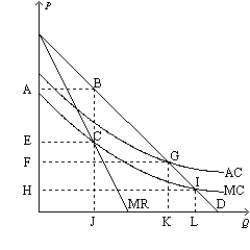 -Refer to Figure 15-25. If this firm profit maximizes, which letter represents the quantity it will produce?
 (Short Answer)
4.9/5 (89)
(89) Table 15-9
Consider the following demand and cost information for a monopoly.
 -Refer to Table 15-9. At the profit-maximizing price, how much profit will the monopoly earn?
 (Multiple Choice)
4.9/5 (79)
(79) Scenario 15-7
Black Box Cable TV is able to purchase an exclusive right to sell a premium movie channel (PMC) in its market area. Let's assume that Black Box Cable pays $150,000 a year for the exclusive marketing rights to PMC. Since Black Box has already installed cable to all of the homes in its market area, the marginal cost of delivering PMC to subscribers is zero. The manager of Black Box needs to know what price to charge for the PMC service to maximize her profit. Before setting price, she hires an economist to estimate demand for the PMC service. The economist discovers that there are two types of subscribers who value premium movie channels. First are the 4,000 die-hard TV viewers who will pay as much as $150 a year for the new PMC premium channel. Second, the PMC channel will appeal to 20,000 occasional TV viewers who will pay as much as $20 a year for a subscription to PMC.
-Refer to Scenario 15-7. If Black Box Cable TV is unable to price discriminate, what price will it choose to maximize its profit, and what is the amount of the profit?
(Multiple Choice)
4.8/5 (76)
(76) Due to the nature of the patent laws on pharmaceuticals, the market for such drugs
(Multiple Choice)
4.9/5 (84)
(84) Which of the following is not an example of a barrier to entry?
(Multiple Choice)
4.9/5 (72)
(72) 
Filters
- Essay(0)
- Multiple Choice(0)
- Short Answer(0)
- True False(0)
- Matching(0)