



 Chat with AI
Exam 15: Monopoly

Exam 1: Ten Principles of Economics439 Questions
Exam 2: Thinking Like an Economist617 Questions
Exam 3: Interdependence and the Gains From Trade527 Questions
Exam 4: The Market Forces of Supply and Demand698 Questions
Exam 5: Elasticity and Its Application595 Questions
Exam 6: Supply, Demand, and Government Policies644 Questions
Exam 7: Consumers, Producers, and the Efficiency of Markets549 Questions
Exam 8: Application: The Costs of Taxation511 Questions
Exam 9: Application: International Trade493 Questions
Exam 10: Externalities524 Questions
Exam 11: Public Goods and Common Resources433 Questions
Exam 12: The Design of the Tax System551 Questions
Exam 13: The Costs of Production420 Questions
Exam 14: Firms in Competitive Markets543 Questions
Exam 15: Monopoly637 Questions
Exam 16: Monopolistic Competition587 Questions
Exam 17: Oligopoly496 Questions
Exam 18: The Markets for the Factors of Production564 Questions
Exam 19: Earnings and Discrimination490 Questions
Exam 20: Income Inequality and Poverty457 Questions
Exam 21: The Theory of Consumer Choice440 Questions
Exam 22: Frontiers of Microeconomics441 Questions
Select questions type


Figure 15-7 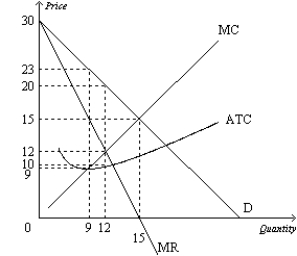 -Refer to Figure 15-7. In order to maximize profits, the monopolist should charge a price of
 (Multiple Choice)
4.8/5  (80)
(80) Figure 15-3 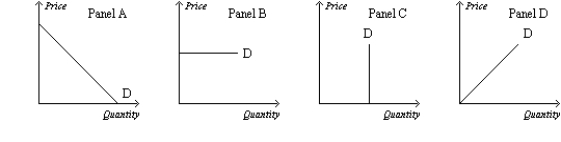 -Refer to Figure 15-3. Which of the following statements is correct?
 (Multiple Choice)
4.8/5 (81)
(81) Which of the following is an example of a barrier to entry?
(Multiple Choice)
4.9/5 (90)
(90) Suppose when a monopolist produces 50 units its average revenue is $8 per unit, its marginal revenue is $4 per unit, its marginal cost is $4 per unit, and its average total cost is $3 per unit. What can we conclude about this monopolist?
(Multiple Choice)
4.8/5 (89)
(89) During the holiday season, high-end retailers frequently place a high price on merchandise on weekends and discount the price during the week. They do this because they believe that two groups of customers exist: shoppers with little free time and bargain hunters. Bargain hunters have time to shop around and frequently shop during the week. What do economists call this price strategy used by high-end retailers?
(Multiple Choice)
4.9/5 (93)
(93) Table 15-6
A monopolist faces the following demand curve:
 -Refer to Table 15-6. Suppose the monopolist has total fixed costs equal to $5 and a variable cost equal to $4 per unit for all units produced. What would the total profit be if she charged $6 per unit for her product?
 (Multiple Choice)
4.7/5 (86)
(86) Scenario 15-8
Mega Media Cable TV is able to purchase an exclusive right to sell a premium sports channel in its market area. Let's assume that Mega Media pays $100,000 a year for the exclusive marketing rights to the sports channel. Since Mega Media has already installed cable to all of the homes in its market area, the marginal cost of delivering the sports channel to subscribers is zero. The manager of Mega Media needs to know what price to charge for the sports channel service to maximize her profit. Before setting price, she hires an economist to estimate demand for the sports channel. The economist discovers that there are two types of subscribers who value premium sporting channels. First are the 3,000 die-hard sports fans who will pay as much as $150 a year for the new channel. Second, the premium sports channel will appeal to 20,000 occasional sports viewers who will pay as much as $25 a year for a subscription to it.
-Refer to Scenario 15-8. How much profit will Mega Media Cable TV earn if it sets the price at $150?
(Multiple Choice)
4.9/5 (73)
(73) Which of the following is not an example of a barrier to entry?
(Multiple Choice)
4.9/5 (89)
(89) The price effect describes the situation when a monopolist lowers the price of output and, all else equal, total revenue
(Multiple Choice)
4.7/5 (79)
(79) Table 15-9
Consider the following demand and cost information for a monopoly.
 -Refer to Table 15-9. What is the monopolist's average total cost of production at the profitmaximizing price?
 (Multiple Choice)
4.9/5 (85)
(85) Consider a profit-maximizing monopoly pricing under the following conditions. The profit-maximizing price charged for goods produced is $12.The intersection of the marginal revenue and marginal cost curves occurs where output is 10 units and marginal cost is $6. The socially efficient level of production is 12 units. The demand curve and marginal cost curves are linear. What is the value of the deadweight loss created by the monopolist?
(Multiple Choice)
5.0/5 (88)
(88) Suppose a profit-maximizing monopolist faces a constant marginal cost of $10, produces an output level of 100 units, and charges a price of $50. The socially efficient level of output is 200 units. Assume that the demand curve and marginal revenue curve are the typical downward-sloping straight lines. The monopoly deadweight loss equals $2,000.
(True/False)
4.9/5 (83)
(83) In the majority of cases where there is a natural monopoly in the United States, the government usually deals with the problem
(Multiple Choice)
4.8/5 (80)
(80) Suppose ABC Aluminum Inc. owns 80% of the world's bauxite, a mineral used in the production of aluminum. Which of the following reasons describes the fundamental barrier to entry for the aluminum industry?
(Multiple Choice)
4.8/5 (80)
(80) Even with market power, monopolists cannot achieve any level of profit they desire because they will sell lower quantities at higher prices.
(True/False)
4.7/5 (72)
(72) Figure 15-4 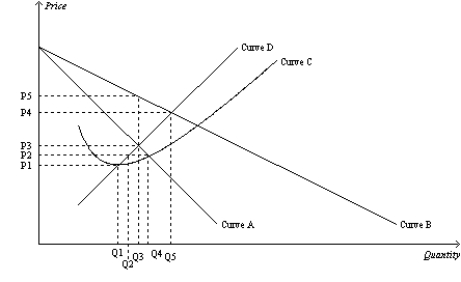 -Refer to Figure 15-4. If the monopoly firm wants to maximize its profit, it should operate at a level of output equal to
 (Multiple Choice)
4.8/5 (83)
(83) 
Filters
- Essay(0)
- Multiple Choice(0)
- Short Answer(0)
- True False(0)
- Matching(0)