



 Chat with AI
Exam 10: Thermal Relations

Exam 1: Animals and Environments: Function on the Ecological Stage66 Questions
Exam 2: Molecules and Cells in Animal Physiology65 Questions
Exam 3: Genomics, Proteomics, and Related Approaches to Physiology64 Questions
Exam 4: Physiological Development and Epigenetics59 Questions
Exam 5: Transport of Solutes and Water67 Questions
Exam 6: Nutrition, Feeding, and Digestion77 Questions
Exam 7: Energy Metabolism68 Questions
Exam 8: Aerobic and Anaerobic Forms of Metabolism75 Questions
Exam 9: The Energetics of Aerobic Activity72 Questions
Exam 10: Thermal Relations84 Questions
Exam 11: Food, Energy, and Temperature at Work: The Lives of Mammals in Frigid Places76 Questions
Exam 12: Neurons59 Questions
Exam 13: Synapses58 Questions
Exam 14: Sensory Processes67 Questions
Exam 15: Nervous System Organization and Biological Clocks59 Questions
Exam 16: Endocrine and Neuroendocrine Physiology69 Questions
Exam 17: Reproduction68 Questions
Exam 18: Integrating Systems at Work: Animal Navigation61 Questions
Exam 19: Control of Movement71 Questions
Exam 20: Muscle78 Questions
Exam 21: Movement and Muscle at Work: Plasticity in Response to Use and Disuse67 Questions
Exam 22: Introduction to Oxygen and Carbon Dioxide in Physiology65 Questions
Exam 23: External Respiration: the Physiology of Breathing70 Questions
Exam 24: Transport of Oxygen and Carbon Dioxide in Body Fluids With an Introduction to Acid- Base Physiology68 Questions
Exam 25: Circulation72 Questions
Exam 26: Oxygen, Carbon Dioxide, and Internal Transport at Work: Diving by Marine Mammals63 Questions
Exam 27: Water and Salt Physiology: Introduction and Mechanisms72 Questions
Exam 29: Kidneys and Excretion With Notes on Nitrogen Excretion89 Questions
Exam 30: Water, Salts, and Excretion at Work: Mammals of Deserts and Dry Savannas64 Questions
Exam 28: Water and Salt Physiology of Animals in Their Environments87 Questions
Select questions type


In 10°C ocean water, you would expect the tip of a killer whale's flipper to be about
(Multiple Choice)
4.9/5  (84)
(84) Which of the following is not one of the mechanisms by which animals exchange heat with their environment?
(Multiple Choice)
4.8/5 (74)
(74) At any given temperature, LDH-substrate affinity _______ across species of poikilotherms; at the temperatures at which these species typically live in nature, LDH-substrate affinity _______ across species.
(Multiple Choice)
4.9/5 (84)
(84) Refer to the figure shown. One species of homeotherm under two different environmental conditions was exposed to temperature changes.
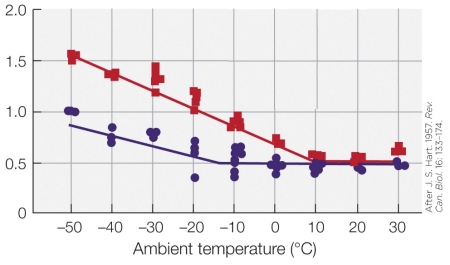 Which term best describes what was studied in this experiment?
 (Multiple Choice)
4.8/5 (81)
(81) A 20-kg metal block and a 100-kg metal block are both brought to room temperature, which is 25°C. Choose the correct statement.
(Multiple Choice)
4.8/5 (77)
(77) What happens to a homeotherm's resting metabolic rate when the temperature is outside its thermoneutral zone?
(Multiple Choice)
4.7/5 (92)
(92) Refer to the figure shown. Fish were housed under three different temperature conditions. Their response to acute and chronic temperature changes is plotted on the figure.
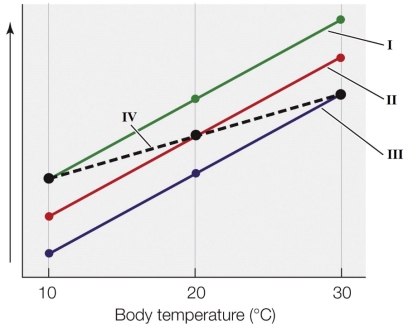 What is the property most likely to be plotted on the y axis?
 (Multiple Choice)
4.7/5 (80)
(80) You collect lizards from three populations, immediately measure each lizard's metabolic rate at 20°C and find that the rates differ among the lizards. Other than genetic differences among the populations, what factor could these differences be attributed to?
(Essay)
5.0/5 (73)
(73) On an overcast night, as opposed to a night with a clear sky, the thermal environment experienced by a desert rodent will be
(Multiple Choice)
4.7/5 (72)
(72) Some animals can survive freezing and others cannot. Which of the following is associated with the ability of animals to survive freezing?
(Multiple Choice)
4.9/5 (81)
(81) On hot days some dragonflies tip their abdomen and point it directly at the sun. From the perspective of heat exchange, what effect might this have and why?
(Essay)
4.7/5 (86)
(86) Behavioral thermoregulation depends on _______ of the thermal environment and preferential selection of _______ sites within the environment.
(Multiple Choice)
4.8/5 (93)
(93) Suppose that due to global climate change, the average minimum air temperature during January increased by 4°C. What would be the likely effect on the northern range limit for birds such as the eastern phoebe?
(Multiple Choice)
4.9/5 (77)
(77) Suppose you use inanimate lizard models to comprehensively and randomly sample the thermal environment of a lizard's habitat. You then compare that distribution of inanimate model temperatures with the distribution of actual body temperatures from lizards in that habitat. If the distributions differ, what does the discrepancy indicate?
(Short Answer)
4.9/5 (78)
(78) 
Filters
- Essay(0)
- Multiple Choice(0)
- Short Answer(0)
- True False(0)
- Matching(0)