



 Chat with AI
Exam 21: Movement and Muscle at Work: Plasticity in Response to Use and Disuse

Exam 1: Animals and Environments: Function on the Ecological Stage66 Questions
Exam 2: Molecules and Cells in Animal Physiology65 Questions
Exam 3: Genomics, Proteomics, and Related Approaches to Physiology64 Questions
Exam 4: Physiological Development and Epigenetics59 Questions
Exam 5: Transport of Solutes and Water67 Questions
Exam 6: Nutrition, Feeding, and Digestion77 Questions
Exam 7: Energy Metabolism68 Questions
Exam 8: Aerobic and Anaerobic Forms of Metabolism75 Questions
Exam 9: The Energetics of Aerobic Activity72 Questions
Exam 10: Thermal Relations84 Questions
Exam 11: Food, Energy, and Temperature at Work: The Lives of Mammals in Frigid Places76 Questions
Exam 12: Neurons59 Questions
Exam 13: Synapses58 Questions
Exam 14: Sensory Processes67 Questions
Exam 15: Nervous System Organization and Biological Clocks59 Questions
Exam 16: Endocrine and Neuroendocrine Physiology69 Questions
Exam 17: Reproduction68 Questions
Exam 18: Integrating Systems at Work: Animal Navigation61 Questions
Exam 19: Control of Movement71 Questions
Exam 20: Muscle78 Questions
Exam 21: Movement and Muscle at Work: Plasticity in Response to Use and Disuse67 Questions
Exam 22: Introduction to Oxygen and Carbon Dioxide in Physiology65 Questions
Exam 23: External Respiration: the Physiology of Breathing70 Questions
Exam 24: Transport of Oxygen and Carbon Dioxide in Body Fluids With an Introduction to Acid- Base Physiology68 Questions
Exam 25: Circulation72 Questions
Exam 26: Oxygen, Carbon Dioxide, and Internal Transport at Work: Diving by Marine Mammals63 Questions
Exam 27: Water and Salt Physiology: Introduction and Mechanisms72 Questions
Exam 29: Kidneys and Excretion With Notes on Nitrogen Excretion89 Questions
Exam 30: Water, Salts, and Excretion at Work: Mammals of Deserts and Dry Savannas64 Questions
Exam 28: Water and Salt Physiology of Animals in Their Environments87 Questions
Select questions type


Suppose you take a muscle biopsy from an elite athlete and perform a histological analysis on the sample. You find that the muscle cells are relatively small in diameter, contain high numbers of mitochondria, and have an unusually large proportion of Type IIa myosin. The athlete is most likely a

Free
(Multiple Choice)
4.8/5  (79)
(79) Correct Answer: Verified
D
There currently is great scientific interest in identifying genetic polymorphisms that underlie different individual responses to exercise training. The muscle size and bulk of a champion bodybuilder, for example, might be due in part to a missense mutation in the
Free
(Multiple Choice)
4.8/5 (77)
(77) Correct Answer:Verified
VerifiedC
Studies of bears indicate that their adaptations for a lifestyle that involves hibernation include
Free
(Multiple Choice)
4.9/5 (70)
(70) Correct Answer:Verified
VerifiedB
Resistance training increases muscle mass primarily by increasing the
(Multiple Choice)
4.8/5 (83)
(83) Resistance training of skeletal muscle would normally result in an increase in the
(Multiple Choice)
4.9/5 (65)
(65) Refer to the figure shown.
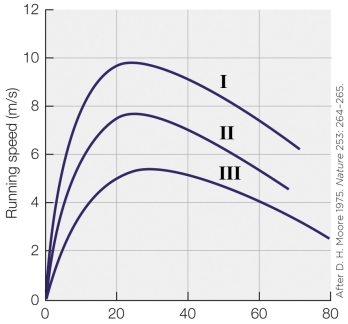 An elite distance runner would display a curve that is closest to
 (Multiple Choice)
4.7/5 (89)
(89) Describe the effects of exercise training on cardiac muscle and identify how they are similar to the effects of either endurance or resistance training on skeletal muscle.
(Essay)
4.9/5 (71)
(71) Describe the effects of wearing a cast for a broken foot on whole-muscle performance in a person's calf muscles.
(Essay)
4.9/5 (84)
(84) Endurance training produces the greatest percentage increase in expression of genes encoding
(Multiple Choice)
4.8/5 (88)
(88) To identify the cellular signals responsible for exercise effects in human muscle, scientists can examine
(Multiple Choice)
4.8/5 (90)
(90) Compare and contrast the effects of resistance and endurance exercise on skeletal muscle tissue. What changes in protein expression occur in each mode of training? How do the overall effects on the muscle cells and the whole muscle differ between the two modes?
(Essay)
4.9/5 (60)
(60) Fast glycolytic fibers can generate more power than slow oxidative fibers of similar diameter because they
(Multiple Choice)
4.8/5 (77)
(77) A training program that increased the proportion of slow oxidative fibers in a muscle would _______ the muscle's maximum _______.
(Multiple Choice)
4.8/5 (80)
(80) List two experimental techniques used to study muscle atrophy in animal or human models.
(Essay)
4.9/5 (68)
(68) Binding of IGF-1 (insulin-like growth factor-1) to its receptor on a skeletal muscle cell membrane leads to _______ protein synthesis and _______ protein degradation.
(Multiple Choice)
4.9/5 (78)
(78) Burmese pythons are a uniquely useful model for studies of cardiac hypertrophy because their heart(s)
(Multiple Choice)
4.9/5 (80)
(80) Bob has been sedentary for several years. As a New Year's resolution, he starts an intense exercise program, but after three months he stops exercising completely. What was the likely effect of the program on his heart mass while he was exercising, and what is the most likely outcome a year later?
(Multiple Choice)
4.8/5 (79)
(79) 
Filters
- Essay(0)
- Multiple Choice(0)
- Short Answer(0)
- True False(0)
- Matching(0)