



 Chat with AI
Exam 21: Movement and Muscle at Work: Plasticity in Response to Use and Disuse

Exam 1: Animals and Environments: Function on the Ecological Stage66 Questions
Exam 2: Molecules and Cells in Animal Physiology65 Questions
Exam 3: Genomics, Proteomics, and Related Approaches to Physiology64 Questions
Exam 4: Physiological Development and Epigenetics59 Questions
Exam 5: Transport of Solutes and Water67 Questions
Exam 6: Nutrition, Feeding, and Digestion77 Questions
Exam 7: Energy Metabolism68 Questions
Exam 8: Aerobic and Anaerobic Forms of Metabolism75 Questions
Exam 9: The Energetics of Aerobic Activity72 Questions
Exam 10: Thermal Relations84 Questions
Exam 11: Food, Energy, and Temperature at Work: The Lives of Mammals in Frigid Places76 Questions
Exam 12: Neurons59 Questions
Exam 13: Synapses58 Questions
Exam 14: Sensory Processes67 Questions
Exam 15: Nervous System Organization and Biological Clocks59 Questions
Exam 16: Endocrine and Neuroendocrine Physiology69 Questions
Exam 17: Reproduction68 Questions
Exam 18: Integrating Systems at Work: Animal Navigation61 Questions
Exam 19: Control of Movement71 Questions
Exam 20: Muscle78 Questions
Exam 21: Movement and Muscle at Work: Plasticity in Response to Use and Disuse67 Questions
Exam 22: Introduction to Oxygen and Carbon Dioxide in Physiology65 Questions
Exam 23: External Respiration: the Physiology of Breathing70 Questions
Exam 24: Transport of Oxygen and Carbon Dioxide in Body Fluids With an Introduction to Acid- Base Physiology68 Questions
Exam 25: Circulation72 Questions
Exam 26: Oxygen, Carbon Dioxide, and Internal Transport at Work: Diving by Marine Mammals63 Questions
Exam 27: Water and Salt Physiology: Introduction and Mechanisms72 Questions
Exam 29: Kidneys and Excretion With Notes on Nitrogen Excretion89 Questions
Exam 30: Water, Salts, and Excretion at Work: Mammals of Deserts and Dry Savannas64 Questions
Exam 28: Water and Salt Physiology of Animals in Their Environments87 Questions
Select questions type


Which experimental treatment would most likely increase levels of IGF-1 protein in a rat's plantaris muscle?
(Multiple Choice)
4.7/5  (92)
(92) In which order are motor units recruited as the load on a muscle increases?
(Multiple Choice)
4.9/5 (76)
(76) In skeletal muscle cells, resistance training typically results in an increase in
(Multiple Choice)
4.8/5 (77)
(77) Refer to the figure shown.
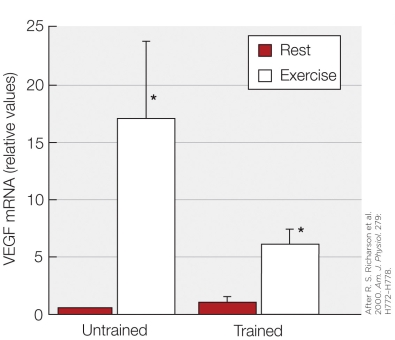 According to the data in the figure, a single bout of endurance exercise
 (Multiple Choice)
4.8/5 (73)
(73) Refer to the figure shown.
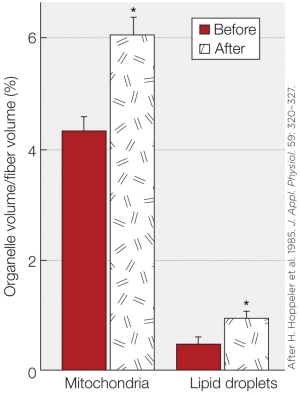 The figure illustrates a part of the typical response of skeletal muscle to
 (Multiple Choice)
4.8/5 (83)
(83) Experiments involving microgravity can be used to study the cellular processes involved in
(Multiple Choice)
4.8/5 (80)
(80) In humans, the vastus lateralis is a mixed fiber type muscle from which biopsies are often taken in exercise studies. Why might it be particularly worthwhile to use a mixed fiber type muscle in studies of exercise training?
(Essay)
4.7/5 (93)
(93) Explain how endurance training increases the ability of muscle cells to use oxygen. Include three specific cellular effects of endurance training and explain how each one increases oxygen uptake.
(Essay)
4.7/5 (79)
(79) Glycolytic muscle fibers contain _______ and myosin isoforms that go through the cross-bridge cycle _______.
(Multiple Choice)
4.8/5 (77)
(77) A single bout of exercise increases VEGF mRNA less in a trained muscle than in an untrained muscle. The most plausible explanation for this difference is that trained muscle has more
(Multiple Choice)
4.8/5 (75)
(75) Experiments that combine endurance and resistance training indicate that
(Multiple Choice)
4.8/5 (84)
(84) Refer to the figure shown.
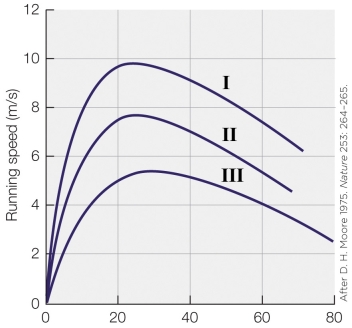 What is the most logical label for the x axis?
 (Multiple Choice)
4.9/5 (83)
(83) Describe what happens to the muscle cells at the molecular level in a person's biceps when the person has to wear a cast for a broken arm.
(Essay)
4.9/5 (84)
(84) In response to exercise training, the muscles in adult mammals change as
(Multiple Choice)
4.8/5 (73)
(73) Describe how force, speed, and power output differ among muscle fibers of different fiber types.
(Essay)
4.7/5 (73)
(73) Refer to the figure shown.
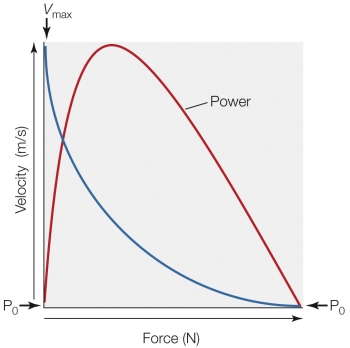 If the muscle represented in the figure can produce a maximal power of 6 watts and has a Vmax of 1.5 m/s, what is its maximum isometric force?
 (Multiple Choice)
4.9/5 (85)
(85) Many athletes engage in resistance training to increase the speed at which they can perform motions required for their sports. Which statement best explains the effect of resistance training on speed?
(Multiple Choice)
4.7/5 (90)
(90) 
Filters
- Essay(0)
- Multiple Choice(0)
- Short Answer(0)
- True False(0)
- Matching(0)