



 Chat with AI
Exam 2: Molecules and Cells in Animal Physiology

Exam 1: Animals and Environments: Function on the Ecological Stage66 Questions
Exam 2: Molecules and Cells in Animal Physiology65 Questions
Exam 3: Genomics, Proteomics, and Related Approaches to Physiology64 Questions
Exam 4: Physiological Development and Epigenetics59 Questions
Exam 5: Transport of Solutes and Water67 Questions
Exam 6: Nutrition, Feeding, and Digestion77 Questions
Exam 7: Energy Metabolism68 Questions
Exam 8: Aerobic and Anaerobic Forms of Metabolism75 Questions
Exam 9: The Energetics of Aerobic Activity72 Questions
Exam 10: Thermal Relations84 Questions
Exam 11: Food, Energy, and Temperature at Work: The Lives of Mammals in Frigid Places76 Questions
Exam 12: Neurons59 Questions
Exam 13: Synapses58 Questions
Exam 14: Sensory Processes67 Questions
Exam 15: Nervous System Organization and Biological Clocks59 Questions
Exam 16: Endocrine and Neuroendocrine Physiology69 Questions
Exam 17: Reproduction68 Questions
Exam 18: Integrating Systems at Work: Animal Navigation61 Questions
Exam 19: Control of Movement71 Questions
Exam 20: Muscle78 Questions
Exam 21: Movement and Muscle at Work: Plasticity in Response to Use and Disuse67 Questions
Exam 22: Introduction to Oxygen and Carbon Dioxide in Physiology65 Questions
Exam 23: External Respiration: the Physiology of Breathing70 Questions
Exam 24: Transport of Oxygen and Carbon Dioxide in Body Fluids With an Introduction to Acid- Base Physiology68 Questions
Exam 25: Circulation72 Questions
Exam 26: Oxygen, Carbon Dioxide, and Internal Transport at Work: Diving by Marine Mammals63 Questions
Exam 27: Water and Salt Physiology: Introduction and Mechanisms72 Questions
Exam 29: Kidneys and Excretion With Notes on Nitrogen Excretion89 Questions
Exam 30: Water, Salts, and Excretion at Work: Mammals of Deserts and Dry Savannas64 Questions
Exam 28: Water and Salt Physiology of Animals in Their Environments87 Questions
Select questions type


A protein kinase catalyzes the phosphorylation of another protein kinase, which in turn catalyzes the phosphorylation of a third protein kinase. This series of multiple enzyme sequences is an excellent example of

Free
(Multiple Choice)
4.9/5  (72)
(72) Correct Answer: Verified
A
Which reaction does not directly produce an amplification?
Free
(Multiple Choice)
4.8/5 (91)
(91) Correct Answer:Verified
VerifiedD
Describe how epithelial cells control the transport of substances between the apical and basal sides and thus between different body regions.
Free
(Essay)
4.9/5 (67)
(67) Correct Answer:Verified
VerifiedEpithelial cells are able to control and even mediate the transport of substances between the apical and basal areas via occluding junctions between epithelial cells. Substances must pass through the cell to cross the epithelia, and this transcellular path can be highly controlled. Only very small molecules may be able to pass through the occluding junctions and thus take the paracellular path.
List and briefly describe the four types of receptor proteins involved in cell signaling.
(Essay)
4.8/5 (90)
(90) Intracellular modification of activity in response to an external signal is an example of
(Multiple Choice)
4.9/5 (79)
(79) Turnover number (kcat) describes what property of an enzymatic reaction?
(Multiple Choice)
4.8/5 (84)
(84) Refer to the figure shown.
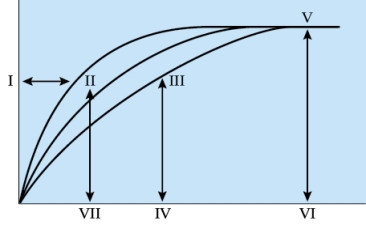 Which letter in the figure best represents the Vmax?
 (Multiple Choice)
4.8/5 (83)
(83) Per gram, the leopard frog can jump farther per jump compared to the western toad because the leopard frog
(Multiple Choice)
5.0/5 (77)
(77) In rats, phosphoenolpyruvate carboxykinase activity per gram of liver significantly increases at birth and remains at this higher level for the life of the animal. This is an example of enzymatic change that takes place over a(n) _______ time frame.
(Multiple Choice)
4.7/5 (75)
(75) Choose a feature that is not common to all simple epithelia.
(Multiple Choice)
4.8/5 (85)
(85) An enzyme-encoding gene is considered to be _______ within a cell if the gene results in the synthesis of the encoded enzyme within that same cell.
(Multiple Choice)
4.9/5 (69)
(69) Extracellular signaling molecules initiate their actions on a cell by binding with certain protein molecules of the cell called
(Multiple Choice)
4.8/5 (76)
(76) Which membrane protein is responsible for the passive movement of K+ across the typical animal cell membrane?
(Multiple Choice)
4.9/5 (78)
(78) When a protein is denatured, which of the following structures is disrupted first?
(Multiple Choice)
4.7/5 (93)
(93) Refer to the figure shown.
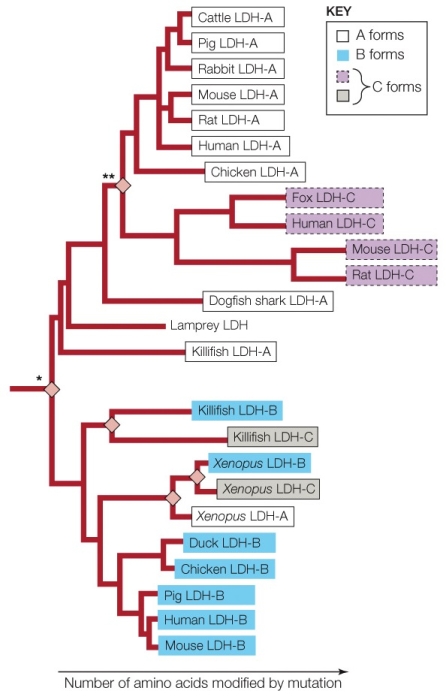 What is the best explanation for why mammalian and fish LDH-C enzymes are shown to be so distantly related?
 (Multiple Choice)
4.8/5 (81)
(81) Refer to the figure shown.
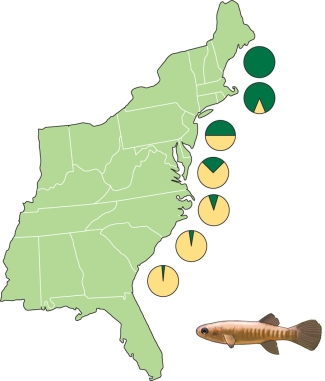 Which abiotic factor most likely explains the data in the figure?
 (Multiple Choice)
4.7/5 (72)
(72) A molecule that consists of a polar portion and a nonpolar portion is said to be
(Multiple Choice)
4.9/5 (85)
(85) 
Filters
- Essay(0)
- Multiple Choice(0)
- Short Answer(0)
- True False(0)
- Matching(0)