



 Chat with AI
Exam 19: Control of Movement


Draw a diagram of a network oscillator involving at least three neurons and label each synapse as excitatory or inhibitory. Graph the membrane potential of each neuron in the oscillator as a function of time on a single x-axis and write a paragraph describing how the network works and the pattern of output that it generates.

 (87)
 Verified
Answers may vary. Shown is one example of a network oscillator. Many other valid networks could be diagrammed.
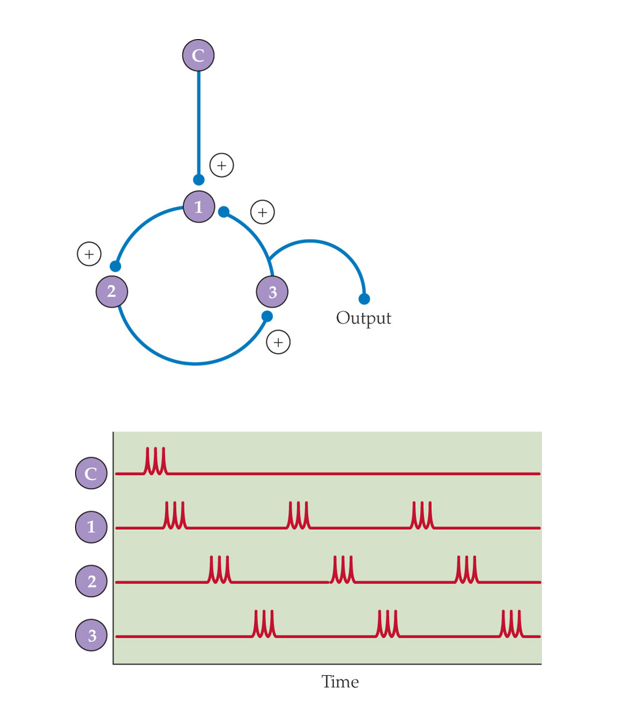 All synapses in the circuit are excitatory and each neuron fires a brief burst of action potentials before fatiguing. The circuit is activated by a burst of action potentials from the command neuron (C) and then continues oscillating through many cycles. Synaptic transmission and axonal transmission are slow enough that neuron #1 recovers before it is re-excited by neuron #3. The output of the entire network corresponds to the activity of neuron #3. The circuit could stop sending output by one of several means. For example, the #3 neuron could be inhibited by a neuron that is not shown in the diagram. Alternately, neuron #1 could depend on low-level tonic output from the command neuron to remain sensitive to excitation from neuron #3.
The involvement of the cerebellum in preprogramming voluntary movements is demonstrated by the observation that many patients with cerebellar lesions are
(89) VerifiedD
Refer to the figure shown.
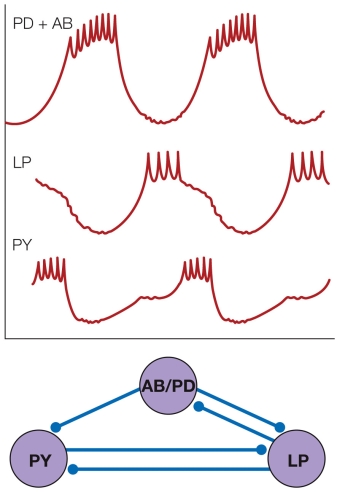 The hybrid oscillator in the figure produces
 (71) VerifiedA
Most of the neurons in the basal ganglia are inhibitory. How can an inhibitory synapse be involved in generating a movement?
(83) Refer to the figure shown.
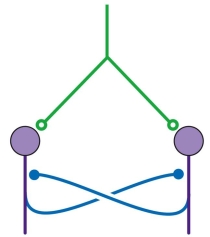 In order to function effectively as an oscillatory network, the half-center model depicted in the figure must
 (87) According to the principle of reciprocity, when a muscle is stimulated to contract, its
(70) Refer to the figure shown.
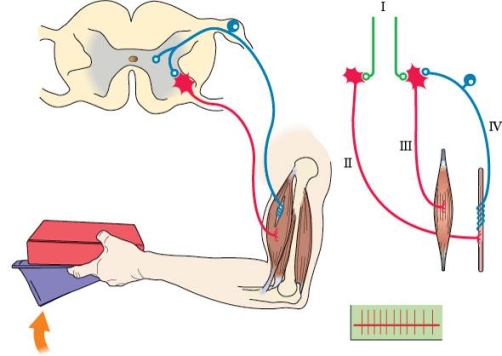 Of the four numerals in the figure, which one best represents a reflex pathway?
 (68) Excitatory inputs from the cerebral cortex to the striatum will lead to what effects on corresponding neurons downstream in the direct pathway of the basal ganglia?
(83) Refer to the figure shown.
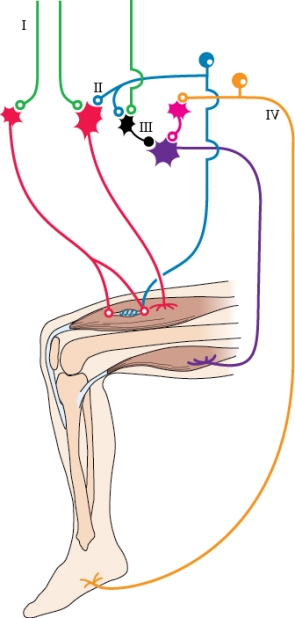 The flexion-reflex afferent pathway originates with which neuron?
 (78) In the network of central pattern generators that governs walking and swimming in salamanders,
(79) Evidence for the role of the primary motor cortex comes from experiments that show that
(68) Modeling experiments on walking and swimming in robotic salamanders suggest that
(70) A 66-year-old man has difficulty controlling voluntary movements. He can clearly state what he intends to do, describe how he would do it, and initiate or stop the movement. However, he has poor coordination and often misses his target. If his difficulty arises from a defect in one particular area of the central nervous system, which area is most likely to be involved?
(82) Which experimental results would demonstrate that central pattern generators are involved in producing the muscle contractions involved in rhythmic movement?
(81) Experiments in which cats with transected spinal cords are able to walk on treadmills demonstrate that the
(79) Output from the primary motor cortex consists mostly of action potentials that are transmitted to
(71) What experimental evidence indicates that the decision to perform a voluntary movement originates in the association cortex?
(85) Which human pathology has been linked to degeneration of the basal ganglia?
(87) Electrical recordings from human volunteers indicate that the decision to move a body part and the signals generating that movement arise from
(79) 
Filters
- Essay(0)
- Multiple Choice(0)
- Short Answer(0)
- True False(0)
- Matching(0)