



 Chat with AI
Exam 19: Control of Movement

Exam 1: Animals and Environments: Function on the Ecological Stage66 Questions
Exam 2: Molecules and Cells in Animal Physiology65 Questions
Exam 3: Genomics, Proteomics, and Related Approaches to Physiology64 Questions
Exam 4: Physiological Development and Epigenetics59 Questions
Exam 5: Transport of Solutes and Water67 Questions
Exam 6: Nutrition, Feeding, and Digestion77 Questions
Exam 7: Energy Metabolism68 Questions
Exam 8: Aerobic and Anaerobic Forms of Metabolism75 Questions
Exam 9: The Energetics of Aerobic Activity72 Questions
Exam 10: Thermal Relations84 Questions
Exam 11: Food, Energy, and Temperature at Work: The Lives of Mammals in Frigid Places76 Questions
Exam 12: Neurons59 Questions
Exam 13: Synapses58 Questions
Exam 14: Sensory Processes67 Questions
Exam 15: Nervous System Organization and Biological Clocks59 Questions
Exam 16: Endocrine and Neuroendocrine Physiology69 Questions
Exam 17: Reproduction68 Questions
Exam 18: Integrating Systems at Work: Animal Navigation61 Questions
Exam 19: Control of Movement71 Questions
Exam 20: Muscle78 Questions
Exam 21: Movement and Muscle at Work: Plasticity in Response to Use and Disuse67 Questions
Exam 22: Introduction to Oxygen and Carbon Dioxide in Physiology65 Questions
Exam 23: External Respiration: the Physiology of Breathing70 Questions
Exam 24: Transport of Oxygen and Carbon Dioxide in Body Fluids With an Introduction to Acid- Base Physiology68 Questions
Exam 25: Circulation72 Questions
Exam 26: Oxygen, Carbon Dioxide, and Internal Transport at Work: Diving by Marine Mammals63 Questions
Exam 27: Water and Salt Physiology: Introduction and Mechanisms72 Questions
Exam 29: Kidneys and Excretion With Notes on Nitrogen Excretion89 Questions
Exam 30: Water, Salts, and Excretion at Work: Mammals of Deserts and Dry Savannas64 Questions
Exam 28: Water and Salt Physiology of Animals in Their Environments87 Questions
Select questions type


In rhythmic behavior such as human walking, each muscle contraction occurs in response to
(Multiple Choice)
5.0/5  (74)
(74) When you step on a tack, excitation of sensory afferents leads to excitation of motor neurons innervating one set of muscles and inhibition of motor neurons innervating another set of muscles. The stimulus produces opposite responses in different motor neurons because
(Multiple Choice)
4.9/5 (92)
(92) How are central pattern generators and peripheral reflexes thought to interact in normal locomotion?
(Multiple Choice)
4.8/5 (87)
(87) Contrast the mechanisms by which cellular oscillators and network oscillators generate patterns of rhythmic motion.
(Essay)
4.8/5 (84)
(84) Injections of L-dopa, the precursor of norepinephrine, can enable spinally transected cats to walk on a treadmill. The most likely explanation for this result is that
(Multiple Choice)
4.8/5 (69)
(69) Refer to the figure shown.
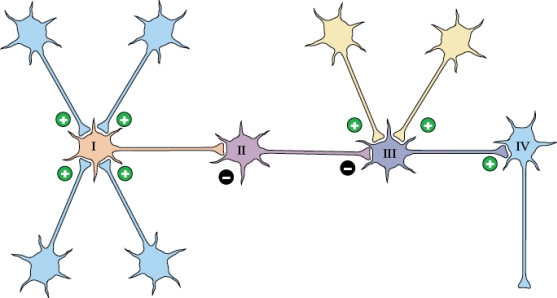 Joey is lying in bed motionless. Which neuron in this figure is tonically active?
 (Multiple Choice)
4.7/5 (82)
(82) Neuromodulators of the stomatogastric ganglion of a decapod crustacean would be least likely to have what action?
(Multiple Choice)
4.8/5 (83)
(83) Refer to the figure shown.
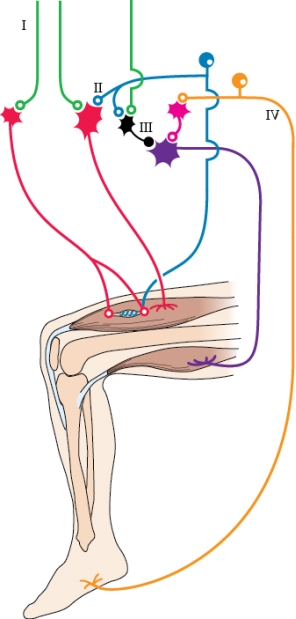 Which numeral in the figure represents the 1a afferent pathway?
 (Multiple Choice)
4.9/5 (90)
(90) The action potentials that directly trigger muscle contractions of walking movements in a vertebrate animal are initiated by neurons whose cell bodies are located in the
(Multiple Choice)
4.9/5 (79)
(79) 
Filters
- Essay(0)
- Multiple Choice(0)
- Short Answer(0)
- True False(0)
- Matching(0)