



 Chat with AI
Exam 19: Control of Movement

Exam 1: Animals and Environments: Function on the Ecological Stage66 Questions
Exam 2: Molecules and Cells in Animal Physiology65 Questions
Exam 3: Genomics, Proteomics, and Related Approaches to Physiology64 Questions
Exam 4: Physiological Development and Epigenetics59 Questions
Exam 5: Transport of Solutes and Water67 Questions
Exam 6: Nutrition, Feeding, and Digestion77 Questions
Exam 7: Energy Metabolism68 Questions
Exam 8: Aerobic and Anaerobic Forms of Metabolism75 Questions
Exam 9: The Energetics of Aerobic Activity72 Questions
Exam 10: Thermal Relations84 Questions
Exam 11: Food, Energy, and Temperature at Work: The Lives of Mammals in Frigid Places76 Questions
Exam 12: Neurons59 Questions
Exam 13: Synapses58 Questions
Exam 14: Sensory Processes67 Questions
Exam 15: Nervous System Organization and Biological Clocks59 Questions
Exam 16: Endocrine and Neuroendocrine Physiology69 Questions
Exam 17: Reproduction68 Questions
Exam 18: Integrating Systems at Work: Animal Navigation61 Questions
Exam 19: Control of Movement71 Questions
Exam 20: Muscle78 Questions
Exam 21: Movement and Muscle at Work: Plasticity in Response to Use and Disuse67 Questions
Exam 22: Introduction to Oxygen and Carbon Dioxide in Physiology65 Questions
Exam 23: External Respiration: the Physiology of Breathing70 Questions
Exam 24: Transport of Oxygen and Carbon Dioxide in Body Fluids With an Introduction to Acid- Base Physiology68 Questions
Exam 25: Circulation72 Questions
Exam 26: Oxygen, Carbon Dioxide, and Internal Transport at Work: Diving by Marine Mammals63 Questions
Exam 27: Water and Salt Physiology: Introduction and Mechanisms72 Questions
Exam 29: Kidneys and Excretion With Notes on Nitrogen Excretion89 Questions
Exam 30: Water, Salts, and Excretion at Work: Mammals of Deserts and Dry Savannas64 Questions
Exam 28: Water and Salt Physiology of Animals in Their Environments87 Questions
Select questions type


According to the peripheral control model of insect flight,
(Multiple Choice)
4.9/5  (73)
(73) Refer to the figure shown.
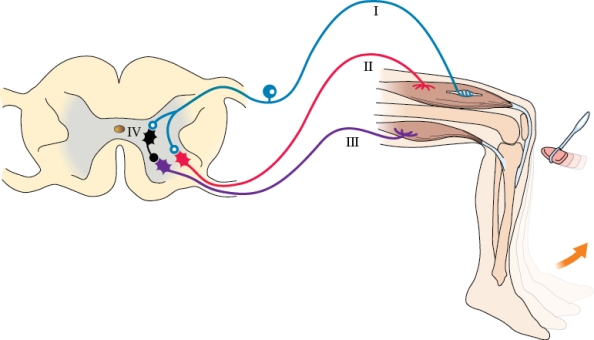 Which neuron in the figure is inhibitory?
 (Multiple Choice)
4.8/5 (76)
(76) The involvement of the cerebellum in motor learning is demonstrated by the observation that patients with cerebellar lesions are
(Multiple Choice)
4.9/5 (77)
(77) Refer to the figure shown.
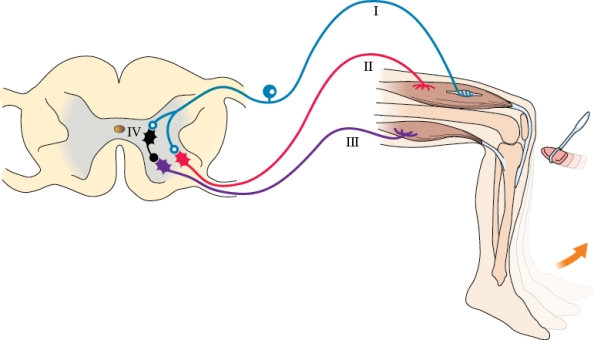 According to the figure, which numeral represents the sensory neuron?
 (Multiple Choice)
4.9/5 (75)
(75) Your family physician taps your left patellar tendon with a mallet. What is the correct sequence of the events that occur?
I. Inhibition of motor neuron innervating flexors
II. Action potentials in 1a sensory neuron
III. Muscle spindle stretch receptor activated
IV. Action potentials in neuron innervating flexors
V. Action potentials in neuron innervating extensors
(Multiple Choice)
5.0/5 (80)
(80) Write a paragraph describing the mechanism that causes you to withdraw your right hand very rapidly when you reach out and touch a hot frying pan by mistake.
(Essay)
4.9/5 (71)
(71) Refer to the figure shown.
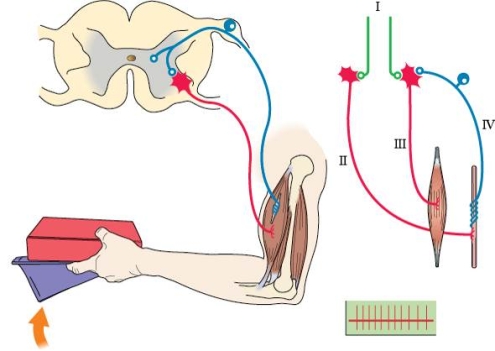 Which caption best describes the figure?
 (Multiple Choice)
4.9/5 (67)
(67) In the primary motor cortex, the neurons most responsible for sending motor output to spinal motor neurons are the
(Multiple Choice)
4.8/5 (78)
(78) The phrase "like a chicken with its head cut off" refers to a person rushing around frantically or carelessly. Explain how a chicken might be able to run (briefly) after its brain has been disconnected from the rest of its body.
(Essay)
4.8/5 (103)
(103) Describe how observations of human patients or animals with lesions of the nervous system have contributed to our understanding of normal motor control. Include relevant examples and relate them to general experimental principles.
(Essay)
4.7/5 (69)
(69) Movement disorders such as Parkinson's disease and Huntington's disease are associated with degeneration in what areas of the central nervous system?
(Multiple Choice)
4.9/5 (76)
(76) Sketch and give a written description of how the nervous system plans, programs, and executes a voluntary movement. Include a sentence describing the role of each of at least four different brain areas.
(Essay)
4.9/5 (88)
(88) Compared to the neural circuits responsible for reflexes of invertebrates, the circuits of vertebrates involve
(Multiple Choice)
4.7/5 (77)
(77) Compare and contrast the central control hypothesis and peripheral control hypothesis as they relate to insect flight
(Essay)
4.8/5 (72)
(72) Refer to the figure shown.
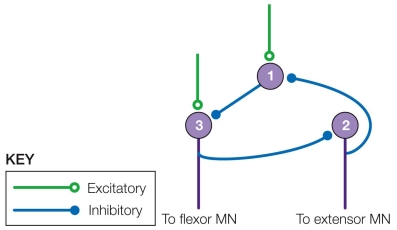 In the closed-loop network depicted in the figure, stimulation from outside the network would cause cell 3 to fire
 (Multiple Choice)
4.9/5 (64)
(64) In what ways do mirror neurons in the premotor areas of the cerebral cortex highlight the complexity of motor pathways?
(Essay)
4.7/5 (88)
(88) 
Filters
- Essay(0)
- Multiple Choice(0)
- Short Answer(0)
- True False(0)
- Matching(0)