



 Chat with AI
Exam 10: Thermal Relations

Exam 1: Animals and Environments: Function on the Ecological Stage66 Questions
Exam 2: Molecules and Cells in Animal Physiology65 Questions
Exam 3: Genomics, Proteomics, and Related Approaches to Physiology64 Questions
Exam 4: Physiological Development and Epigenetics59 Questions
Exam 5: Transport of Solutes and Water67 Questions
Exam 6: Nutrition, Feeding, and Digestion77 Questions
Exam 7: Energy Metabolism68 Questions
Exam 8: Aerobic and Anaerobic Forms of Metabolism75 Questions
Exam 9: The Energetics of Aerobic Activity72 Questions
Exam 10: Thermal Relations84 Questions
Exam 11: Food, Energy, and Temperature at Work: The Lives of Mammals in Frigid Places76 Questions
Exam 12: Neurons59 Questions
Exam 13: Synapses58 Questions
Exam 14: Sensory Processes67 Questions
Exam 15: Nervous System Organization and Biological Clocks59 Questions
Exam 16: Endocrine and Neuroendocrine Physiology69 Questions
Exam 17: Reproduction68 Questions
Exam 18: Integrating Systems at Work: Animal Navigation61 Questions
Exam 19: Control of Movement71 Questions
Exam 20: Muscle78 Questions
Exam 21: Movement and Muscle at Work: Plasticity in Response to Use and Disuse67 Questions
Exam 22: Introduction to Oxygen and Carbon Dioxide in Physiology65 Questions
Exam 23: External Respiration: the Physiology of Breathing70 Questions
Exam 24: Transport of Oxygen and Carbon Dioxide in Body Fluids With an Introduction to Acid- Base Physiology68 Questions
Exam 25: Circulation72 Questions
Exam 26: Oxygen, Carbon Dioxide, and Internal Transport at Work: Diving by Marine Mammals63 Questions
Exam 27: Water and Salt Physiology: Introduction and Mechanisms72 Questions
Exam 29: Kidneys and Excretion With Notes on Nitrogen Excretion89 Questions
Exam 30: Water, Salts, and Excretion at Work: Mammals of Deserts and Dry Savannas64 Questions
Exam 28: Water and Salt Physiology of Animals in Their Environments87 Questions
Select questions type


Refer to the figure shown. Fish were housed under three different temperature conditions. Their response to acute and chronic temperature changes is plotted on the figure.
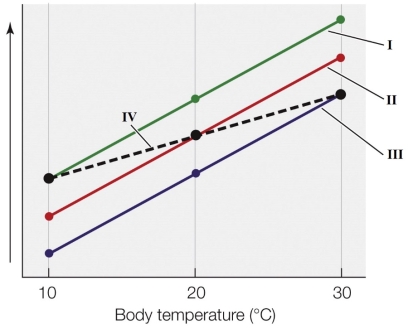 What will happen to line IV as temperature continues to increase beyond the scale of the visible x axis?
Free
(Multiple Choice)
4.8/5  (82)
(82) Correct Answer: Verified
C
The three time frames over which animals respond physiologically to environmental change are
Free
(Multiple Choice)
5.0/5 (68)
(68) Correct Answer:Verified
VerifiedB
Why is it that the body temperatures of terrestrial poikilotherms can substantially exceed air temperature but body temperatures of aquatic poikilotherms are generally very close to water temperature?
Free
(Essay)
4.9/5 (76)
(76) Correct Answer:Verified
VerifiedOn land, thermal radiation can increase body temperature above the air temperature. In water, thermal radiation would heat the surface of the water, not the animal. The conductance of water is also very high such that true poikilotherms essentially match water temperature.
All else being equal, the convective coefficient (per unit area) is likely to be highest when wind speed is _______ and animal size (diameter) is _______.
(Multiple Choice)
4.8/5 (70)
(70) Evaporation is an effective mechanism for cooling because the latent heat of
(Multiple Choice)
4.9/5 (82)
(82) Refer to the figure shown. Fish were housed under three different temperature conditions. Their response to acute and chronic temperature changes is plotted on the figure.
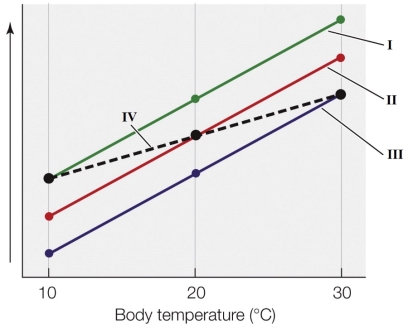 Which line best represents the acute response line of animals acclimated to the coldest temperature?
 (Multiple Choice)
4.8/5 (71)
(71) Over evolutionary time, membrane fluidity can be maintained at lower temperatures by
(Multiple Choice)
4.8/5 (75)
(75) What are two major benefits of controlled hypothermia in birds and mammals?
(Essay)
4.8/5 (69)
(69) How would the emissivities (e) of a desert rodent and a desert lizard compare at wavelengths of 3‒4 mm or longer?
(Essay)
4.9/5 (89)
(89) Refer to the figure shown. Multiple species of poikilotherms that naturally experience different body temperatures are shown in the figure. The response of each species at multiple temperatures is plotted on the figure.
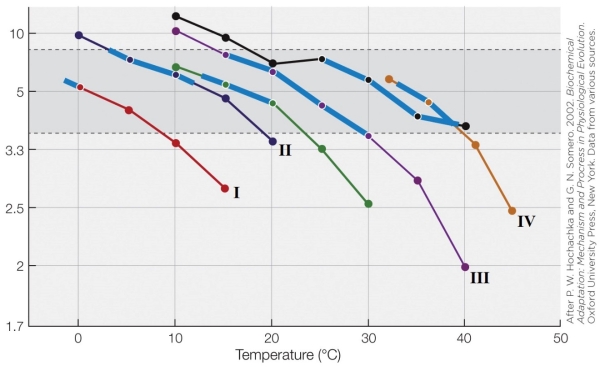 What is the most appropriate label for the y axis?
 (Multiple Choice)
4.8/5 (80)
(80) The environmental temperature is 25°C. A small lizard at 20°C will _______ the environment whereas a large dog at 37°C contains _______ heat than the lizard and will _______ the environment.
(Multiple Choice)
4.9/5 (90)
(90) Animals, plants, and other objects in the natural environment generally emit radiation at wavelengths of _______ or longer.
(Multiple Choice)
4.8/5 (86)
(86) Which method of evaporative water loss can induce respiratory alkalosis?
(Multiple Choice)
4.8/5 (78)
(78) Compared to the average field metabolic rates for a nonavian reptile, the average field metabolic rate of a similar size bird or mammal is
(Multiple Choice)
4.8/5 (78)
(78) Refer to the figure shown. One species of homeotherm under two different environmental conditions was exposed to temperature changes.
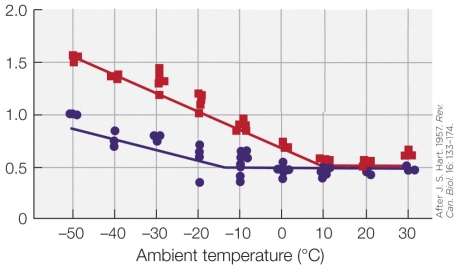 What is the most appropriate label for the y axis?
 (Multiple Choice)
4.9/5 (81)
(81) Suppose that a mammal that was a temporal heterotherm needed to survive in a winter environment with severely limited food resources. At which of the following mean ambient temperatures would the animal most likely survive the winter?
(Multiple Choice)
4.8/5 (74)
(74) The dromedary camel can survive without drinking water for days because of
(Multiple Choice)
4.9/5 (70)
(70) You are in Las Vegas in summer and you see a dog tied to a fence with no access to shade. As the dog is obviously having problems with the heat, what would be the fastest means of cooling the dog's internal temperature?
(Multiple Choice)
4.9/5 (75)
(75) 
Filters
- Essay(0)
- Multiple Choice(0)
- Short Answer(0)
- True False(0)
- Matching(0)