



 Chat with AI
Exam 10: Thermal Relations

Exam 1: Animals and Environments: Function on the Ecological Stage66 Questions
Exam 2: Molecules and Cells in Animal Physiology65 Questions
Exam 3: Genomics, Proteomics, and Related Approaches to Physiology64 Questions
Exam 4: Physiological Development and Epigenetics59 Questions
Exam 5: Transport of Solutes and Water67 Questions
Exam 6: Nutrition, Feeding, and Digestion77 Questions
Exam 7: Energy Metabolism68 Questions
Exam 8: Aerobic and Anaerobic Forms of Metabolism75 Questions
Exam 9: The Energetics of Aerobic Activity72 Questions
Exam 10: Thermal Relations84 Questions
Exam 11: Food, Energy, and Temperature at Work: The Lives of Mammals in Frigid Places76 Questions
Exam 12: Neurons59 Questions
Exam 13: Synapses58 Questions
Exam 14: Sensory Processes67 Questions
Exam 15: Nervous System Organization and Biological Clocks59 Questions
Exam 16: Endocrine and Neuroendocrine Physiology69 Questions
Exam 17: Reproduction68 Questions
Exam 18: Integrating Systems at Work: Animal Navigation61 Questions
Exam 19: Control of Movement71 Questions
Exam 20: Muscle78 Questions
Exam 21: Movement and Muscle at Work: Plasticity in Response to Use and Disuse67 Questions
Exam 22: Introduction to Oxygen and Carbon Dioxide in Physiology65 Questions
Exam 23: External Respiration: the Physiology of Breathing70 Questions
Exam 24: Transport of Oxygen and Carbon Dioxide in Body Fluids With an Introduction to Acid- Base Physiology68 Questions
Exam 25: Circulation72 Questions
Exam 26: Oxygen, Carbon Dioxide, and Internal Transport at Work: Diving by Marine Mammals63 Questions
Exam 27: Water and Salt Physiology: Introduction and Mechanisms72 Questions
Exam 29: Kidneys and Excretion With Notes on Nitrogen Excretion89 Questions
Exam 30: Water, Salts, and Excretion at Work: Mammals of Deserts and Dry Savannas64 Questions
Exam 28: Water and Salt Physiology of Animals in Their Environments87 Questions
Select questions type


Human blood has an osmolarity of about 300 mOsm and shark blood has an osmolarity of about 1000 mOsm. If you collected blood samples from both humans and sharks and attempted to freeze them, which would freeze at a lower temperature?
(Essay)
4.9/5  (68)
(68) Refer to the figure shown. Fish were housed under three different temperature conditions. Their response to acute and chronic temperature changes is plotted on the figure.
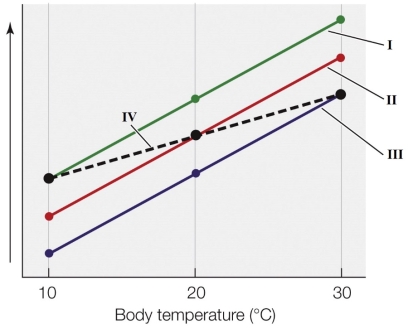 Which line best represents the chronic response of animals being cooled from 30°C to 10°C?
 (Multiple Choice)
4.9/5 (87)
(87) The optimum temperature of flight muscle of a sphinx moth is _______ and this _______ with decreasing environmental temperature.
(Multiple Choice)
4.7/5 (78)
(78) Suppose an animal has a metabolic rate of 10 ml O2/h at 20°C. The Q10 is 2.5. What is its metabolic rate at 10°C?
(Multiple Choice)
4.8/5 (78)
(78) Antarctic fur seals live in cold water, thermoregulate, and maintain elevated core body temperatures. Manatees, another marine mammal, live in warm water, thermoregulate, and maintain elevated core body temperatures. Based on general principles, one would predict that for Antarctic fur seals, the effect of temperature on enzyme-substrate activity would be similar to that of _______-water fish, and for manatees it would be similar to that of _______-water fish.
(Multiple Choice)
4.9/5 (84)
(84) During the onset of a fever, the body's temperature set point _______ and results in the body adjusting to this new set point by _______.
(Multiple Choice)
4.8/5 (84)
(84) Most commonly, the slope of the line depicting the chronic response of metabolic rate to temperature is _______ the slope of the lines depicting the acute response of metabolic rate to temperature.
(Multiple Choice)
4.9/5 (77)
(77) Which statement about an animal's body temperature is true?
(Multiple Choice)
4.9/5 (82)
(82) Based on how the metabolic rates of ectotherms and endotherms respond to temperature, at which temperature would you expect the differences in metabolic rates between ectotherms and endotherms to be largest? (Hint: Think about the response curve of each type of animal to environmental temperature.)
(Multiple Choice)
4.7/5 (77)
(77) Suppose an animal has a metabolic rate of 3 ml O2/h at 10°C? The Q10 is 2. What is its metabolic rate at 20°C?
(Multiple Choice)
4.9/5 (76)
(76) Compared to a summer acclimatized fox, what is a winter fox's resting metabolic rate when both are placed at -50°C?
(Multiple Choice)
5.0/5 (94)
(94) Why can warmer winter temperatures have a negative impact on hibernators?
(Essay)
4.9/5 (81)
(81) In a very hot environment, the benefit of hyperthermia is that it
(Multiple Choice)
4.8/5 (66)
(66) Refer to the figure shown. Multiple species of poikilotherms that naturally experience different body temperatures are shown in the figure. The response of each species at multiple temperatures is plotted on the figure.
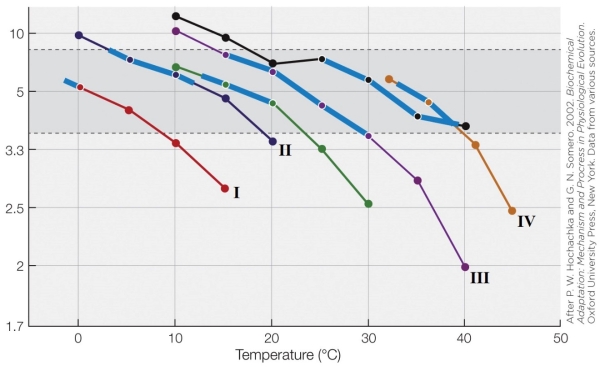 Which line indicates the species that naturally experiences the narrowest body temperature range?
 (Multiple Choice)
4.7/5 (80)
(80) 
Filters
- Essay(0)
- Multiple Choice(0)
- Short Answer(0)
- True False(0)
- Matching(0)