



 Chat with AI
Exam 11: Food, Energy, and Temperature at Work: The Lives of Mammals in Frigid Places

Exam 1: Animals and Environments: Function on the Ecological Stage66 Questions
Exam 2: Molecules and Cells in Animal Physiology65 Questions
Exam 3: Genomics, Proteomics, and Related Approaches to Physiology64 Questions
Exam 4: Physiological Development and Epigenetics59 Questions
Exam 5: Transport of Solutes and Water67 Questions
Exam 6: Nutrition, Feeding, and Digestion77 Questions
Exam 7: Energy Metabolism68 Questions
Exam 8: Aerobic and Anaerobic Forms of Metabolism75 Questions
Exam 9: The Energetics of Aerobic Activity72 Questions
Exam 10: Thermal Relations84 Questions
Exam 11: Food, Energy, and Temperature at Work: The Lives of Mammals in Frigid Places76 Questions
Exam 12: Neurons59 Questions
Exam 13: Synapses58 Questions
Exam 14: Sensory Processes67 Questions
Exam 15: Nervous System Organization and Biological Clocks59 Questions
Exam 16: Endocrine and Neuroendocrine Physiology69 Questions
Exam 17: Reproduction68 Questions
Exam 18: Integrating Systems at Work: Animal Navigation61 Questions
Exam 19: Control of Movement71 Questions
Exam 20: Muscle78 Questions
Exam 21: Movement and Muscle at Work: Plasticity in Response to Use and Disuse67 Questions
Exam 22: Introduction to Oxygen and Carbon Dioxide in Physiology65 Questions
Exam 23: External Respiration: the Physiology of Breathing70 Questions
Exam 24: Transport of Oxygen and Carbon Dioxide in Body Fluids With an Introduction to Acid- Base Physiology68 Questions
Exam 25: Circulation72 Questions
Exam 26: Oxygen, Carbon Dioxide, and Internal Transport at Work: Diving by Marine Mammals63 Questions
Exam 27: Water and Salt Physiology: Introduction and Mechanisms72 Questions
Exam 29: Kidneys and Excretion With Notes on Nitrogen Excretion89 Questions
Exam 30: Water, Salts, and Excretion at Work: Mammals of Deserts and Dry Savannas64 Questions
Exam 28: Water and Salt Physiology of Animals in Their Environments87 Questions
Select questions type


If an adult animal had a lot of brown fat,

Free
(Multiple Choice)
4.9/5  (87)
(87) Correct Answer: Verified
A
According to the experiment done by Nilssen et al. (1984), the resting metabolic rate in adult reindeer during winter
Free
(Multiple Choice)
4.7/5 (81)
(81) Correct Answer:Verified
VerifiedC
Which animal will have the greatest amount of brown fat, relative to its body, at birth?
Free
(Multiple Choice)
4.8/5 (80)
(80) Correct Answer:Verified
VerifiedA
Researchers have shown that animals that consume a diet rich in _______ can tolerate the lowest body temperature without being aroused from hibernation.
(Multiple Choice)
4.8/5 (68)
(68) Explain how animals prepare for hibernation. Include the cues that trigger preparation, the type of nutrients stored, and the specific location of storage molecules.
(Essay)
4.9/5 (63)
(63) Refer to the figure shown.
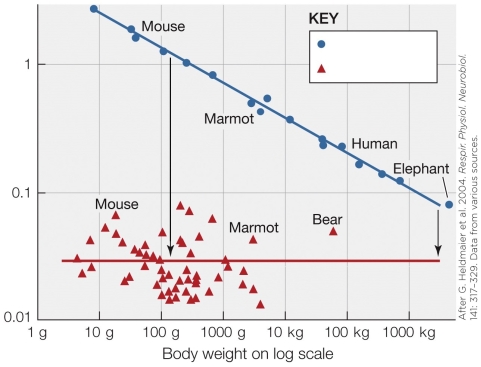 In the figure, what do the arrows represent?
 (Multiple Choice)
4.8/5 (80)
(80) If near-term sheep fetuses with normal blood circulation are cooled inside the uteruses of their mothers,
(Multiple Choice)
5.0/5 (89)
(89) In ground squirrels, testosterone levels _______ during hibernation.
(Multiple Choice)
4.9/5 (94)
(94) Explain how body size relates to weight-specific metabolic rate in hibernating and nonhibernating animals.
(Essay)
4.8/5 (69)
(69) 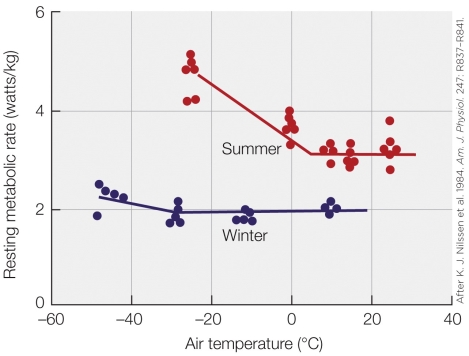 What is this figure showing?
Physiologists have always pondered the relationship of body size to the evolution of hibernation. Based on evolutionary theory, an animal of that weighs _______ kg will have the least energy savings in hibernation.
(Multiple Choice)
4.7/5 (82)
(82) Which mammal would be most likely to maintain some brown fat as an adult?
(Multiple Choice)
4.7/5 (68)
(68) Lambs born to shorn mothers _______ at birth compared to lambs born to unshorn mothers.
(Multiple Choice)
4.8/5 (86)
(86) The biggest threat to a newborn reindeer's life upon birth is
(Multiple Choice)
4.9/5 (87)
(87) Which would have more brown fat, a lamb born in Palm Desert or one born in Alaska?
(Multiple Choice)
4.9/5 (91)
(91) The elevated rate of oxygen consumption response to norepinephrine in newborn reindeer has declined by _______ of age.
(Multiple Choice)
4.8/5 (84)
(84) Which statement regarding microbes in reindeer rumen is false?
(Multiple Choice)
4.8/5 (56)
(56) Refer to the figure shown.
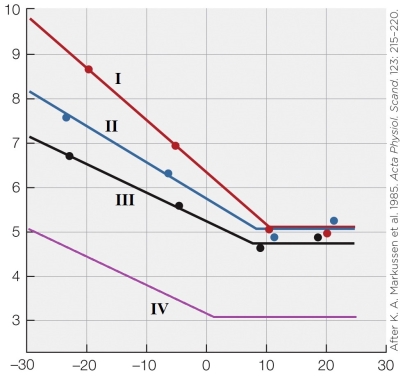 Which line most closely approximates an adult animal in the summer season?
 (Multiple Choice)
4.7/5 (91)
(91) 
Filters
- Essay(0)
- Multiple Choice(0)
- Short Answer(0)
- True False(0)
- Matching(0)