



 Chat with AI
Exam 11: Food, Energy, and Temperature at Work: The Lives of Mammals in Frigid Places

Exam 1: Animals and Environments: Function on the Ecological Stage66 Questions
Exam 2: Molecules and Cells in Animal Physiology65 Questions
Exam 3: Genomics, Proteomics, and Related Approaches to Physiology64 Questions
Exam 4: Physiological Development and Epigenetics59 Questions
Exam 5: Transport of Solutes and Water67 Questions
Exam 6: Nutrition, Feeding, and Digestion77 Questions
Exam 7: Energy Metabolism68 Questions
Exam 8: Aerobic and Anaerobic Forms of Metabolism75 Questions
Exam 9: The Energetics of Aerobic Activity72 Questions
Exam 10: Thermal Relations84 Questions
Exam 11: Food, Energy, and Temperature at Work: The Lives of Mammals in Frigid Places76 Questions
Exam 12: Neurons59 Questions
Exam 13: Synapses58 Questions
Exam 14: Sensory Processes67 Questions
Exam 15: Nervous System Organization and Biological Clocks59 Questions
Exam 16: Endocrine and Neuroendocrine Physiology69 Questions
Exam 17: Reproduction68 Questions
Exam 18: Integrating Systems at Work: Animal Navigation61 Questions
Exam 19: Control of Movement71 Questions
Exam 20: Muscle78 Questions
Exam 21: Movement and Muscle at Work: Plasticity in Response to Use and Disuse67 Questions
Exam 22: Introduction to Oxygen and Carbon Dioxide in Physiology65 Questions
Exam 23: External Respiration: the Physiology of Breathing70 Questions
Exam 24: Transport of Oxygen and Carbon Dioxide in Body Fluids With an Introduction to Acid- Base Physiology68 Questions
Exam 25: Circulation72 Questions
Exam 26: Oxygen, Carbon Dioxide, and Internal Transport at Work: Diving by Marine Mammals63 Questions
Exam 27: Water and Salt Physiology: Introduction and Mechanisms72 Questions
Exam 29: Kidneys and Excretion With Notes on Nitrogen Excretion89 Questions
Exam 30: Water, Salts, and Excretion at Work: Mammals of Deserts and Dry Savannas64 Questions
Exam 28: Water and Salt Physiology of Animals in Their Environments87 Questions
Select questions type


Describe the immunocytochemistry assay that was devised to test for brown fat in newborn reindeer.
(Essay)
4.7/5  (92)
(92) Refer to the figure shown.
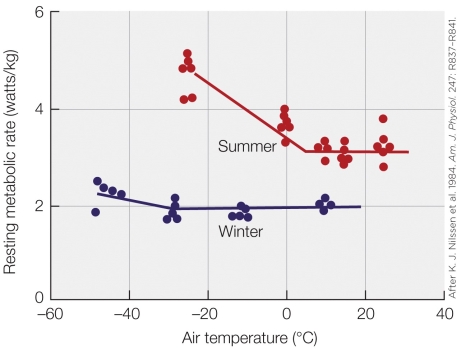 If animals in both groups of animals were exposed to progressively higher air temperatures than shown, and data collection from the experiment continued, what results would you expect to see?
 (Multiple Choice)
4.9/5 (79)
(79) Refer to the figure shown.
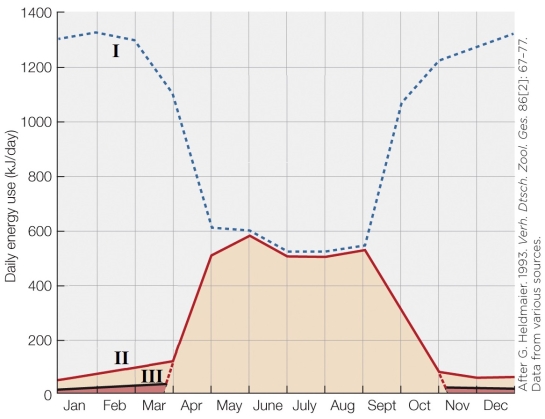 What is the most accurate title for this figure?
 (Multiple Choice)
4.8/5 (67)
(67) As the ambient temperature drops below zero, a newborn reindeer's resting metabolic rate
(Multiple Choice)
4.9/5 (92)
(92) If you were to do an immunocytochemistry experiment on a newborn reindeer, a one-month-old reindeer, and a two-month-old reindeer to test for the presence of brown fat, your results would show a _______ amount of brown fat on the _______ compared to the _______-month old.
(Multiple Choice)
4.9/5 (73)
(73) Explain how technological advances have helped researchers record data pertaining to hibernation and other physiological mechanisms.
(Essay)
4.9/5 (91)
(91) In response to seasonal diets, the microbial community in reindeer will preferentially breakdown _______ in the winter.
(Multiple Choice)
4.7/5 (71)
(71) An early hypothesis for arousal during hibernation was that animals
(Multiple Choice)
4.8/5 (79)
(79) 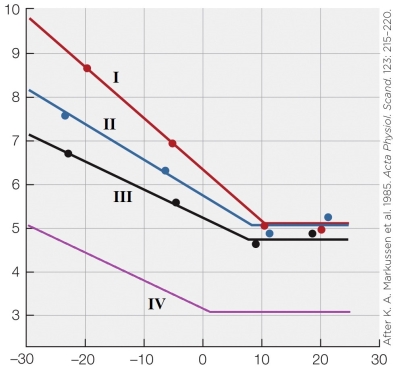 What does the figure show?
Which animal will have the highest weight-specific metabolic rate during hibernation?
(Multiple Choice)
4.9/5 (70)
(70) 
Filters
- Essay(0)
- Multiple Choice(0)
- Short Answer(0)
- True False(0)
- Matching(0)