



 Chat with AI
Exam 11: Food, Energy, and Temperature at Work: The Lives of Mammals in Frigid Places

Exam 1: Animals and Environments: Function on the Ecological Stage66 Questions
Exam 2: Molecules and Cells in Animal Physiology65 Questions
Exam 3: Genomics, Proteomics, and Related Approaches to Physiology64 Questions
Exam 4: Physiological Development and Epigenetics59 Questions
Exam 5: Transport of Solutes and Water67 Questions
Exam 6: Nutrition, Feeding, and Digestion77 Questions
Exam 7: Energy Metabolism68 Questions
Exam 8: Aerobic and Anaerobic Forms of Metabolism75 Questions
Exam 9: The Energetics of Aerobic Activity72 Questions
Exam 10: Thermal Relations84 Questions
Exam 11: Food, Energy, and Temperature at Work: The Lives of Mammals in Frigid Places76 Questions
Exam 12: Neurons59 Questions
Exam 13: Synapses58 Questions
Exam 14: Sensory Processes67 Questions
Exam 15: Nervous System Organization and Biological Clocks59 Questions
Exam 16: Endocrine and Neuroendocrine Physiology69 Questions
Exam 17: Reproduction68 Questions
Exam 18: Integrating Systems at Work: Animal Navigation61 Questions
Exam 19: Control of Movement71 Questions
Exam 20: Muscle78 Questions
Exam 21: Movement and Muscle at Work: Plasticity in Response to Use and Disuse67 Questions
Exam 22: Introduction to Oxygen and Carbon Dioxide in Physiology65 Questions
Exam 23: External Respiration: the Physiology of Breathing70 Questions
Exam 24: Transport of Oxygen and Carbon Dioxide in Body Fluids With an Introduction to Acid- Base Physiology68 Questions
Exam 25: Circulation72 Questions
Exam 26: Oxygen, Carbon Dioxide, and Internal Transport at Work: Diving by Marine Mammals63 Questions
Exam 27: Water and Salt Physiology: Introduction and Mechanisms72 Questions
Exam 29: Kidneys and Excretion With Notes on Nitrogen Excretion89 Questions
Exam 30: Water, Salts, and Excretion at Work: Mammals of Deserts and Dry Savannas64 Questions
Exam 28: Water and Salt Physiology of Animals in Their Environments87 Questions
Select questions type


Fatty acids isolated from the distal limb of a reindeer would consist of
(Multiple Choice)
4.9/5  (78)
(78) Refer to the figure shown.
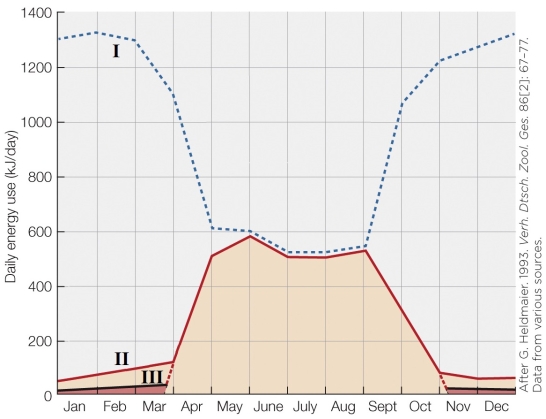 What best represents the actual cost savings of hibernation?
 (Multiple Choice)
4.9/5 (79)
(79) Which of the following is an advantage for small mammals, such as lemmings, in the winter?
(Multiple Choice)
5.0/5 (72)
(72) If a newborn reindeer's maximum rate of metabolic heat production is 10 watts/kg, its resting metabolic rate is _______ watts/kg.
(Multiple Choice)
4.8/5 (86)
(86) Refer to the figure shown.
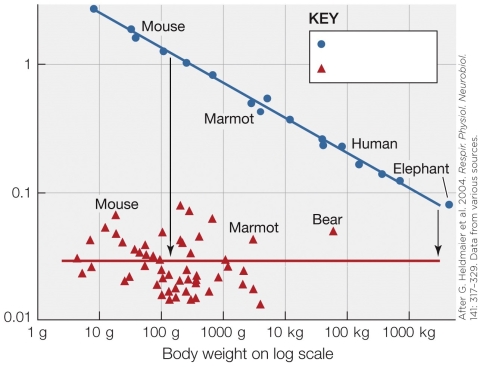 Which statement is not supported by data shown in the figure?
 (Multiple Choice)
4.8/5 (81)
(81) Which hormone was used to test for brown-fat function in newborn reindeer?
(Multiple Choice)
4.8/5 (82)
(82) Which animal is most likely to have the advantage of migration to a warmer region as winter approaches?
(Multiple Choice)
4.9/5 (84)
(84) One of the negative consequences to reindeer of rain falling in Arctic areas instead of snow is
(Multiple Choice)
4.9/5 (73)
(73) Reindeer have low energy costs in cold environments because of their
(Multiple Choice)
5.0/5 (79)
(79) The fat stored in animals prior to hibernation is in the form of
(Multiple Choice)
5.0/5 (85)
(85) Refer to the figure shown.
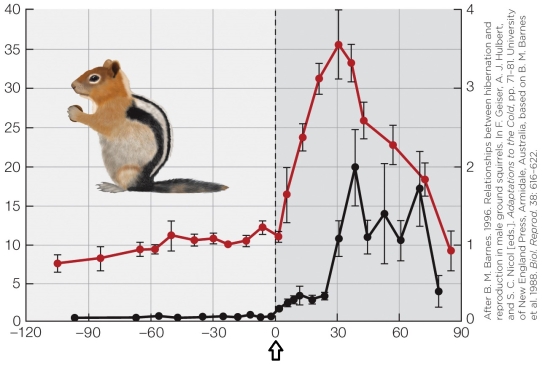 Which conclusion is best supported by the data in the figure?
 (Multiple Choice)
4.9/5 (74)
(74) Which hypotheses for arousal during hibernation are currently popular?
(Essay)
4.9/5 (95)
(95) Which type of fat is important for calcium pump function in heart cells at low temperatures?
(Multiple Choice)
4.7/5 (65)
(65) Refer to the figure shown.
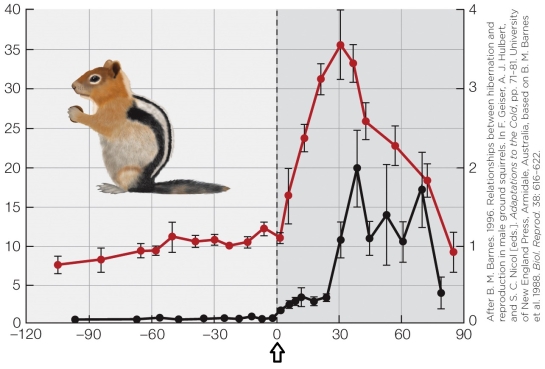 What is indicated by the arrow in the figure?
 (Multiple Choice)
4.9/5 (81)
(81) Ground squirrels that live in the Arctic Circle cannot burrow deeper than _______ m.
(Multiple Choice)
4.7/5 (71)
(71) Refer to the figure shown.
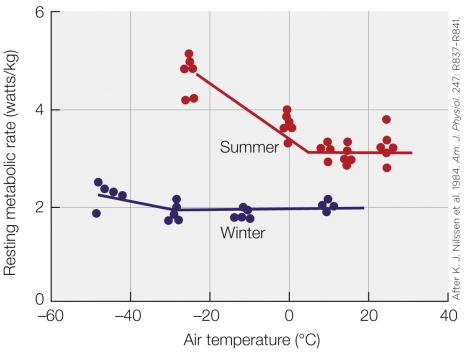 According to the figure, which animal is saving the most energy?
 (Multiple Choice)
4.9/5 (86)
(86) Based on the relationship of metabolic rate and body weight, an animal that weighs _______ kg as an adult is most likely to hibernate.
(Multiple Choice)
4.9/5 (83)
(83) 
Filters
- Essay(0)
- Multiple Choice(0)
- Short Answer(0)
- True False(0)
- Matching(0)