



 Chat with AI
Exam 24: Transport of Oxygen and Carbon Dioxide in Body Fluids With an Introduction to Acid- Base Physiology

Exam 1: Animals and Environments: Function on the Ecological Stage66 Questions
Exam 2: Molecules and Cells in Animal Physiology65 Questions
Exam 3: Genomics, Proteomics, and Related Approaches to Physiology64 Questions
Exam 4: Physiological Development and Epigenetics59 Questions
Exam 5: Transport of Solutes and Water67 Questions
Exam 6: Nutrition, Feeding, and Digestion77 Questions
Exam 7: Energy Metabolism68 Questions
Exam 8: Aerobic and Anaerobic Forms of Metabolism75 Questions
Exam 9: The Energetics of Aerobic Activity72 Questions
Exam 10: Thermal Relations84 Questions
Exam 11: Food, Energy, and Temperature at Work: The Lives of Mammals in Frigid Places76 Questions
Exam 12: Neurons59 Questions
Exam 13: Synapses58 Questions
Exam 14: Sensory Processes67 Questions
Exam 15: Nervous System Organization and Biological Clocks59 Questions
Exam 16: Endocrine and Neuroendocrine Physiology69 Questions
Exam 17: Reproduction68 Questions
Exam 18: Integrating Systems at Work: Animal Navigation61 Questions
Exam 19: Control of Movement71 Questions
Exam 20: Muscle78 Questions
Exam 21: Movement and Muscle at Work: Plasticity in Response to Use and Disuse67 Questions
Exam 22: Introduction to Oxygen and Carbon Dioxide in Physiology65 Questions
Exam 23: External Respiration: the Physiology of Breathing70 Questions
Exam 24: Transport of Oxygen and Carbon Dioxide in Body Fluids With an Introduction to Acid- Base Physiology68 Questions
Exam 25: Circulation72 Questions
Exam 26: Oxygen, Carbon Dioxide, and Internal Transport at Work: Diving by Marine Mammals63 Questions
Exam 27: Water and Salt Physiology: Introduction and Mechanisms72 Questions
Exam 29: Kidneys and Excretion With Notes on Nitrogen Excretion89 Questions
Exam 30: Water, Salts, and Excretion at Work: Mammals of Deserts and Dry Savannas64 Questions
Exam 28: Water and Salt Physiology of Animals in Their Environments87 Questions
Select questions type


Refer to the figure.
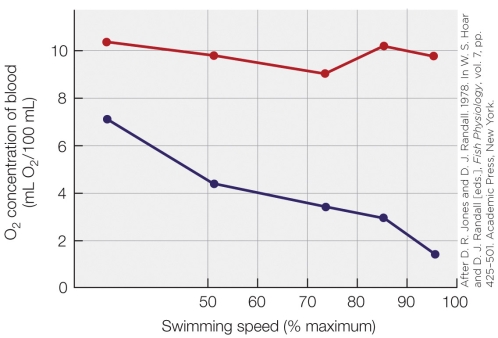 According to the figure shown, which statement is the most accurate?
Free
(Multiple Choice)
5.0/5  (90)
(90) Correct Answer: Verified
D
The P50 in a fish species adapted to a low oxygen aquatic environment would likely be _______ the P50 of a fish species adapted to a well-oxygenated aquatic environment.
Free
(Multiple Choice)
4.8/5 (74)
(74) Correct Answer:Verified
VerifiedC
The key enzyme involved in the formation of bicarbonate from CO2 is
Free
(Multiple Choice)
4.8/5 (88)
(88) Correct Answer:Verified
VerifiedC
During chronic exposure to high altitude, increasing 2,3-DPG
(Multiple Choice)
4.9/5 (85)
(85) The buffering effectiveness of any given buffer reaction is greatest when the prevailing pH _______ the pKʹ of the reaction.
(Multiple Choice)
4.9/5 (83)
(83) The image on a graph showing the functional relationship between the percentage of oxygenated binding sites and the O2 partial pressure is best known as
(Multiple Choice)
4.8/5 (78)
(78) In mammals, the bulk of the CO2 is transported from the tissue to the lungs as
(Multiple Choice)
4.7/5 (88)
(88) Why are carbonic anhydrase and anion transporters important in vertebrate CO2 transport?
(Essay)
5.0/5 (72)
(72) Refer to the figure shown.
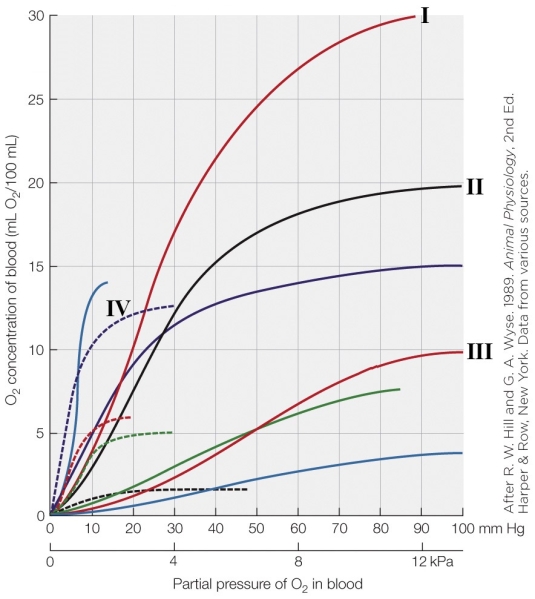 Which oxygen dissociation curve in the figure would represent a hypoxia-adapted species such as a carp?
 (Multiple Choice)
4.8/5 (91)
(91) The alphastat hypothesis attempts to explain why _______ as temperature falls.
(Multiple Choice)
4.8/5 (78)
(78) What is unique about the respiratory pigments and circulatory O2 transport of the octopus?
(Essay)
4.7/5 (71)
(71) Why is human hemoglobin a good example of evolutionary molecular design?
(Essay)
4.8/5 (83)
(83) In a healthy human at rest, what is the approximate O2 saturation of venous blood as it is leaving the tissues?
(Multiple Choice)
5.0/5 (72)
(72) The exposure of Daphnia to O2-poor water for days would result in
(Multiple Choice)
4.9/5 (78)
(78) Which of the following is not a chemical category of respiratory pigment?
(Multiple Choice)
4.9/5 (83)
(83) 
Filters
- Essay(0)
- Multiple Choice(0)
- Short Answer(0)
- True False(0)
- Matching(0)