



 Chat with AI
Exam 24: Transport of Oxygen and Carbon Dioxide in Body Fluids With an Introduction to Acid- Base Physiology

Exam 1: Animals and Environments: Function on the Ecological Stage66 Questions
Exam 2: Molecules and Cells in Animal Physiology65 Questions
Exam 3: Genomics, Proteomics, and Related Approaches to Physiology64 Questions
Exam 4: Physiological Development and Epigenetics59 Questions
Exam 5: Transport of Solutes and Water67 Questions
Exam 6: Nutrition, Feeding, and Digestion77 Questions
Exam 7: Energy Metabolism68 Questions
Exam 8: Aerobic and Anaerobic Forms of Metabolism75 Questions
Exam 9: The Energetics of Aerobic Activity72 Questions
Exam 10: Thermal Relations84 Questions
Exam 11: Food, Energy, and Temperature at Work: The Lives of Mammals in Frigid Places76 Questions
Exam 12: Neurons59 Questions
Exam 13: Synapses58 Questions
Exam 14: Sensory Processes67 Questions
Exam 15: Nervous System Organization and Biological Clocks59 Questions
Exam 16: Endocrine and Neuroendocrine Physiology69 Questions
Exam 17: Reproduction68 Questions
Exam 18: Integrating Systems at Work: Animal Navigation61 Questions
Exam 19: Control of Movement71 Questions
Exam 20: Muscle78 Questions
Exam 21: Movement and Muscle at Work: Plasticity in Response to Use and Disuse67 Questions
Exam 22: Introduction to Oxygen and Carbon Dioxide in Physiology65 Questions
Exam 23: External Respiration: the Physiology of Breathing70 Questions
Exam 24: Transport of Oxygen and Carbon Dioxide in Body Fluids With an Introduction to Acid- Base Physiology68 Questions
Exam 25: Circulation72 Questions
Exam 26: Oxygen, Carbon Dioxide, and Internal Transport at Work: Diving by Marine Mammals63 Questions
Exam 27: Water and Salt Physiology: Introduction and Mechanisms72 Questions
Exam 29: Kidneys and Excretion With Notes on Nitrogen Excretion89 Questions
Exam 30: Water, Salts, and Excretion at Work: Mammals of Deserts and Dry Savannas64 Questions
Exam 28: Water and Salt Physiology of Animals in Their Environments87 Questions
Select questions type


When oxygen binds with hemoglobin, why is this not oxidation?
(Multiple Choice)
4.9/5  (72)
(72) 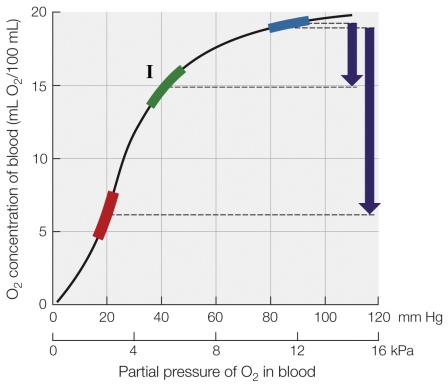 The curve on the graph
Refer to the figure.
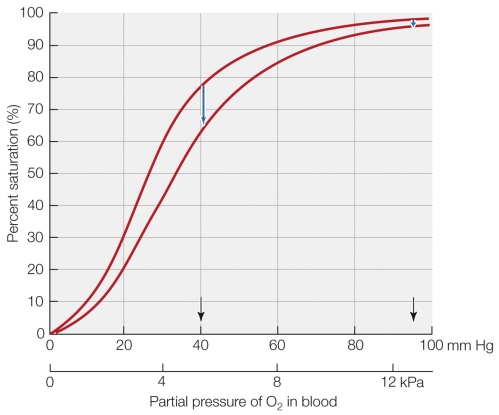 The figure shown shows that a reduction in O2 affinity
 (Multiple Choice)
4.9/5 (74)
(74) _______ binds to hemoglobin at the allosteric site and _______.
(Multiple Choice)
4.8/5 (78)
(78) If HCO3- is retained in the body, it binds with _______ and causes the body fluids to become more _______.
(Multiple Choice)
4.8/5 (79)
(79) In octopuses, venous saturation is about _______% at rest and about _______% during exercise.
(Multiple Choice)
4.7/5 (86)
(86) When the body detects _______, _______ is secreted to increase the production of red blood cells.
(Multiple Choice)
4.9/5 (79)
(79) Refer to the figure shown.
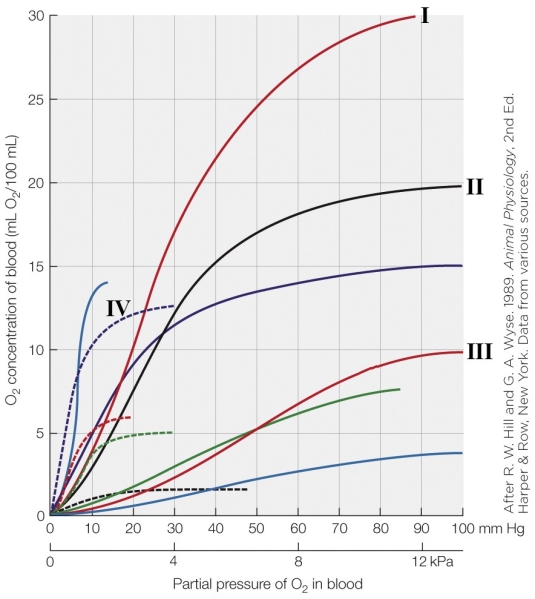 Which oxygen dissociation curve in the figure would represent a diving mammal such as a Weddell seal?
 (Multiple Choice)
4.9/5 (80)
(80) Refer to the figure shown.
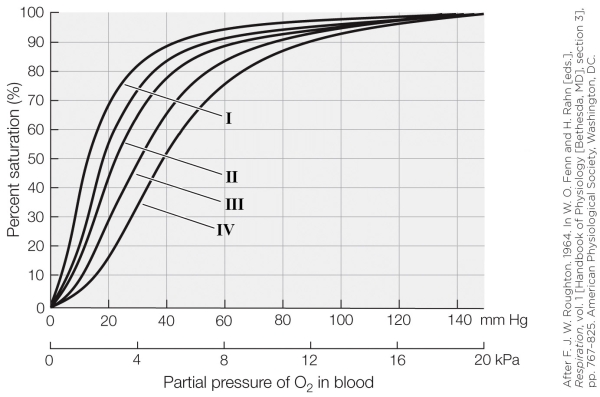 On the graph, which oxygen dissociation curve represents a very high blood pH (e.g., 7.6)?
 (Multiple Choice)
4.8/5 (87)
(87) In many cases, lowland people who travel to an area of high altitude for an extended period of time will develop a condition known as
(Multiple Choice)
4.8/5 (81)
(81) Which statement comparing human adult and fetal hemoglobin is true?
(Multiple Choice)
5.0/5 (68)
(68) The venous blood displays a reduced O2 affinity compared to arterial blood because its
(Multiple Choice)
4.7/5 (84)
(84) Explain the significance of measurements of mixed venous O2 partial pressure.
(Essay)
4.9/5 (69)
(69) A respiratory pigment that requires a relatively low O2 partial pressure for loading has _______ affinity for O2.
(Multiple Choice)
4.8/5 (87)
(87) Refer to the figure shown.
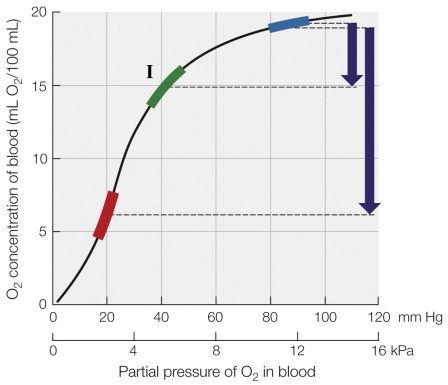 Region I in the figure represents the
 (Multiple Choice)
4.7/5 (78)
(78) 
Filters
- Essay(0)
- Multiple Choice(0)
- Short Answer(0)
- True False(0)
- Matching(0)