



 Chat with AI
Exam 24: Transport of Oxygen and Carbon Dioxide in Body Fluids With an Introduction to Acid- Base Physiology

Exam 1: Animals and Environments: Function on the Ecological Stage66 Questions
Exam 2: Molecules and Cells in Animal Physiology65 Questions
Exam 3: Genomics, Proteomics, and Related Approaches to Physiology64 Questions
Exam 4: Physiological Development and Epigenetics59 Questions
Exam 5: Transport of Solutes and Water67 Questions
Exam 6: Nutrition, Feeding, and Digestion77 Questions
Exam 7: Energy Metabolism68 Questions
Exam 8: Aerobic and Anaerobic Forms of Metabolism75 Questions
Exam 9: The Energetics of Aerobic Activity72 Questions
Exam 10: Thermal Relations84 Questions
Exam 11: Food, Energy, and Temperature at Work: The Lives of Mammals in Frigid Places76 Questions
Exam 12: Neurons59 Questions
Exam 13: Synapses58 Questions
Exam 14: Sensory Processes67 Questions
Exam 15: Nervous System Organization and Biological Clocks59 Questions
Exam 16: Endocrine and Neuroendocrine Physiology69 Questions
Exam 17: Reproduction68 Questions
Exam 18: Integrating Systems at Work: Animal Navigation61 Questions
Exam 19: Control of Movement71 Questions
Exam 20: Muscle78 Questions
Exam 21: Movement and Muscle at Work: Plasticity in Response to Use and Disuse67 Questions
Exam 22: Introduction to Oxygen and Carbon Dioxide in Physiology65 Questions
Exam 23: External Respiration: the Physiology of Breathing70 Questions
Exam 24: Transport of Oxygen and Carbon Dioxide in Body Fluids With an Introduction to Acid- Base Physiology68 Questions
Exam 25: Circulation72 Questions
Exam 26: Oxygen, Carbon Dioxide, and Internal Transport at Work: Diving by Marine Mammals63 Questions
Exam 27: Water and Salt Physiology: Introduction and Mechanisms72 Questions
Exam 29: Kidneys and Excretion With Notes on Nitrogen Excretion89 Questions
Exam 30: Water, Salts, and Excretion at Work: Mammals of Deserts and Dry Savannas64 Questions
Exam 28: Water and Salt Physiology of Animals in Their Environments87 Questions
Select questions type


The deoxygenation of hemoglobin promotes CO2 uptake, and the oxygenation of hemoglobin promotes the unloading of CO2. This phenomenon is called the _______ effect.
(Multiple Choice)
4.9/5  (73)
(73) Refer to the figure shown.
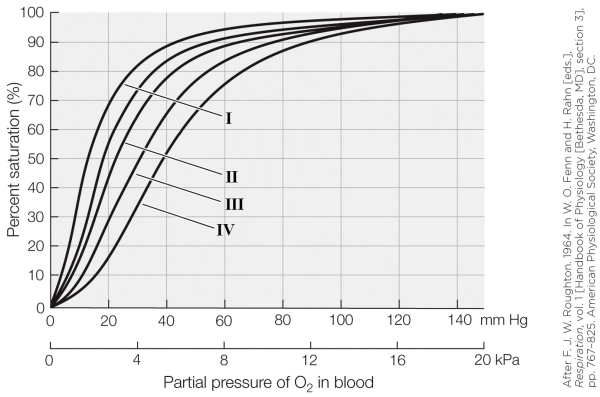 On the graph, which oxygen dissociation curve represents a P50 of about 4 kPa?
 (Multiple Choice)
4.9/5 (71)
(71) A respiratory pigment that requires a relatively low O2 partial pressure for loading and has a high affinity for O2 would also have
(Multiple Choice)
4.9/5 (80)
(80) The effect of acid in reducing the affinity of hemoglobin for O2 is called the _______ effect.
(Multiple Choice)
4.9/5 (73)
(73) The extent of bicarbonate formation in the blood depends primarily on the
(Multiple Choice)
5.0/5 (67)
(67) Refer to the figure shown.
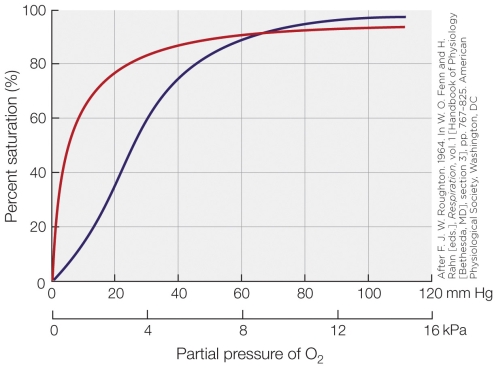 Which statement regarding the figure is false?
 (Multiple Choice)
4.8/5 (80)
(80) 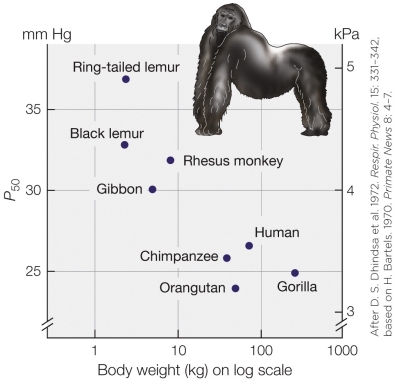 The figure shows that
Refer to the figure shown.
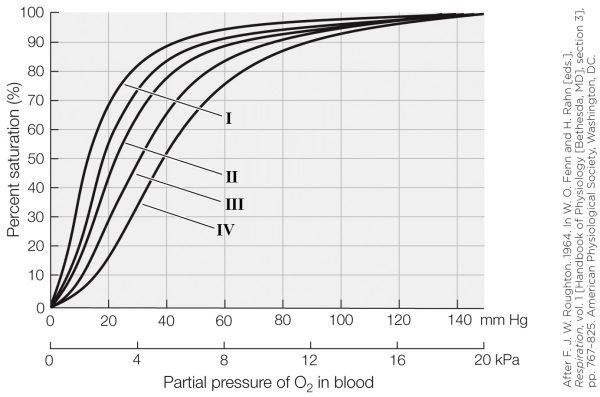 On the graph, which oxygen dissociation curve represents blood with a high CO2 partial pressure (e.g., 80 mm Hg)?
 (Multiple Choice)
4.9/5 (80)
(80) Which species would have the highest total blood CO2 concentration?
(Multiple Choice)
4.8/5 (86)
(86) Different respiratory pigments can pass O2 from one to another because of differences in
(Multiple Choice)
4.8/5 (69)
(69) An octopus meets the increased demand for O2 at the tissues during intense exercise by
(Multiple Choice)
4.9/5 (84)
(84) Mammalian fetal hemoglobin has a _______ oxygen affinity than the mother's hemoglobin in order to _______ the maternal blood.
(Multiple Choice)
4.8/5 (75)
(75) Refer to the figure shown.
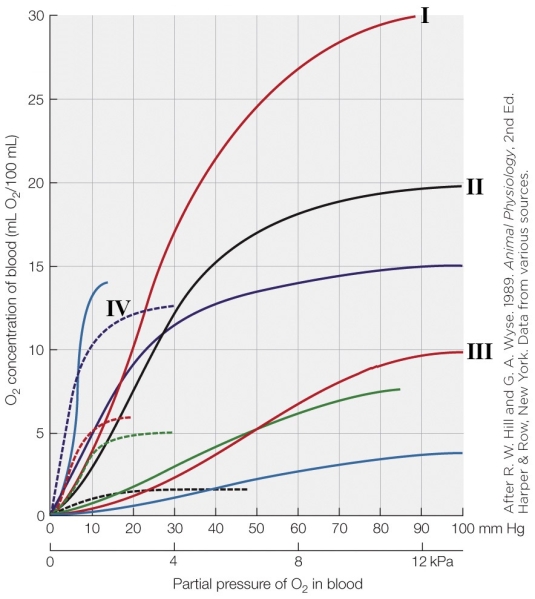 Which oxygen dissociation curve in the figure carries the least amount of oxygen per unit volume of blood?
 (Multiple Choice)
4.9/5 (91)
(91) The venous O2 partial pressure below which aerobic catabolism becomes impaired is known as the
(Multiple Choice)
4.8/5 (79)
(79) If exhalation of CO2 is abnormally increased relative to production, the likely result will be
(Multiple Choice)
4.8/5 (78)
(78) 
Filters
- Essay(0)
- Multiple Choice(0)
- Short Answer(0)
- True False(0)
- Matching(0)