



 Chat with AI
Exam 9: The Energetics of Aerobic Activity

Exam 1: Animals and Environments: Function on the Ecological Stage66 Questions
Exam 2: Molecules and Cells in Animal Physiology65 Questions
Exam 3: Genomics, Proteomics, and Related Approaches to Physiology64 Questions
Exam 4: Physiological Development and Epigenetics59 Questions
Exam 5: Transport of Solutes and Water67 Questions
Exam 6: Nutrition, Feeding, and Digestion77 Questions
Exam 7: Energy Metabolism68 Questions
Exam 8: Aerobic and Anaerobic Forms of Metabolism75 Questions
Exam 9: The Energetics of Aerobic Activity72 Questions
Exam 10: Thermal Relations84 Questions
Exam 11: Food, Energy, and Temperature at Work: The Lives of Mammals in Frigid Places76 Questions
Exam 12: Neurons59 Questions
Exam 13: Synapses58 Questions
Exam 14: Sensory Processes67 Questions
Exam 15: Nervous System Organization and Biological Clocks59 Questions
Exam 16: Endocrine and Neuroendocrine Physiology69 Questions
Exam 17: Reproduction68 Questions
Exam 18: Integrating Systems at Work: Animal Navigation61 Questions
Exam 19: Control of Movement71 Questions
Exam 20: Muscle78 Questions
Exam 21: Movement and Muscle at Work: Plasticity in Response to Use and Disuse67 Questions
Exam 22: Introduction to Oxygen and Carbon Dioxide in Physiology65 Questions
Exam 23: External Respiration: the Physiology of Breathing70 Questions
Exam 24: Transport of Oxygen and Carbon Dioxide in Body Fluids With an Introduction to Acid- Base Physiology68 Questions
Exam 25: Circulation72 Questions
Exam 26: Oxygen, Carbon Dioxide, and Internal Transport at Work: Diving by Marine Mammals63 Questions
Exam 27: Water and Salt Physiology: Introduction and Mechanisms72 Questions
Exam 29: Kidneys and Excretion With Notes on Nitrogen Excretion89 Questions
Exam 30: Water, Salts, and Excretion at Work: Mammals of Deserts and Dry Savannas64 Questions
Exam 28: Water and Salt Physiology of Animals in Their Environments87 Questions
Select questions type


Which animal covers the largest distance at the lowest weight-specific cost?

Free
(Multiple Choice)
4.9/5  (64)
(64) Correct Answer: Verified
D
The relationship between average daily metabolic rate (ADMR) per unit of body weight and body size is a(n)
Free
(Multiple Choice)
4.8/5 (75)
(75) Correct Answer:Verified
VerifiedA
Which behavior represents the smallest component per unit time of the average daily metabolic rate (ADMR)?
Free
(Multiple Choice)
4.8/5 (86)
(86) Correct Answer:Verified
VerifiedC
Refer to the figure shown.
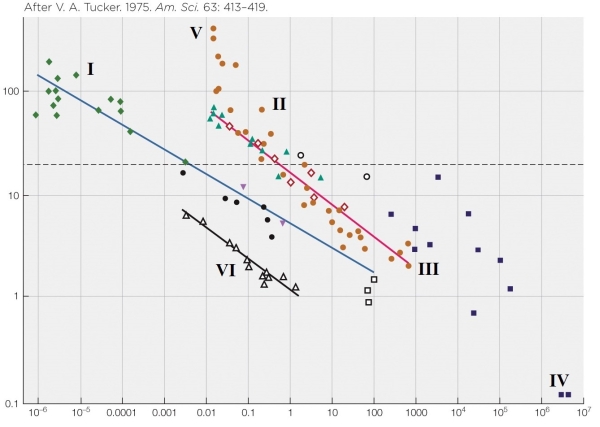 Choose the most appropriate label for the x axis.
 (Multiple Choice)
4.9/5 (81)
(81) If an organism has a resting oxygen consumption of 1mL/g•h, and its V̇O2max is 10 mL/g•h, its aerobic expansibility will be
(Multiple Choice)
4.8/5 (89)
(89) Which animal would display a U-shaped curve of oxygen consumption per unit of time relative to speed?
(Multiple Choice)
4.8/5 (74)
(74) When comparing the difference in V̇O2max and resting O2 consumption at the same temperature, we are referring to the
(Multiple Choice)
4.9/5 (84)
(84) An athlete weighs 70 kg. His V̇O2max is 30 mL/kg•min. After 6 months of regular endurance training, his V̇O2max could be as high as _______ mL/kg•min.
(Multiple Choice)
5.0/5 (86)
(86) Assuming individuals of the same body size, a person who is _______ years old would have the most difficulty performing an exercise that requires 65% V̇O2max.
(Multiple Choice)
4.7/5 (87)
(87) An untrained sedentary person has a V̇O2max measured at 40 mL/kg•min. After 10 weeks of intense endurance training, this person's aerobic performance has improved. A reasonable measurement of this person's V̇O2max would be _______ mL/kg•min.
(Multiple Choice)
4.9/5 (77)
(77) The speed that _______ the cost of transport is the speed that _______ the distance that can be traveled with a given amount of energy.
(Multiple Choice)
4.9/5 (88)
(88) What are some specific characteristics of the relationship between the metabolic cost per unit time and the speed of locomotion in swimming, running, and flying animals?
(Essay)
4.9/5 (85)
(85) For animals of any given body size, engaging in their primary form of locomotion, which activity would be the most energetically costly to cover a long distance?
(Multiple Choice)
4.8/5 (87)
(87) The average daily metabolic rate (ADMR) refers to the amount of energy expended _______ in their natural habitat.
(Multiple Choice)
4.9/5 (74)
(74) A monitor placed on or in a study animal that stores data is called a
(Multiple Choice)
4.9/5 (89)
(89) If an organism has a V̇O2max of 5 mL/g•h, and its aerobic expansibility is 5, its resting oxygen consumption will be
(Multiple Choice)
4.8/5 (90)
(90) If an animal spends 3 hours a day chasing a prey (49 kJ/hr) and 20 hours a day resting (using 15 kJ/hr), its total daily cost of behavior in kJ is
(Multiple Choice)
4.8/5 (75)
(75) 
Filters
- Essay(0)
- Multiple Choice(0)
- Short Answer(0)
- True False(0)
- Matching(0)