



 Chat with AI
Exam 9: The Energetics of Aerobic Activity

Exam 1: Animals and Environments: Function on the Ecological Stage66 Questions
Exam 2: Molecules and Cells in Animal Physiology65 Questions
Exam 3: Genomics, Proteomics, and Related Approaches to Physiology64 Questions
Exam 4: Physiological Development and Epigenetics59 Questions
Exam 5: Transport of Solutes and Water67 Questions
Exam 6: Nutrition, Feeding, and Digestion77 Questions
Exam 7: Energy Metabolism68 Questions
Exam 8: Aerobic and Anaerobic Forms of Metabolism75 Questions
Exam 9: The Energetics of Aerobic Activity72 Questions
Exam 10: Thermal Relations84 Questions
Exam 11: Food, Energy, and Temperature at Work: The Lives of Mammals in Frigid Places76 Questions
Exam 12: Neurons59 Questions
Exam 13: Synapses58 Questions
Exam 14: Sensory Processes67 Questions
Exam 15: Nervous System Organization and Biological Clocks59 Questions
Exam 16: Endocrine and Neuroendocrine Physiology69 Questions
Exam 17: Reproduction68 Questions
Exam 18: Integrating Systems at Work: Animal Navigation61 Questions
Exam 19: Control of Movement71 Questions
Exam 20: Muscle78 Questions
Exam 21: Movement and Muscle at Work: Plasticity in Response to Use and Disuse67 Questions
Exam 22: Introduction to Oxygen and Carbon Dioxide in Physiology65 Questions
Exam 23: External Respiration: the Physiology of Breathing70 Questions
Exam 24: Transport of Oxygen and Carbon Dioxide in Body Fluids With an Introduction to Acid- Base Physiology68 Questions
Exam 25: Circulation72 Questions
Exam 26: Oxygen, Carbon Dioxide, and Internal Transport at Work: Diving by Marine Mammals63 Questions
Exam 27: Water and Salt Physiology: Introduction and Mechanisms72 Questions
Exam 29: Kidneys and Excretion With Notes on Nitrogen Excretion89 Questions
Exam 30: Water, Salts, and Excretion at Work: Mammals of Deserts and Dry Savannas64 Questions
Exam 28: Water and Salt Physiology of Animals in Their Environments87 Questions
Select questions type


Compared to wild animals, humans have _____ average daily metabolic rates (ADMRs) when compared to basal metabolic rates.
(Multiple Choice)
4.8/5  (78)
(78) For animals of any given body size, engaging in their primary form of locomotion, which is the least energetically costly way to cover a long distance?
(Multiple Choice)
4.8/5 (74)
(74) Which animal will have the fastest rate of aerobic ATP production per unit of body mass?
(Multiple Choice)
4.9/5 (74)
(74) Which animal will have the fastest rate of aerobic ATP production per unit of body mass?
(Multiple Choice)
4.9/5 (92)
(92) Refer to the figure shown.
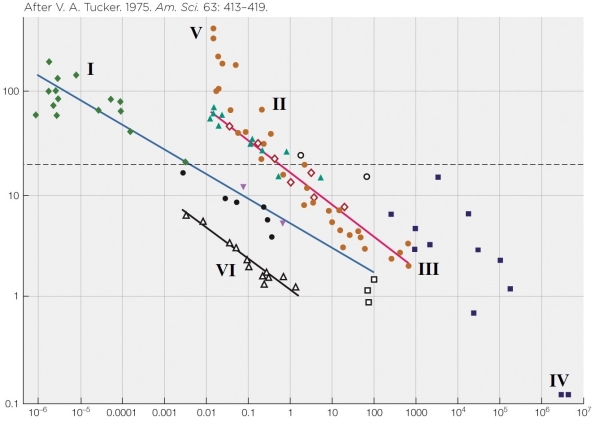 A horse would most likely be indicated by which data point?
 (Multiple Choice)
4.8/5 (70)
(70) Refer to the figure shown.
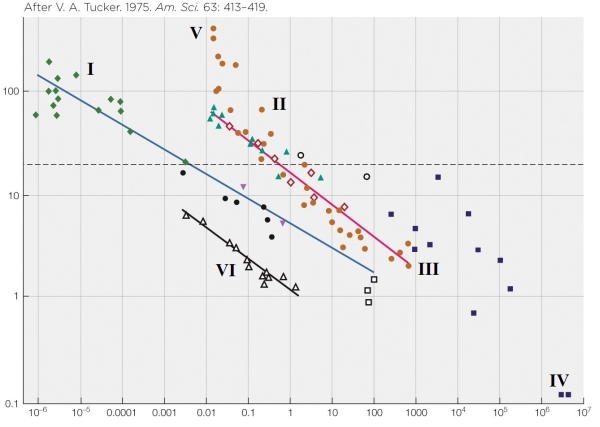 If you were to plot a mouse on this figure, where would the data point go?
 (Multiple Choice)
4.9/5 (74)
(74) A monitor placed on or in a study animal that transmits data is called a
(Multiple Choice)
4.8/5 (75)
(75) If animal A has a V̇O2max of 22.4 ml/g•h and animal B has a V̇O2max of 24 ml/ g•h,
(Multiple Choice)
4.9/5 (73)
(73) If a human has a V̇O2max of 2.5 ml O2/kg•min, his O2 consumption at rest is about _______ O2/kg•min.
(Multiple Choice)
4.8/5 (76)
(76) If an animal spends 3 hours a day running away from a predator and 20 hours a day resting (using 20 kJ/hr), the total daily cost of behavior is 700 kJ. The kJ spent per hour running away from a predator is _______ kJ/hr.
(Multiple Choice)
4.7/5 (76)
(76) If a human has a resting O2 consumption of 10 mL/kg•min, her V̇O2max consumption is _______ mL O2/kg•min.
(Multiple Choice)
4.8/5 (76)
(76) Which rate would allow an animal to continue walking for the longest period of time?
(Multiple Choice)
4.9/5 (88)
(88) The metabolic rate of a young adult human is greatest while
(Multiple Choice)
4.8/5 (74)
(74) If an organism has a resting oxygen consumption of 1mL/g•h, and its V̇O2max is 10 mL/g•h, its aerobic scope of activity will be _______ mL/g•h.
(Multiple Choice)
4.8/5 (79)
(79) Assuming the same body size, an individual who is _______ years old would have the lowest V̇O2max.
(Multiple Choice)
4.9/5 (73)
(73) Which rate would be most advantageous for a fish trying to swim for the longest period of time?
(Multiple Choice)
4.8/5 (89)
(89) According to the study done by Lindstedt (1991), which animal has the highest V̇O2max?
(Multiple Choice)
4.9/5 (85)
(85) 
Filters
- Essay(0)
- Multiple Choice(0)
- Short Answer(0)
- True False(0)
- Matching(0)