



 Chat with AI
Exam 9: The Energetics of Aerobic Activity

Exam 1: Animals and Environments: Function on the Ecological Stage66 Questions
Exam 2: Molecules and Cells in Animal Physiology65 Questions
Exam 3: Genomics, Proteomics, and Related Approaches to Physiology64 Questions
Exam 4: Physiological Development and Epigenetics59 Questions
Exam 5: Transport of Solutes and Water67 Questions
Exam 6: Nutrition, Feeding, and Digestion77 Questions
Exam 7: Energy Metabolism68 Questions
Exam 8: Aerobic and Anaerobic Forms of Metabolism75 Questions
Exam 9: The Energetics of Aerobic Activity72 Questions
Exam 10: Thermal Relations84 Questions
Exam 11: Food, Energy, and Temperature at Work: The Lives of Mammals in Frigid Places76 Questions
Exam 12: Neurons59 Questions
Exam 13: Synapses58 Questions
Exam 14: Sensory Processes67 Questions
Exam 15: Nervous System Organization and Biological Clocks59 Questions
Exam 16: Endocrine and Neuroendocrine Physiology69 Questions
Exam 17: Reproduction68 Questions
Exam 18: Integrating Systems at Work: Animal Navigation61 Questions
Exam 19: Control of Movement71 Questions
Exam 20: Muscle78 Questions
Exam 21: Movement and Muscle at Work: Plasticity in Response to Use and Disuse67 Questions
Exam 22: Introduction to Oxygen and Carbon Dioxide in Physiology65 Questions
Exam 23: External Respiration: the Physiology of Breathing70 Questions
Exam 24: Transport of Oxygen and Carbon Dioxide in Body Fluids With an Introduction to Acid- Base Physiology68 Questions
Exam 25: Circulation72 Questions
Exam 26: Oxygen, Carbon Dioxide, and Internal Transport at Work: Diving by Marine Mammals63 Questions
Exam 27: Water and Salt Physiology: Introduction and Mechanisms72 Questions
Exam 29: Kidneys and Excretion With Notes on Nitrogen Excretion89 Questions
Exam 30: Water, Salts, and Excretion at Work: Mammals of Deserts and Dry Savannas64 Questions
Exam 28: Water and Salt Physiology of Animals in Their Environments87 Questions
Select questions type


Suppose at a particular body temperature, a fish has a resting oxygen consumption rate of 0.05 mL/g•h and an aerobic expansibility of 6. What is its aerobic scope?
(Essay)
5.0/5  (79)
(79) An animal weighing _______ kg can cover the greatest distance before running out of fat (assuming all the animals have the same proportion of body fat).
(Multiple Choice)
4.8/5 (81)
(81) Which one of the following is not a major factor in bumblebee energetics?
(Multiple Choice)
4.7/5 (80)
(80) Refer to the figure shown.
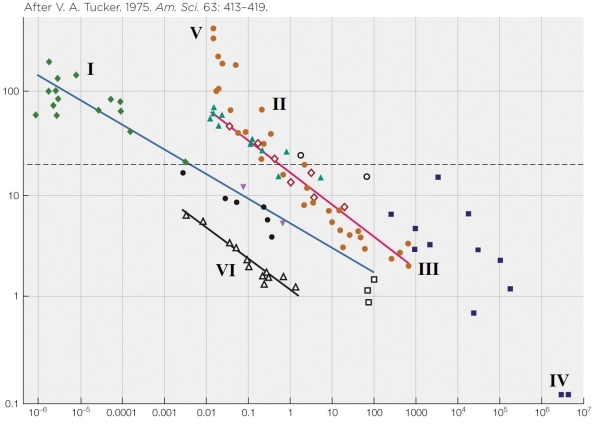 Choose the most appropriate units for the y axis.
 (Multiple Choice)
4.8/5 (81)
(81) What is the fuel that birds store and use to meet their energy needs during migration? How are birds able to use this energy source?
(Essay)
4.9/5 (64)
(64) Bumblebees require a specific flight muscle temperature to fly. What is this temperature and how do bumblebees maintain it during flight and while hovering between flowers?
(Essay)
4.8/5 (88)
(88) If an organism has a resting oxygen consumption of 1mL/g•h, and its aerobic expansibility is 10, its V̇O2max will be
(Multiple Choice)
4.7/5 (77)
(77) If an organism has a V̇O2max of 10mL/g•h, and its aerobic scope of activity is 8 mL/g•h, its resting oxygen consumption will be _______ mL/g•h.
(Multiple Choice)
5.0/5 (81)
(81) Individual A has a V̇O2max of 30 mL O2/kg•min. Individual B has a V̇O2max of 60 mL O2/kg•min. If both individuals are competing in a soccer activity, who will be able compete for a longer period of time?
(Multiple Choice)
4.8/5 (77)
(77) Of the following values, an exercise requiring _______ of V̇O2max is the most strenuous.
(Multiple Choice)
4.8/5 (63)
(63) According to the study done by Lindstedt (1991), which animal has the highest V̇O2max?
(Multiple Choice)
4.7/5 (80)
(80) 
Filters
- Essay(0)
- Multiple Choice(0)
- Short Answer(0)
- True False(0)
- Matching(0)