



 Chat with AI
Exam 25: Circulation

Exam 1: Animals and Environments: Function on the Ecological Stage66 Questions
Exam 2: Molecules and Cells in Animal Physiology65 Questions
Exam 3: Genomics, Proteomics, and Related Approaches to Physiology64 Questions
Exam 4: Physiological Development and Epigenetics59 Questions
Exam 5: Transport of Solutes and Water67 Questions
Exam 6: Nutrition, Feeding, and Digestion77 Questions
Exam 7: Energy Metabolism68 Questions
Exam 8: Aerobic and Anaerobic Forms of Metabolism75 Questions
Exam 9: The Energetics of Aerobic Activity72 Questions
Exam 10: Thermal Relations84 Questions
Exam 11: Food, Energy, and Temperature at Work: The Lives of Mammals in Frigid Places76 Questions
Exam 12: Neurons59 Questions
Exam 13: Synapses58 Questions
Exam 14: Sensory Processes67 Questions
Exam 15: Nervous System Organization and Biological Clocks59 Questions
Exam 16: Endocrine and Neuroendocrine Physiology69 Questions
Exam 17: Reproduction68 Questions
Exam 18: Integrating Systems at Work: Animal Navigation61 Questions
Exam 19: Control of Movement71 Questions
Exam 20: Muscle78 Questions
Exam 21: Movement and Muscle at Work: Plasticity in Response to Use and Disuse67 Questions
Exam 22: Introduction to Oxygen and Carbon Dioxide in Physiology65 Questions
Exam 23: External Respiration: the Physiology of Breathing70 Questions
Exam 24: Transport of Oxygen and Carbon Dioxide in Body Fluids With an Introduction to Acid- Base Physiology68 Questions
Exam 25: Circulation72 Questions
Exam 26: Oxygen, Carbon Dioxide, and Internal Transport at Work: Diving by Marine Mammals63 Questions
Exam 27: Water and Salt Physiology: Introduction and Mechanisms72 Questions
Exam 29: Kidneys and Excretion With Notes on Nitrogen Excretion89 Questions
Exam 30: Water, Salts, and Excretion at Work: Mammals of Deserts and Dry Savannas64 Questions
Exam 28: Water and Salt Physiology of Animals in Their Environments87 Questions
Select questions type


The mean pressure in the systemic aorta in a healthy human is about _______ mm Hg.

Free
(Multiple Choice)
4.9/5  (78)
(78) Correct Answer: Verified
B
Refer to the figure shown.
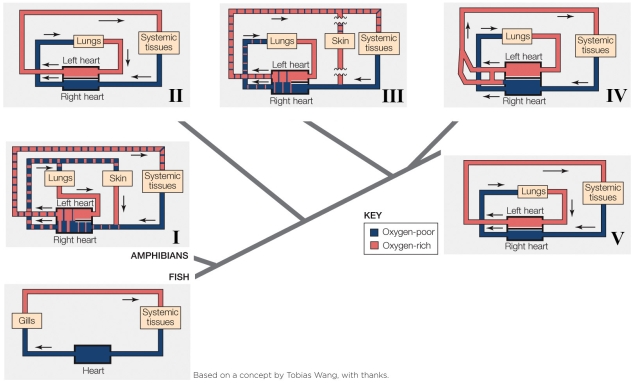 Which plan represents the mammalian circulatory system?
Free
(Multiple Choice)
4.8/5 (89)
(89) Correct Answer:Verified
VerifiedA
Refer to the figure shown.
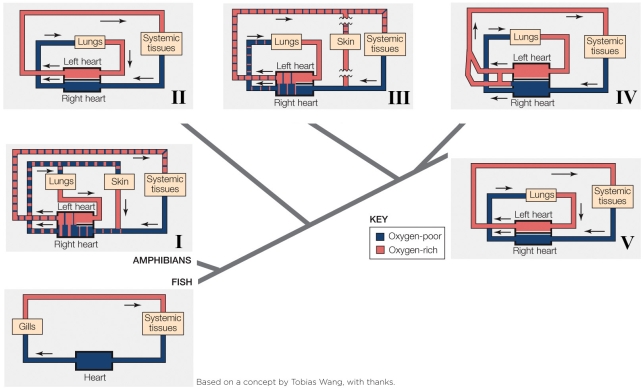 Of the six circulatory plans above, how many partially or completely separate oxygenated and deoxygenated blood in the heart?
Free
(Multiple Choice)
5.0/5 (84)
(84) Correct Answer:Verified
VerifiedD
Refer to the figure shown.
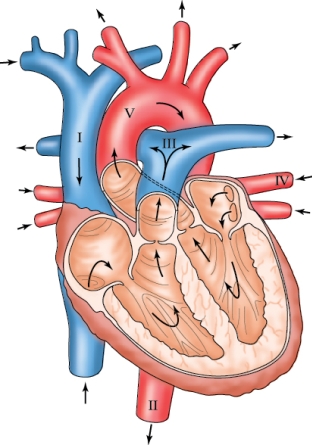 How many labeled areas refer to arteries?
 (Multiple Choice)
4.9/5 (87)
(87) Describe and explain the linear velocity profile of red blood cells as they travel from the heart through the systemic tissues and back.
(Essay)
4.8/5 (83)
(83) Explain, according to the physics of fluid-column effects, why a vascular foot injury needs to be elevated as much and as long as possible.
(Essay)
4.8/5 (81)
(81) The reason why blood capillaries can be exceedingly thin-walled and yet resist substantial pressures can be explained by
(Multiple Choice)
4.8/5 (64)
(64) Refer to the figure shown.
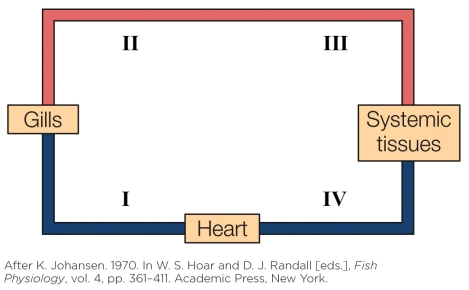 When an air-breathing organ at the mouth is integrated into the circulation depicted in the figure, a new circulation loop is created connecting
 (Multiple Choice)
4.9/5 (71)
(71) Halving the radius of a vessel _______ the resistance to flow through the vessel by a factor of _______.
(Multiple Choice)
4.9/5 (88)
(88) Refer to the figure shown.
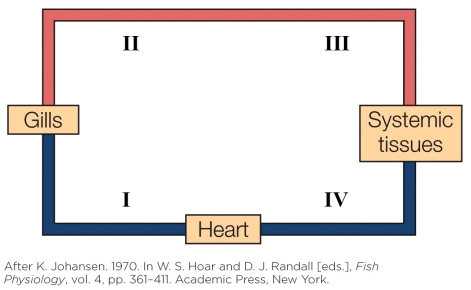 From where do vessels branch off to supply the head and gut with oxygenated blood?
 (Multiple Choice)
4.9/5 (73)
(73) Which of the following is present in crocodilians but not in amphibians?
(Multiple Choice)
4.9/5 (75)
(75) Refer to the figure shown.
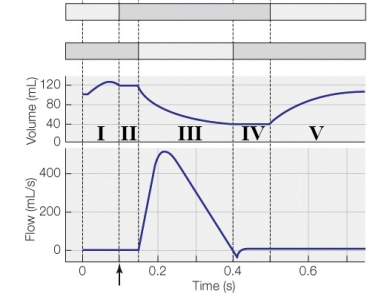 Which region represents the isovolumetric contraction portion of the heart cycle?
 (Multiple Choice)
4.7/5 (83)
(83) If a squid and a fish both double cardiac output during exercise, circulatory oxygen delivery to the tissues in _______ will _______.
(Multiple Choice)
4.8/5 (70)
(70) Explain how some animals modulate blood flow to their lungs independently of flow to the rest of the body and what the advantages are to this arrangement.
(Essay)
4.7/5 (89)
(89) Which statement describes a characteristic not found in the African lungfish Protopterus?
(Multiple Choice)
4.8/5 (87)
(87) Refer to the figure shown.
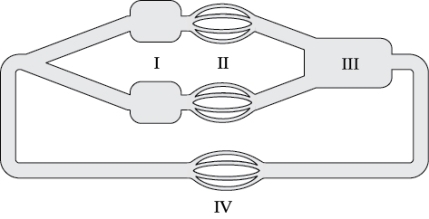 According to the diagram, the highest blood pressure would be found just exiting the structure(s) at
 (Multiple Choice)
4.9/5 (86)
(86) Refer to the figure shown.
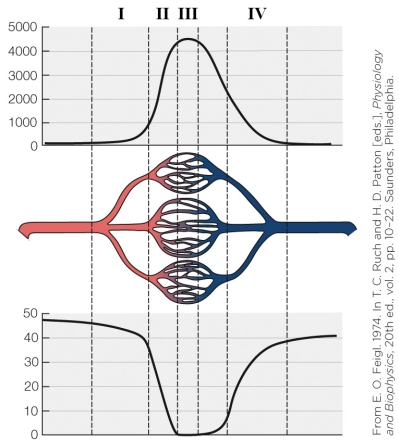 Which vertical section denotes the vascular portion with the lowest mean blood velocity?
 (Multiple Choice)
4.8/5 (92)
(92) 
Filters
- Essay(0)
- Multiple Choice(0)
- Short Answer(0)
- True False(0)
- Matching(0)