



 Chat with AI
Exam 25: Circulation

Exam 1: Animals and Environments: Function on the Ecological Stage66 Questions
Exam 2: Molecules and Cells in Animal Physiology65 Questions
Exam 3: Genomics, Proteomics, and Related Approaches to Physiology64 Questions
Exam 4: Physiological Development and Epigenetics59 Questions
Exam 5: Transport of Solutes and Water67 Questions
Exam 6: Nutrition, Feeding, and Digestion77 Questions
Exam 7: Energy Metabolism68 Questions
Exam 8: Aerobic and Anaerobic Forms of Metabolism75 Questions
Exam 9: The Energetics of Aerobic Activity72 Questions
Exam 10: Thermal Relations84 Questions
Exam 11: Food, Energy, and Temperature at Work: The Lives of Mammals in Frigid Places76 Questions
Exam 12: Neurons59 Questions
Exam 13: Synapses58 Questions
Exam 14: Sensory Processes67 Questions
Exam 15: Nervous System Organization and Biological Clocks59 Questions
Exam 16: Endocrine and Neuroendocrine Physiology69 Questions
Exam 17: Reproduction68 Questions
Exam 18: Integrating Systems at Work: Animal Navigation61 Questions
Exam 19: Control of Movement71 Questions
Exam 20: Muscle78 Questions
Exam 21: Movement and Muscle at Work: Plasticity in Response to Use and Disuse67 Questions
Exam 22: Introduction to Oxygen and Carbon Dioxide in Physiology65 Questions
Exam 23: External Respiration: the Physiology of Breathing70 Questions
Exam 24: Transport of Oxygen and Carbon Dioxide in Body Fluids With an Introduction to Acid- Base Physiology68 Questions
Exam 25: Circulation72 Questions
Exam 26: Oxygen, Carbon Dioxide, and Internal Transport at Work: Diving by Marine Mammals63 Questions
Exam 27: Water and Salt Physiology: Introduction and Mechanisms72 Questions
Exam 29: Kidneys and Excretion With Notes on Nitrogen Excretion89 Questions
Exam 30: Water, Salts, and Excretion at Work: Mammals of Deserts and Dry Savannas64 Questions
Exam 28: Water and Salt Physiology of Animals in Their Environments87 Questions
Select questions type


Refer to the figure shown.
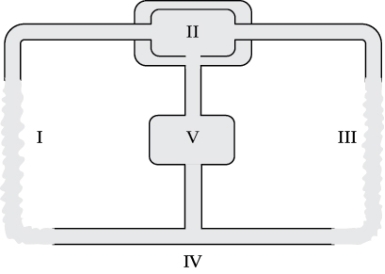 This circulatory plan belongs to which group of animals?
 (Multiple Choice)
4.8/5  (73)
(73) Refer to the figure shown.
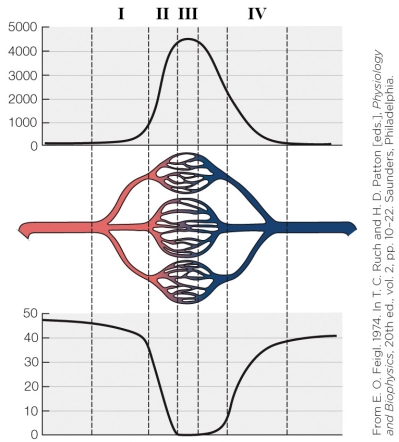 Which vertical section denotes the vascular portion with the highest vascular resistance?
 (Multiple Choice)
4.9/5 (80)
(80) The _______ circulatory system of squids and octopuses consist of two _______.
(Multiple Choice)
4.8/5 (85)
(85) Refer to the figure shown.
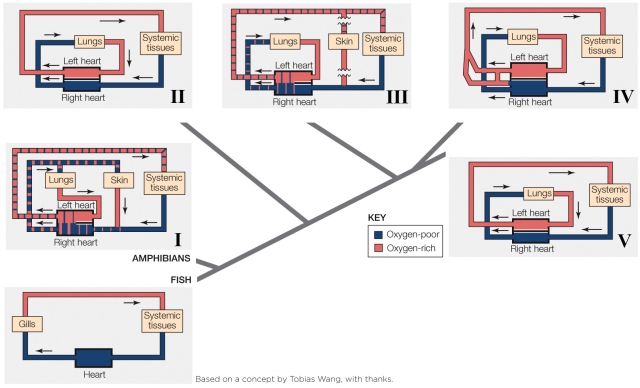 Which circulatory plan allows the animals to modulate blood flow to the lungs independently of blood flow to the rest of the body?
 (Multiple Choice)
4.8/5 (82)
(82) Describe how an air-breathing organ is integrated into the circulatory plan of fish and how this physiology relates to the oxygenation of the fish myocardium.
(Essay)
4.8/5 (74)
(74) Refer to the figure shown.
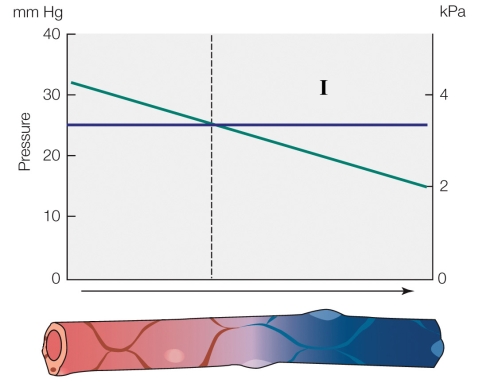 In section I, fluid is _______ the capillary due to _______.
 (Multiple Choice)
4.9/5 (76)
(76) Which structure aids crocodilians in diverting blood flow during diving?
(Multiple Choice)
4.8/5 (75)
(75) Which of the following are considered functional properties of the cardiac conduction system?
I. Initiate cardiac contraction
II. Accelerate depolarization across the atria
III. Slows the depolarization across the A-V node
IV. Accelerates depolarization down the bundle branches and Purkinje fibers
(Multiple Choice)
4.8/5 (78)
(78) Refer to the figure shown.
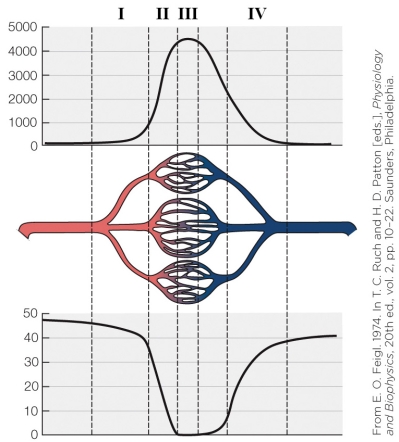 Which vertical section denotes the vascular portion with the highest pressure?
 (Multiple Choice)
4.9/5 (88)
(88) Which characteristic is typical of teleost cardiovascular systems?
(Multiple Choice)
4.8/5 (64)
(64) Which animal does not modulate blood flow to the lungs independently of blood flow to the rest of the body?
(Multiple Choice)
4.9/5 (84)
(84) Refer to the figure shown.
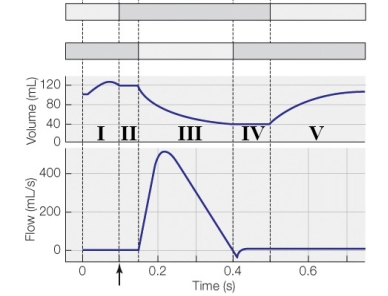 Which region represents the ventricular filling portion of the heart cycle?
 (Multiple Choice)
4.9/5 (76)
(76) A tall human with normal blood pressure standing upright would be expected to have a pressure of about _______ mm Hg in the leg artery, measured 130 cm shown the heart.
(Multiple Choice)
4.8/5 (70)
(70) Refer to the figure shown.
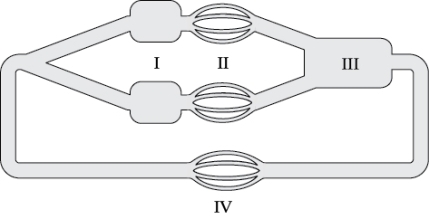 The most oxygenated blood would be found just exiting the structure(s) at
 (Multiple Choice)
4.9/5 (86)
(86) The most important factor modifying flow in blood vessels is the
(Multiple Choice)
4.8/5 (73)
(73) Refer to the figure shown.
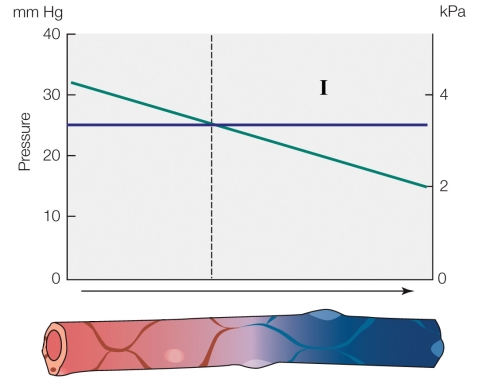 The figure depicts the _______ hypothesis: the initial loss and then regaining of fluid in the capillaries that results, overall, in a net _______ of fluid.
 (Multiple Choice)
4.8/5 (82)
(82) In lobsters and crabs, blood from the _______ collects in the _______ before passing through the gills.
(Multiple Choice)
4.9/5 (64)
(64) Refer to the figure shown.
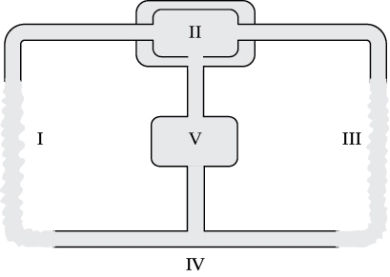 The wavy boundaries at I and III represent the
 (Multiple Choice)
4.8/5 (80)
(80) 
Filters
- Essay(0)
- Multiple Choice(0)
- Short Answer(0)
- True False(0)
- Matching(0)