



 Chat with AI
Exam 25: Circulation

Exam 1: Animals and Environments: Function on the Ecological Stage66 Questions
Exam 2: Molecules and Cells in Animal Physiology65 Questions
Exam 3: Genomics, Proteomics, and Related Approaches to Physiology64 Questions
Exam 4: Physiological Development and Epigenetics59 Questions
Exam 5: Transport of Solutes and Water67 Questions
Exam 6: Nutrition, Feeding, and Digestion77 Questions
Exam 7: Energy Metabolism68 Questions
Exam 8: Aerobic and Anaerobic Forms of Metabolism75 Questions
Exam 9: The Energetics of Aerobic Activity72 Questions
Exam 10: Thermal Relations84 Questions
Exam 11: Food, Energy, and Temperature at Work: The Lives of Mammals in Frigid Places76 Questions
Exam 12: Neurons59 Questions
Exam 13: Synapses58 Questions
Exam 14: Sensory Processes67 Questions
Exam 15: Nervous System Organization and Biological Clocks59 Questions
Exam 16: Endocrine and Neuroendocrine Physiology69 Questions
Exam 17: Reproduction68 Questions
Exam 18: Integrating Systems at Work: Animal Navigation61 Questions
Exam 19: Control of Movement71 Questions
Exam 20: Muscle78 Questions
Exam 21: Movement and Muscle at Work: Plasticity in Response to Use and Disuse67 Questions
Exam 22: Introduction to Oxygen and Carbon Dioxide in Physiology65 Questions
Exam 23: External Respiration: the Physiology of Breathing70 Questions
Exam 24: Transport of Oxygen and Carbon Dioxide in Body Fluids With an Introduction to Acid- Base Physiology68 Questions
Exam 25: Circulation72 Questions
Exam 26: Oxygen, Carbon Dioxide, and Internal Transport at Work: Diving by Marine Mammals63 Questions
Exam 27: Water and Salt Physiology: Introduction and Mechanisms72 Questions
Exam 29: Kidneys and Excretion With Notes on Nitrogen Excretion89 Questions
Exam 30: Water, Salts, and Excretion at Work: Mammals of Deserts and Dry Savannas64 Questions
Exam 28: Water and Salt Physiology of Animals in Their Environments87 Questions
Select questions type


Which is the correct sequence of blood movement through the human heart?
(Multiple Choice)
5.0/5  (78)
(78) The _______ prevents the initial depolarization at the S-A node from spreading across the heart from the atria through the ventricles and ending at the tip of the septum.
(Multiple Choice)
4.8/5 (85)
(85) Which of the following best describes the contractile properties of the heart of the elasmobranch fish?
(Multiple Choice)
4.9/5 (89)
(89) Fish with _______ are able to swim faster and longer due to _______.
(Multiple Choice)
4.8/5 (77)
(77) You are measuring the blood pressure (using a standard cuff on the brachial artery) of a patient who insists on holding her arm above her head while you are taking the measurement. How to you deal with the data you collect.
(Multiple Choice)
4.8/5 (75)
(75) Refer to the figure shown.
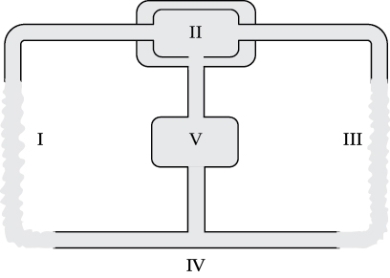 The most oxygenated blood would be found
 (Multiple Choice)
4.7/5 (84)
(84) Describe the four systems that have evolved in animals to supply O2 to the myocardium and name the main animal groups that use each one.
(Essay)
4.8/5 (87)
(87) According to the Poiseuille equation, which of the following does not directly affect flow rate?
(Multiple Choice)
4.8/5 (85)
(85) The blood circulation of crustaceans is _______ than that of fish primarily because of _______.
(Multiple Choice)
5.0/5 (85)
(85) ECG (EKG) electrodes are placed _______ and measures _______.
(Multiple Choice)
5.0/5 (79)
(79) _______ is delivered to muscle via the circulation to support exercise.
(Multiple Choice)
4.8/5 (66)
(66) Refer to the figure shown.
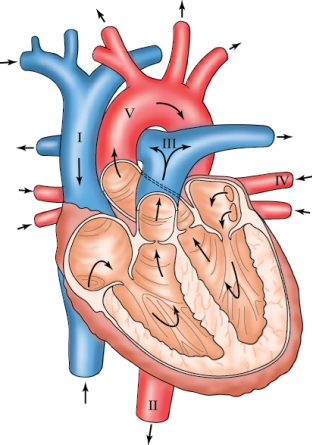 Which area refers to the pulmonary artery?
 (Multiple Choice)
4.9/5 (83)
(83) Which statement regarding the lobster circulatory system is false?
(Multiple Choice)
4.8/5 (90)
(90) Compare and contrast the mammalian and cephalopod circulatory systems.
(Essay)
4.8/5 (84)
(84) Refer to the figure shown.
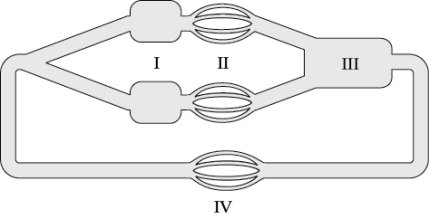 This circulatory plan belongs to which group of animals?
 (Multiple Choice)
4.9/5 (79)
(79) Defend or refute this statement: "Blood flow through open systems is sluggish because of the relatively low-pressure gradients in open circulatory systems."
(Essay)
5.0/5 (81)
(81) The main difference between the pulmonary circuit and the systemic circuit is that the pulmonary circuit
(Multiple Choice)
4.7/5 (86)
(86) Place the patients in order from lowest to highest vascular resistance.
Patient 1) Blood pressure = 120/80 mm Hg; cardiac output 4 L/min
Patient 2) Blood pressure = 140/100 mm Hg; cardiac output 5 L/min
Patient 3) Blood pressure = 100/60 mm Hg; cardiac output 5 L/min
(Multiple Choice)
4.8/5 (97)
(97) 
Filters
- Essay(0)
- Multiple Choice(0)
- Short Answer(0)
- True False(0)
- Matching(0)